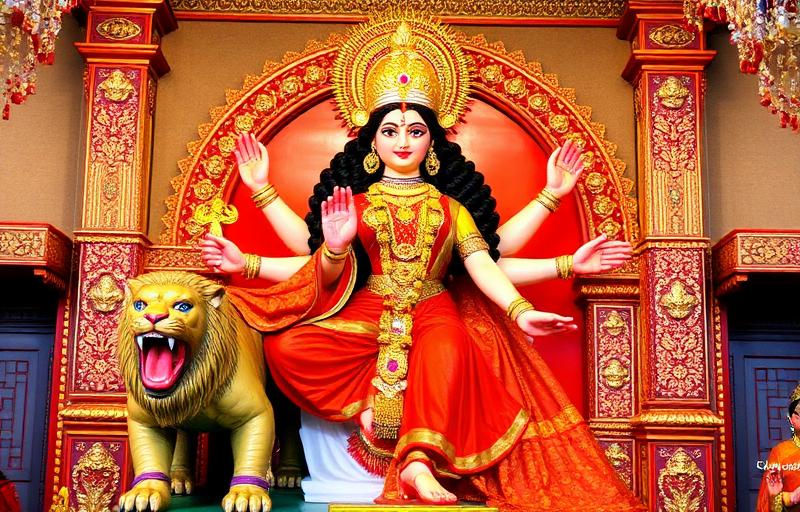
What Is the Mahishasura Mardini Stotram?
The Mahishasura Mardini Stotram, famous by its first words 'Aigiri Nandini', is a powerful hymn to Goddess Durga composed by Adi Shankaracharya. Mahishasura Mardini means 'the slayer of Mahishasura', the buffalo demon whom the Goddess destroyed to save the worlds, as told in the Devi Mahatmya.
The stotram is celebrated for its rolling rhythm and rich alliteration. Each verse piles praise upon praise, describing the Goddess as Nandini (daughter of the mountain Himavan), the joy of Nanda, the destroyer of demons, and the supreme Shakti who dances victorious. It is especially loved during Navratri, when devotees sing it with full devotion before the Devi.
The Famous Opening Verse
The stotram opens with the celebrated invocation:
Devanagari: अयि गिरिनन्दिनि नन्दितमेदिनि विश्वविनोदिनि नन्दिनुते गिरिवरविन्ध्यशिरोऽधिनिवासिनि विष्णुविलासिनि जिष्णुनुते। भगवति हे शितिकण्ठकुटुम्बिनि भूरिकुटुम्बिनि भूरिकृते जय जय हे महिषासुरमर्दिनि रम्यकपर्दिनि शैलसुते॥
Transliteration: Ayi giri-nandini nandita-medini vishva-vinodini nandi-nute Giri-vara-vindhya-shiro'dhi-nivasini vishnu-vilasini jishnu-nute Bhagavati he shiti-kantha-kutumbini bhuri-kutumbini bhuri-krite Jaya jaya he mahishasura-mardini ramya-kapardini shaila-sute
Meaning: O daughter of the mountain, who gladdens the earth and delights the universe, praised by Nandi; O dweller on the peak of the great Vindhya, in whom Vishnu rejoices, praised by the victorious Indra; O Goddess, consort of the blue-throated Shiva, with vast family, doer of great deeds - victory, victory to you, O slayer of Mahishasura, of lovely braided hair, O daughter of the mountain.
The refrain 'Jaya jaya he Mahishasura-mardini' returns at the close of every verse, making the whole hymn a chant of victory to the Goddess.
Benefits of Chanting Aigiri Nandini
Devotees recite this stotram for strength, courage and the Goddess's protection:
- Courage and inner strength: The hymn awakens fearlessness and the power to face difficulties, just as Durga faced Mahishasura.
- Removal of obstacles and negativity: Singing it is believed to drive away fear, enemies and negative energy.
- Victory over difficulties: The victorious refrain inspires confidence and the will to overcome.
- Devotion and focus: Its rhythm draws the mind into deep concentration on the Divine Mother.
- Blessings of Shakti: Sincere recitation invokes Durga's grace for well-being, prosperity and peace at home.
The deeper benefit is inward: by praising the slayer of the demon, the devotee prays for the destruction of the demonic tendencies within - ego, anger and fear.
How to Chant the Stotram

1. Best time: Early morning after a bath, or in the evening during sandhya. It is most powerful during Navratri and on Tuesdays and Fridays, days dear to the Goddess. 2. Place: Sit before an image of Durga, light a ghee or oil lamp and offer red flowers, kumkum and incense. 3. Begin with a bow: Take a moment of stillness, fold your hands and bow to the Divine Mother before starting. 4. Recitation: Chant with the natural rolling rhythm of the verses. If the full stotram (around twenty verses) feels long, begin with the first verse and add more as you learn. 5. Refrain: Let the refrain 'Jaya jaya he Mahishasura-mardini' resound with feeling at the end of each verse. 6. Close: End with a Durga aarti, a prayer for protection and courage, and the distribution of prasad. Consistency and devotion matter more than speed.
What People Ask Most
Who wrote the Aigiri Nandini stotram?+
The Mahishasura Mardini Stotram, known by its opening words 'Aigiri Nandini', is traditionally attributed to Adi Shankaracharya, the great 8th-century saint and philosopher.
What does Mahishasura Mardini mean?+
Mahishasura Mardini means 'the slayer of Mahishasura'. It is a title of Goddess Durga, who destroyed the buffalo demon Mahishasura to save the worlds, as described in the Devi Mahatmya.
When is the best time to chant Aigiri Nandini?+
It is most powerful during Navratri and on Tuesdays and Fridays, days dear to the Goddess. Early morning after a bath or the evening sandhya are ideal times to recite it.
What are the benefits of reciting this stotram?+
Regular recitation is believed to grant courage, inner strength and the Goddess's protection, removing fear, obstacles and negativity. Spiritually, it inspires victory over the demonic tendencies within - ego, anger and fear.
About the author
Acharya Vinaya Kapoor · M.A. Sanskrit, Mantra & Stotra Studies
Acharya Vinaya holds an M.A. in Sanskrit from Banaras Hindu University and writes the mantra and stotra commentary on Vandnaa. Her focus is on accurate pronunciation, traditional context, and helping modern readers connect with classical texts.
Meet the Vandnaa editorial team →