After the Garden Was Already Wrecked
By the time Ravana's court learns there is a problem in Ashoka Vatika, the problem has already grown well past a stray monkey.
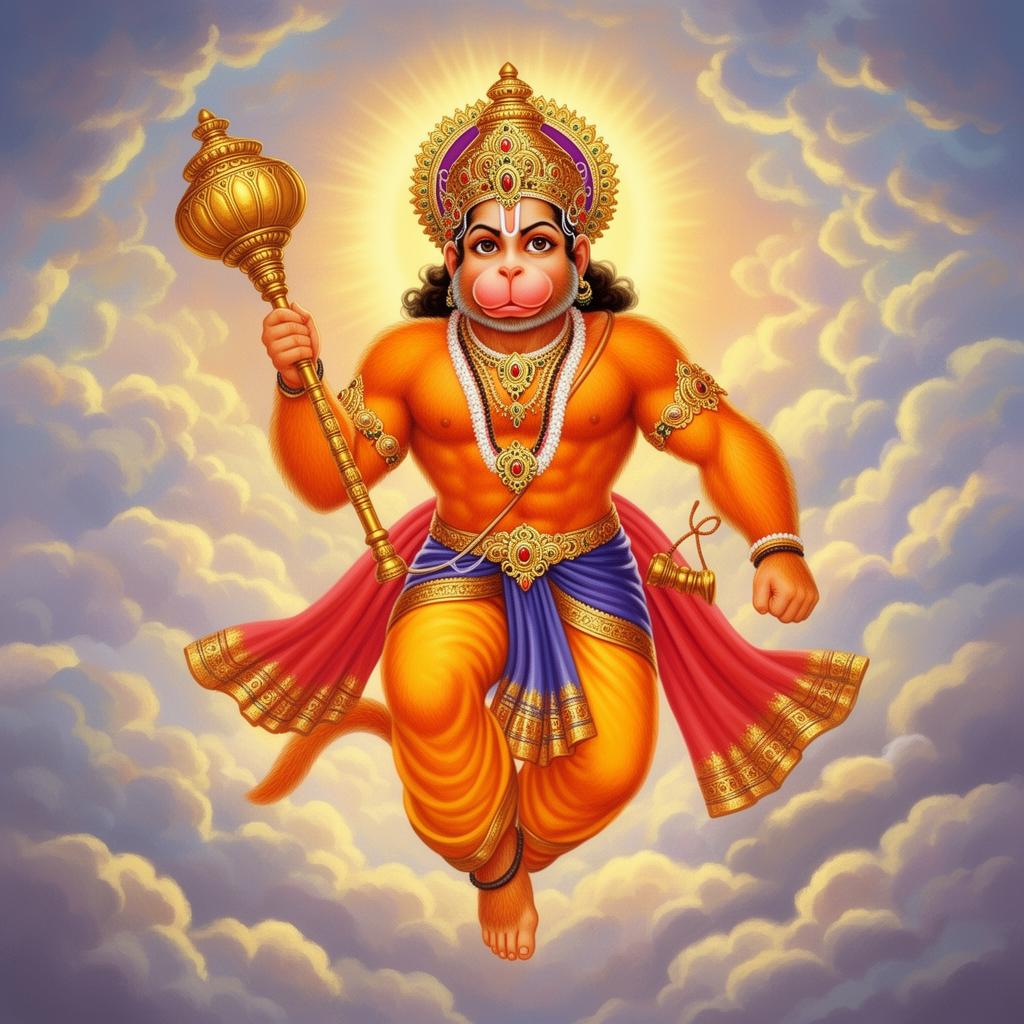
Hanuman has found Sita, delivered Rama's ring as proof, and then, rather than leaving quietly, decided to make sure Ravana understood exactly who had reached his most guarded garden. He tears up trees, kills a number of guards and one of Ravana's own commanders sent to stop him, and allows himself to be captured only after Indrajit binds him with the Brahmastra, an astra Hanuman lets work specifically because refusing it out of respect for Brahma is itself a decision he makes.
Brought before Ravana, Hanuman delivers Rama's message plainly: return Sita or face a war that will end Lanka. Ravana, in fury, orders him killed, and it is Vibhishana who talks him down, reminding him that killing an envoy is against every code of conduct even a king at war observes. Ravana settles instead for humiliation: Hanuman's tail is wrapped in cloth and oil and set on fire.
And Hanuman, rather than fleeing in pain, uses the burning tail to set fire to large sections of Lanka itself before finally leaping across the ocean back to the mainland. It is only after this, with half the city already alight, that Ravana turns to the question of who exactly should be sent to actually kill this monkey.
One Throw
Ravana's response, before the fire, is to send his son Akshaykumar, a young prince already trained in warfare and eager to prove himself against an intruder his father's court is treating as a genuine threat.
Akshaykumar approaches with a full chariot and a real army detachment, not a token force, which tells its own story about how seriously Lanka had already come to take this single vanara.
Hanuman does not use a weapon on him. According to the account most widely followed, he simply catches Akshaykumar, swings him by the leg, and dashes him to the ground with enough force that the prince dies instantly, his chariot and escort broken apart in the same motion.
It is over in the length of a single exchange. No prolonged duel, no exchange of boasts. Akshaykumar's death is less a battle than a demonstration, and it is precisely that speed which forces Ravana's hand toward sending someone with real strategic weight: his own eldest son, Indrajit, who succeeds where Akshaykumar failed only because he uses an astra rather than strength against strength.
A Small Death That Changes the Court's Calculation
Akshaykumar gets only a handful of verses in most tellings of the Yuddha Kanda's build-up, and it would be easy to read his death as a minor beat before the more famous binding of Hanuman by Indrajit's Brahmastra.
But structurally it does real work. It is the moment Ravana's court stops treating the intrusion as a nuisance to be swatted and starts treating it as a genuine military problem requiring their best resources. Every escalation after this, Indrajit's astra, the burning tail, the war councils that follow, traces back to a father sending his son to handle what should have been simple and getting back a body instead.
It also quietly establishes Hanuman's restraint as much as his strength. He has already killed guards and a commander in the garden. Against a prince, a member of the royal family whose death he knows will provoke exactly this kind of escalation, he does not hesitate either. The message Rama sent him to deliver was already blunt. Akshaykumar's death simply makes sure Lanka understood it was not a bluff.
What People Ask Most
Was Akshaykumar Ravana's only son sent against Hanuman?+
No. After Akshaykumar's death, Ravana sends Indrajit, his eldest son and Lanka's most capable warrior, who succeeds in capturing Hanuman using the Brahmastra rather than direct combat.
Why didn't Hanuman use the same restraint he showed toward Ravana himself?+
Restraint toward Ravana was about respecting the code around addressing a king directly as a messenger. Akshaykumar came as an armed attacker with a war chariot, not as a figure Hanuman was there to negotiate with, so the same consideration did not apply.
Where does this episode fall in the Ramayana's timeline?+
It happens in the Sundara Kanda, during Hanuman's single visit to Lanka to find Sita, shortly before he is captured, his tail set alight, and he burns part of the city on his way out.
About the author
Anjali Mehta · Editor, M.A. Religious Studies
Anjali is the managing editor for Vandnaa and oversees the festival and vrat coverage. She holds an M.A. in Religious Studies and reviews every published article for accuracy, accessibility, and tradition-fidelity.
Meet the Vandnaa editorial team →