The Temple at Jagat
The Ambika Mata temple stands in the village of Jagat, in Udaipur district of Rajasthan, roughly fifty to sixty kilometres southeast of Udaipur city by road.
What is there:
- A compact stone temple of the tenth century, complete in its essential parts
- A sanctum holding the image of Ambika
- A mandapa, a pillared hall, with a torana or ornamental arch in front of it
- Exterior walls carrying sculpture over almost every available surface
- A subsidiary shrine and later additions in the enclosure
An inscription associated with the temple gives a date corresponding to 961 CE, placing it in the same century as the great phase of temple building across western India.
The temple is a protected monument, and it is also a living shrine where worship continues, which is a combination that is less common than it sounds.
The local name for the site tells you what people think of it. Jagat is called the Khajuraho of Mewar, and while such comparisons are usually loose, in this case it is earned. The density and quality of carving on a building this size is genuinely exceptional, and the survival rate is what makes it remarkable rather than merely good.
The Image in the Sanctum
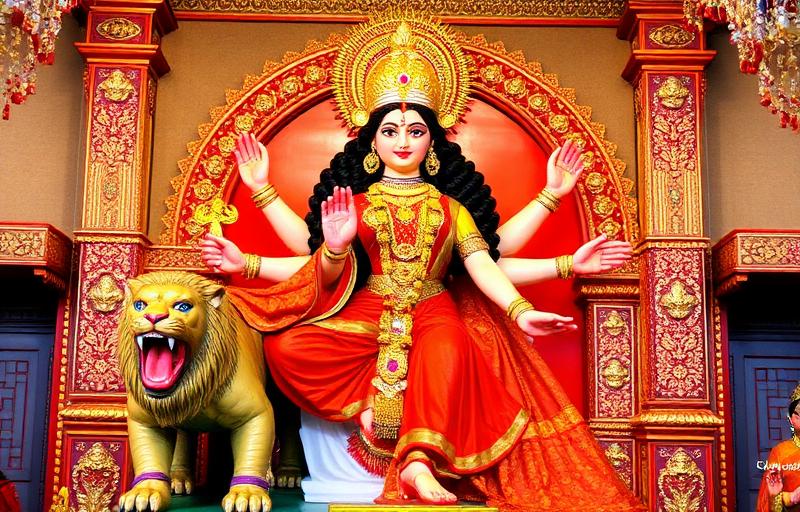
The deity is Ambika, a name of the Devi that carries the sense of mother, and the sanctum image is a form of Mahishasuramardini, the goddess who kills the buffalo demon.
What the form means:
- The image shows the Devi in the act of destroying Mahishasura, the demon who could not be defeated by any god acting alone
- The katha, told at length in the Devi Mahatmya, has the gods pooling their energies to produce a single female power who accomplishes what none of them could
- She is many armed, each hand carrying a weapon contributed by one of the gods
- The buffalo demon is shown beneath her, and the moment depicted is the moment of victory rather than of struggle
Why this form dominates Devi temples of the period. Between roughly the sixth and twelfth centuries, Mahishasuramardini became the standard sanctum image for Devi shrines across large parts of India, and the reason is not only narrative.
- It states the theological claim of the Devi Mahatmya directly, that the goddess is not an assistant to the gods but the power behind them
- It is a legible image, immediately recognisable to a devotee who cannot read
- It carries a promise that suits what people actually pray for, which is help against something that has proved too strong for them
At Jagat this image sits at the centre of a building whose entire exterior is given over to the wider world of the Devi, her attendants, her forms and the beings that surround her.
The Sculpture Programme
The reason Jagat is discussed alongside far larger monuments is the carving, so it is worth setting out what is actually on the walls.
What you see on the exterior:
- Forms of the Devi, including further Mahishasuramardini panels and other manifestations
- Surasundaris and apsaras, celestial women shown in the standard repertoire of poses, at the mirror, with a bird, removing a thorn, adjusting an anklet
- Dikpalas, the guardians of the eight directions, in their proper positions
- Musicians, dancers and attendants in the lower bands
- Kirtimukhas, foliage, and dense ornamental banding between figures
- A torana before the mandapa, carved through
What a modern visitor should understand about the figural sculpture. Temple walls of this period carry a full world, not only deities. Celestial women, couples, musicians and everyday figures belong to the standard programme, and their presence is a statement that the temple encloses the whole of life rather than a narrow religious slice of it.
On the comparison with Khajuraho. Jagat is far smaller, and the resemblance is one of density and quality of figure carving rather than of scale or of subject matter. It is a useful shorthand for a visitor and a poor one for a scholar.
What is genuinely comparable is the level of the work. The figures at Jagat have the elongation, the poise and the confident modelling of the best western Indian sculpture of the tenth century, and they are on a building you can walk around in ten minutes.
Why It Survived

The most interesting question about Jagat is not why it is beautiful. It is why it is still here, when so much of the same period in Rajasthan is not.
What worked in its favour:
- Location. Jagat is a village in hilly, wooded country away from the main routes. Armies, traders and administrations moved along the corridors, and this was not on one
- Size. It is a modest temple, not a wealthy or famous one, and it did not advertise itself
- Continuous local worship. A shrine that never stopped being used is maintained, cleaned and repaired by people who need it
- Protection in the modern period, which arrested decay and stopped the removal of pieces
The contrast with Harshnath near Sikar is instructive. Harshnath was a larger and more ambitious temple, endowed by a dynasty, standing on a prominent hill in open country. It is a ruin. Jagat was smaller and out of the way. It is nearly complete.
This is a pattern across India and it is worth stating without bitterness. What survives is not a fair sample of what existed. The monuments that come down to us are weighted towards the remote, the modest and the continuously used, and any judgement about the artistic past of a region has to be made knowing that the record is skewed.
Which is exactly why Jagat matters. It is one of the few places where Mewar's tenth century can be seen more or less as it was meant to be seen.
A Living Shrine, Not a Monument
It is easy to arrive at Jagat as a visitor to a monument and miss that it is a working temple, so it is worth saying what happens here.
The worship:
- Daily puja to Ambika, performed by the temple's priests
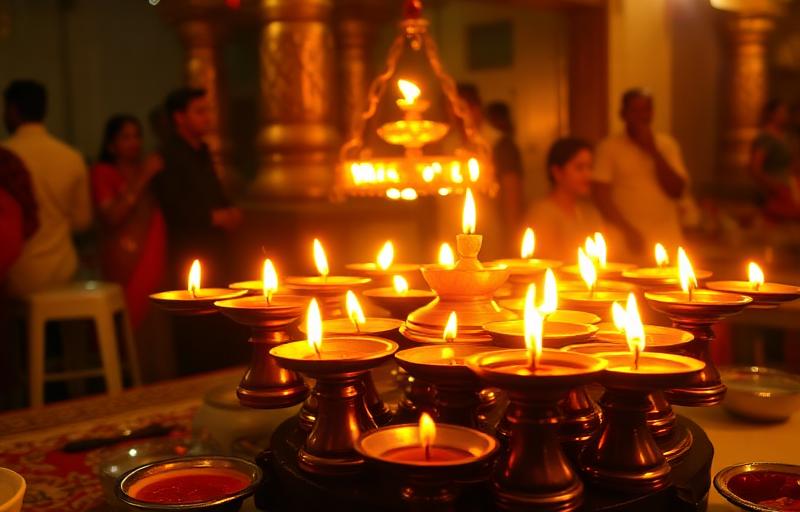
- Offerings of the ordinary kind, flowers, coconut, chunari, sindoor and lamps
- Local families bring children for mundan and come to fulfil vows
- The Meena and other communities of the surrounding villages have a long association with the shrine
The calendar:
- Chaitra Navratri in spring and Shardiya Navratri in autumn, when the temple is busiest and the village fills
- Ashtami and Navami within each Navratri, the principal days
- Weekly observance on Tuesdays and Fridays, the usual days of Devi worship
What this means for how you behave there. A protected monument invites a certain casualness, since the assumption is that nobody minds. That assumption does not hold at Jagat.
- Remove footwear where indicated and follow the sanctum rules
- Do not sit on the plinth, lean on carvings or climb for photographs
- Ask before photographing worship or people
- Dress as you would for any temple
The combination is the point. Very few tenth century buildings anywhere in the world are still doing the job they were built for, with the same deity, in the same village, for the descendants of the same communities. Jagat is one of them, and that is a larger achievement than the carving.
Visiting Jagat
Getting there
- Jagat village, Udaipur district, roughly 50 to 60 km southeast of Udaipur by road
- The drive takes about an hour and a half through hilly country, and the last stretch is a village road
- A hired car or taxi from Udaipur is the practical arrangement. Public transport exists but is slow and infrequent
- Udaipur has the nearest airport and railway station
When to go
- October to March for comfortable weather
- Navratri, spring or autumn, if you want to see the temple in full use
- Morning, for raking light across the carvings, which is when the sculpture reads best
- The monsoon makes the surrounding country green and the village road rougher
How to see it
- Walk the exterior slowly and in one direction, treating the wall as a continuous programme rather than a set of highlights
- Look at the torana before the mandapa
- Take darshan in the sanctum, and observe the rules there
- Allow an hour at least. People who come for twenty minutes see a nice small temple and miss the point
Practical notes
- Carry water. Jagat is a village with limited facilities and no visitor infrastructure
- There is no substantial food. Eat before you leave Udaipur or carry something
- Photography of the exterior is generally fine, but not of the sanctum image or of people at worship without asking
- Do not touch or climb on the carvings
Combining the visit
- Jaisamand Lake, one of the largest artificial lakes in Asia, lies in the same direction from Udaipur
- Eklingji and Nathdwara lie north of Udaipur and make a separate day
- Udaipur itself for the city palace and the lakes
A closing note. Jagat is not on most itineraries, which is exactly why it is worth the detour. You will very likely have a tenth century temple of the first rank almost to yourself, and in India that is close to a vanishing experience.
Quick Answers
Where is the Ambika Mata temple at Jagat?+
In Jagat village, Udaipur district, roughly 50 to 60 km southeast of Udaipur city by road, about an hour and a half through hilly country. Udaipur has the nearest airport and railway station.
How old is the temple?+
An inscription associated with the temple gives a date corresponding to 961 CE, placing it in the tenth century, the same period as the major phase of temple building across western India.
Why is Jagat called the Khajuraho of Mewar?+
Because of the density and quality of figure carving covering almost every surface of a small building. The comparison is about the level of the sculpture rather than scale or subject, since Jagat is far smaller than Khajuraho.
Which form of the Devi is in the sanctum?+
Ambika in the form of Mahishasuramardini, the goddess who kills the buffalo demon Mahishasura. The katha is told at length in the Devi Mahatmya, where the gods pool their energies to produce a single power who accomplishes what none of them could.
Is worship still performed there?+
Yes. Daily puja continues, local families come for mundan and to fulfil vows, and the temple is busiest during Chaitra and Shardiya Navratri, especially on Ashtami and Navami. It is a protected monument and a living shrine at the same time.
How much time should I allow?+
At least an hour at the temple, walking the exterior slowly in one direction before taking darshan, plus about three hours of driving from Udaipur and back. Morning light shows the carving best.
About the author
Pandit Ravindra Sharma · Vedic Rituals & Bhakti, 22+ years
Pandit Ravindra is the Vandnaa editorial team's resident specialist on aarti, chalisa, and daily devotion. He has performed home and temple pujas across Varanasi and Delhi for over two decades and contributes the bhakti-focused articles on this site.
Meet the Vandnaa editorial team →