What is Annaprashan? When to Perform It
Annaprashan (literally 'feeding of grain') is the seventh of the sixteen sanskaras (life-passage rituals) listed in the Grihya Sutras and Manu Smriti. It marks the baby's first taste of solid food - specifically rice, which is regarded as the most sattvic, easily digestible, and spiritually pure of all grains. Until Annaprashan, the baby has been on breast milk (and occasionally water in small amounts). The ceremony graduates the baby into participation in family meals.
Age guidelines:
- Boys: traditionally between 6 and 8 completed months. Most families choose the start of the 7th month (i.e., baby has just completed 6 months).
- Girls: traditionally between 5 and 7 completed months OR specifically at 7 completed months. The age varies more by region: Tamil and Telugu traditions favor 6 months for girls; Bengali tradition often does the ceremony in odd months (5th or 7th) for girls.
The gender asymmetry has a practical basis: Ayurveda considered that female digestive system is slightly delayed in maturation. Modern pediatric science confirms a slight, statistically real difference in gut microbiome development between male and female infants - though for practical purposes, ANY healthy 6-month-old can begin solid food regardless of gender. The traditional rule is a cultural choice, not a medical mandate.
Choosing the date: Annaprashan should be performed on an auspicious day determined by:
- Lunar tithi: avoid Amavasya, Chaturdashi, ashtami; prefer Panchami, Shashthi, Saptami, Ekadashi, Trayodashi.
- Day of week: Wednesday, Thursday, Friday are best. Tuesday and Saturday should be avoided.
- Nakshatra: Rohini, Mrigashira, Punarvasu, Pushya, Hasta, Anuradha, Revati are most auspicious. Bharani, Krittika, Ashlesha, Magha, Jyeshtha should be avoided.
- Tara bal: the baby's janma nakshatra should not be in adverse position.
Most families consult a pandit who provides a custom muhurat (auspicious time window) of 1-2 hours during the chosen day. Within that window, the actual feeding moment is timed precisely. Modern hospitals where the baby was born often have a panditji-on-call who can advise dates.
When NOT to perform Annaprashan:
- During Pitru Paksha (15 days of ancestor worship in September-October).
- During Chaturmas (4 months from Devshayani Ekadashi to Devuthani Ekadashi), unless the baby's age aligns awkwardly and parents must do it.
- During eclipse periods (solar or lunar).
- If a death has occurred in the immediate family within the last 13 days (the period of ashaucha or pollution).
- If the baby is unwell or has been unable to keep down formula or breast milk in recent days.
Complete Vidhi: Step-by-Step Ceremony
Day before the ceremony:
- Deep-clean the puja area and the room where the ceremony will happen.
- Buy fresh new clothes for the baby (traditionally yellow, white, or light green - not red for very young babies; not black under any circumstances).
- Buy a small silver bowl and silver spoon (or use family heirloom set) - silver is the prescribed metal for the first solid food.
- Buy fresh rice (a small quantity, premium quality), milk, ghee, sugar (or jaggery), and a small piece of fresh fruit (typically banana or mango).
- Inform extended family - Annaprashan is traditionally a family-witnessed event.
Morning of ceremony:
- Bathe the baby with warm water, dress in new clothes.
- Apply a small kala tika (black mark behind the ear or on the foot) to protect from evil eye.
- Bathe yourself and dress in puja-clothes.
- Set up the puja platform: place a small wooden chowki, cover with red cloth, place a Ganesha and Lakshmi-Narayan photo, light a ghee diya, set up the kalash (copper pot with water, mango leaves, coconut on top).
- Cook the first rice (annaprashan rice): boil basmati rice with milk, a small spoon of ghee, and a pinch of sugar. The result is essentially a sweet, soft kheer-like preparation. Use fresh ingredients only.
- Prepare the symbolic tray (described in next section).
The ceremony itself (1 hour):
1. Ganesh puja first - invoke Ganesha to remove obstacles for the baby's smooth transition.
2. Kalash sthapana - establish the kalash representing all divine energies.
3. Sankalpa - the head of the family (usually father or grandfather) takes water in hand and announces: 'On this auspicious day, [baby's name], son/daughter of [parents' names], grandchild of [grandparents' names], is performing the Annaprashan sanskara with the blessing of all family deities.'
4. Navagraha shanti - short worship of the 9 planets to ensure planetary support for the baby's growth.
5. The feeding moment - the precise muhurat. The mother or grandmother holds the baby in lap, facing east. The father or maternal uncle dips the silver spoon in the rice-kheer and gently places a tiny amount on the baby's tongue. The baby may resist, gag, or smile - all reactions are accepted. Three small spoonfuls is traditionally enough; do not force more.
6. Family elders' blessing - each elder takes a small amount of the rice on their fingertip, touches the baby's tongue briefly, and gives a personal blessing aloud.
7. Tray ceremony - the symbolic choosing ritual (see next section).
8. Distribute prasad - the remaining rice-kheer is distributed as prasad to all attendees. A small portion is given to a brahmin or to the family priest.
9. Family meal - a celebratory lunch where the family eats together. The menu traditionally includes the baby's first rice in larger quantity for adults, plus dal, vegetables, sweets, and the baby is symbolically 'served' along with everyone.
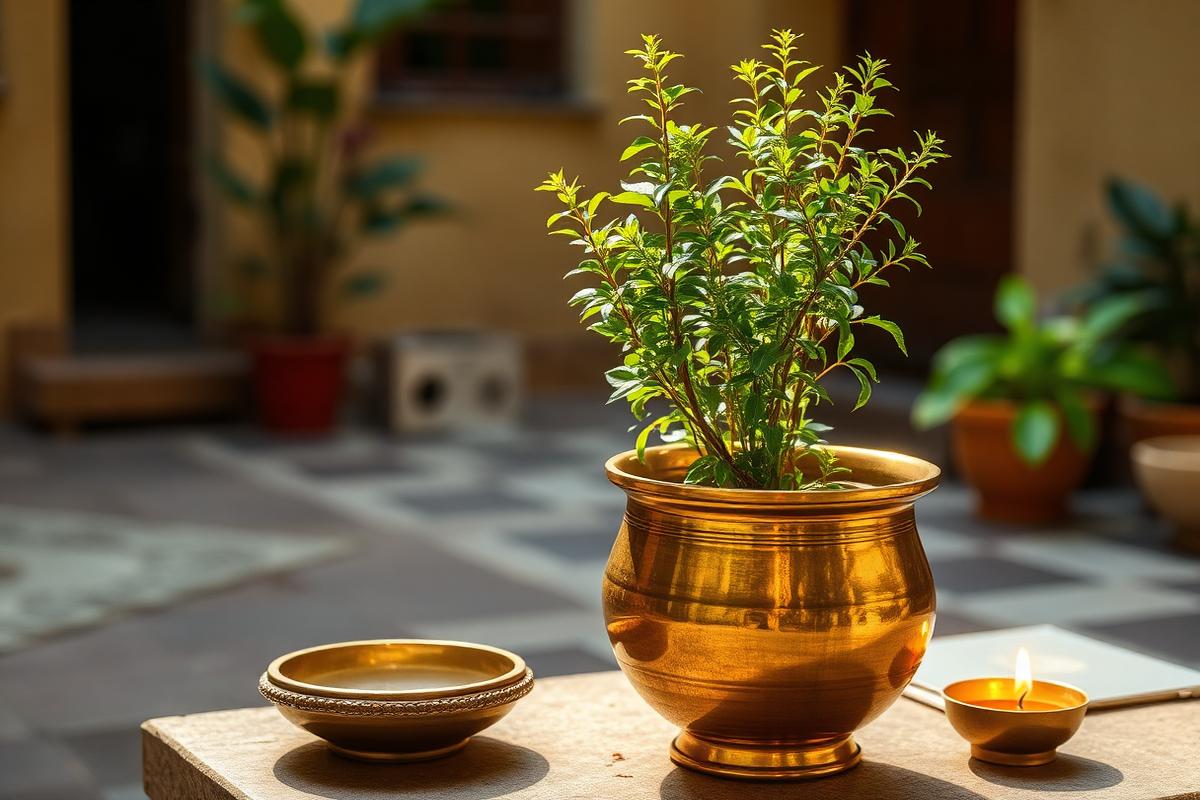
10. Concluding pranam - the baby is taken to the family deity, to the family Tulsi plant, and to the eldest member's feet for final blessings. The new clothes are kept on for the entire day.
The Tray Ceremony - Choosing the Baby's Future
The most beloved and photographed moment of Annaprashan - and the one extended family members travel for - is the tray ceremony. After the baby has been fed the first rice, a large flat tray is placed in front of the baby. On the tray are 5-9 symbolic objects, each representing a possible future career or life-path. The baby is allowed to crawl, reach, or point at the objects; whichever object the baby touches first or shows clearest interest in is taken as a divine indication of the child's future calling.
Traditional 5 essential items (Sanatan version): 1. A book - represents scholarship, teaching, intellectual career 2. A coin (silver or gold) - represents business, commerce, finance 3. A pen - represents writing, journalism, creative arts 4. A piece of jewellery (ring or small ornament) - represents wealth, hospitality, social status 5. A piece of clay or soil - represents farming, real estate, working with the earth
Expanded modern 9-item version: Add to the above: 6. A stethoscope (or model) - medicine, healthcare 7. A small judge's gavel or law book - law, judicial career 8. A small idol of a deity (Ganesha or Saraswati) - priesthood, spiritual life 9. A musical instrument (small flute, miniature tabla) - music, performing arts
Regional variations:
- In Bengal (Mukhe Bhaat), the typical 5 items are: Bhagavad Gita, pen, coin, ornament, and clay. A daughter's tray may include a kitchen item; a son's may include a sword or shield (modernised to a toy).
- In South India, the items typically include: pen, palm-leaf bundle (representing scripture), coin, paddy grain, and a small mirror.
- In Punjab and Haryana, a small gold ring is mandatory; a small phulkari embroidery piece is added for girls; a small kirpan replica (in Sikh families) is added for boys.
What the baby's choice means (interpretation guide):
- Book first → scholar, professor, researcher, teacher
- Coin first → businessperson, banker, entrepreneur
- Pen first → writer, journalist, lawyer, administrator
- Jewellery first → builder of family wealth, possibly luxury industry
- Clay first → farmer, real estate, environmental work
- Stethoscope → doctor, nurse, therapist
- Gavel → judge, lawyer, civil servant
- Idol → priest, spiritual teacher, philosopher
- Musical instrument → musician, performer, artist
If the baby touches multiple objects in sequence, the FIRST is the primary calling, and subsequent ones are secondary inclinations.
How seriously to take the result: Maturely: as a beautiful family ritual that gives the child something to hear about throughout life, not as a binding destiny. Children's actual careers are shaped by countless factors over 25+ years; the tray ceremony's choice should be celebrated and remembered but not enforced. If a baby chose 'book' but at age 15 wants to be a chef, support the chef path - the baby's tray-touch was a moment, the teenager's stated calling is a developed inclination.
That said, many adult Hindus report that the object they touched at their Annaprashan turned out to genuinely correlate with their adult career - particularly true for the more abstract objects (book, pen, idol) which represent broad life-orientations rather than specific jobs. The ritual is part folk-wisdom, part psychology (parents naturally encourage what the baby 'chose'), and part divine indication. Take it with a smile, document it well, and let the child unfold their own life.
Photography and memory: Almost every modern Indian family photographs and videos the tray ceremony - it becomes a treasured family memory. Frame the photo for the baby's room; bring it out at every birthday; show it to the child at age 16-18 when career decisions are being made; ultimately gift the original photo to the child when they get married, as part of their own marriage album. The continuity of this ritual across generations is what makes it powerful: the same ceremony was done for the baby's parents, for the grandparents, going back centuries.
Modern Adaptation: Hospital, Pediatrician, Working Parents
Annaprashan in 2026 has had to adapt significantly. Most urban Hindu babies are introduced to solids by pediatrician's recommendation (usually at 6 months), and many parents have already started rice cereal, mashed vegetables, or other puréed foods by the time the religious Annaprashan is scheduled. This creates a chronological mismatch. Modern practice has evolved several solutions.
Solution 1: Reframe Annaprashan as the 'first formal feeding': Even if the baby has been eating purées for a month, the Annaprashan rice-kheer is the first RITUALLY blessed food. Treat it as a different category from daily nutrition. The baby experiences both: the morning's purée at 8 AM (medical introduction) and the Annaprashan rice-kheer at the muhurta time (spiritual induction). No conflict.
Solution 2: Combine Annaprashan with the actual first-solid-food day: For families who want strict alignment, plan the Annaprashan ceremony for the exact day the pediatrician approves solid food. Some pediatricians (especially in India) actively support this - they advise parents to use the first solid-food day as the religious ceremony, ensuring the religious and medical timelines coincide. This requires planning the muhurta around the pediatric appointment.
Solution 3: For premature babies or special-needs babies: If the baby was born premature and is medically advised to delay solid food beyond 6 months, ALSO delay the Annaprashan. The traditional age-rule assumes a full-term, healthy baby. Pediatric medical advice always overrides traditional timing. Have the ceremony when the baby is actually ready for solids; the pandit can recalculate muhurta for any month with valid nakshatras.
Solution 4: For working parents with limited family-gathering days: Annaprashan can be combined with other family events if the timing aligns:
- Combine with the grandmother's annual visit (so the elder is present).
- Combine with a long-weekend or Diwali/Holi gathering when family is already assembled.
- If the family is geographically scattered, do the ceremony at home with immediate family on the religious muhurta, AND have a 'reception' on a later weekend when extended family can attend. The religious efficacy is in the muhurta-time ceremony; the celebration is social.
Solution 5: For inter-faith families (Hindu mother, non-Hindu father, or vice-versa): The Annaprashan can still be done - it is a child-blessing ceremony, not a sectarian act. The non-Hindu parent can participate in the cultural aspects (feeding, blessing, tray ceremony) while sitting through the Sanskrit parts respectfully. Many inter-faith couples report that Annaprashan is one of the most beloved rituals because it focuses on the baby's future rather than religious doctrine.
Solution 6: For diaspora families abroad: Most cities with significant Hindu populations (US, UK, Canada, Australia, Singapore, Dubai) have pandits available for home-based Annaprashan. The ceremony can be conducted at home or in a community temple. Some Indian-origin parents abroad video-call grandparents in India so the entire ritual is witnessed across continents. The tray items may need creative substitution (using local equivalents - a US dollar bill instead of rupee coin, an English alphabet book, etc.).
Common questions answered:
- 'Can a foster or adopted child have an Annaprashan?' YES, and it is especially recommended - the ceremony formally welcomes the child into the adopting family's spiritual lineage.
- 'My baby refuses to eat the rice - what do we do?' The ritual is symbolic; even one grain on the tongue counts as a complete Annaprashan. Do not force-feed. Many babies of this age cry or push the spoon away - the ritual proceeds even with minimal actual eating.
- 'Can we feed something other than rice?' Rice is strongly traditional, but in cases of rice allergy or specific dietary needs, mashed bananas, ragi porridge, or oats kheer have been accepted in some communities. Consult a flexible pandit.
- 'Should we invite many people or keep it small?' Quality over quantity. 8-12 people who genuinely love the child is better than 50 distant relatives. The baby's nervous system is not yet ready for crowd-stimulation; an overwhelmed baby gives 'bad omen' interpretations of the tray ceremony.
Quick Answers
What if my baby has milk allergy - can we skip the milk in Annaprashan rice?+
Yes - make the rice with water + a tiny amount of ghee + a pinch of sugar. The kheer-like consistency can be approximated. For severe milk allergy, replace milk with almond milk (in Hindu tradition, almond is considered sattvic and acceptable). Inform the pandit beforehand so he can adjust the mantra-wording (some mantras specifically mention milk; he can substitute with 'sweet sustenance' or omit the milk-specific line). The ritual's spiritual efficacy does not depend on milk specifically - it depends on the offering of the first solid food, whatever its safe form. The baby's health always overrides the recipe.
Can the mother feed the baby instead of the father or maternal uncle?+
Yes - modern practice strongly accepts mothers as the feeder. Traditional rule had the maternal uncle (mama) feed because in joint-family systems, the mama's blessing was considered to give the baby protection beyond the immediate family. In modern nuclear families with no nearby maternal uncle, the father or grandfather feeds. If only the mother is present (single-mother family, or husband traveling for work), the mother feeds and there is no ritual deficiency. The act of feeding-as-blessing is universal across genders; the traditional male-role was social, not spiritual.
What is the connection between Annaprashan and Annapurna goddess?+
Direct and profound. Annapurna is the goddess of food and sustenance; Annaprashan is the ceremony where a baby first receives sustained food. Many families specifically invoke Annapurna during the Annaprashan ceremony, asking her to bless the baby with a lifetime of never going hungry. The rice itself is considered to be Annapurna's gift in physical form. Some communities have an additional sub-ritual: the baby is briefly held in front of an Annapurna picture before the first spoon is given, and the mother whispers 'Mata, this child is now in your care.' This single moment is believed to ensure the child never knows real hunger throughout life - a powerful blessing in a country with food-insecurity history.
What if we missed performing Annaprashan in time - can we do it now (at age 2 or 3)?+
Yes - late Annaprashan is acceptable and common. The standard practice is to do a 'delayed Annaprashan' along with the next major sanskara (typically Chudakarana - the first hair-cutting ceremony, done at age 1-3). Tell the pandit about the missed Annaprashan; he will combine both rituals in the same ceremony. The 'first solid food' aspect is symbolic by this age (the child has been eating for months) - what is being completed is the religious blessing. There is no penalty for delay; you simply complete the cycle. Better late than never. Many adults whose Annaprashan was missed entirely have done a symbolic 'belated' ceremony before their wedding or before becoming parents - the spiritual lineage gets restored.
About the author
Anjali Mehta · Editor, M.A. Religious Studies
Anjali is the managing editor for Vandnaa and oversees the festival and vrat coverage. She holds an M.A. in Religious Studies and reviews every published article for accuracy, accessibility, and tradition-fidelity.
Meet the Vandnaa editorial team →