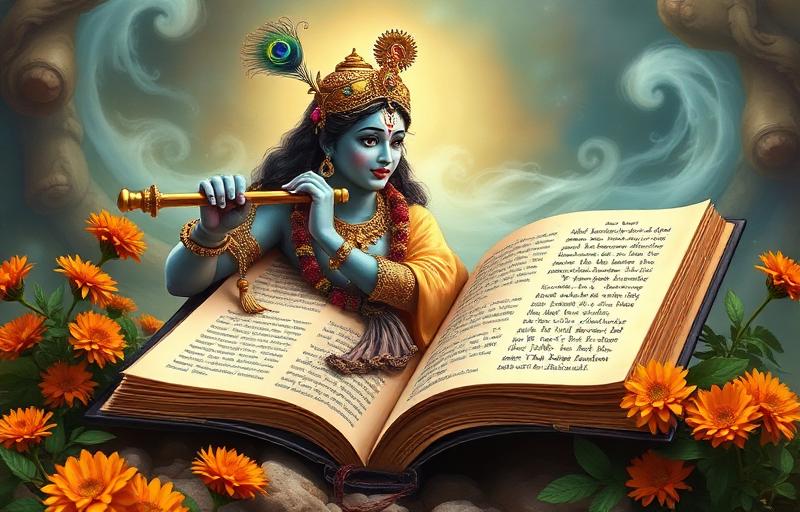
A Second Son on the Mountain
Bhima was born on Mount Shatashringa, where Pandu had retired after his own curse, in the years when Kunti was using the mantra Durvasa had given her to invoke different gods as fathers for the children Pandu could not have. Yudhishthira had already been born from Dharma. For her second son, on the sages' advice that the family needed strength as much as righteousness, Kunti invoked Vayu, the wind god.
The Mahabharata is direct about the result being extraordinary from the moment of birth. Bhima is described as unusually large and heavy even as an infant, and the text uses him, more than any other Pandava, to establish physical strength as a defining trait from earliest childhood rather than something he grew into later.
The rock accident happens in this early period, while the family is still living in the forest hermitage, in a scene the text places almost incidentally among the ordinary business of caring for a baby.
The Accident on the Slope
Kunti, holding the infant Bhima, dozed off on a hillside, and her grip loosened enough that the baby slipped from her lap and rolled down the slope, striking a large rock at the bottom.
In any ordinary account this would be the setup for a tragedy. In the Mahabharata it is the opposite: the rock is the thing that breaks. The text describes the boulder shattering into pieces on impact, while the infant Bhima is entirely unharmed, apparently not even waking from the fall.
Sages and family members who witnessed it are described as startled less by the danger than by what the outcome revealed. A baby who could not be hurt by a fall that pulverized stone was not showing ordinary infant hardiness. It was read immediately as visible proof of Vayu's paternity, the same god whose strength would later manifest directly in Bhima's build, his appetite, his mace-work, and his role as the physically dominant Pandava through every major battle of the epic, including his eventual killing of Duryodhana.
Some regional tellings place a large stone or a cleft rock formation on Shatashringa itself as the literal site of this event, shown to pilgrims as physical evidence, in the same way many Puranic incidents are tied to specific geographic markers that remain places of local devotion.
The First of a Recurring Pattern
The rock incident is the first in a series of childhood episodes the Mahabharata uses to establish Bhima's exceptional strength before he is old enough to demonstrate it deliberately. Later stories tell of him overpowering his cousins in rough play hard enough that the Kauravas, particularly Duryodhana, began plotting against him from boyhood, well before Kurukshetra was even a possibility, including the poisoning attempt during the Naga-related incident that features elsewhere in this series.
Read together, these early episodes do real narrative work: they explain why Duryodhana's hatred of the Pandavas predates any of the political disputes over succession, rooting it instead in a childhood fear of a physically unbeatable rival. The shattered rock is the quietest of these signs, requiring no malice or conflict to make its point, just an accident that revealed, without anyone intending it to, exactly whose son Bhima was.
What People Ask Most
Where did the rock-shattering incident take place?+
The text places it on Mount Shatashringa, the forest hermitage where Pandu, Kunti and Madri lived after Pandu's retirement, and where all five Pandavas were born.
Is this the same story as Bhima's fight with Duryodhana as children?+
No, this is an earlier infancy episode showing his strength as an accident of birth. The rivalry with the Kauravas develops separately, in Hastinapura during their shared upbringing under Drona.
Why was Vayu chosen as Bhima's divine father?+
The sages at Shatashringa advised Kunti that the family, facing Pandu's incapacity and eventual threats from Hastinapura, needed a son of exceptional strength, and Vayu was invoked specifically for that quality.
About the author
Anjali Mehta · Editor, M.A. Religious Studies
Anjali is the managing editor for Vandnaa and oversees the festival and vrat coverage. She holds an M.A. in Religious Studies and reviews every published article for accuracy, accessibility, and tradition-fidelity.
Meet the Vandnaa editorial team →