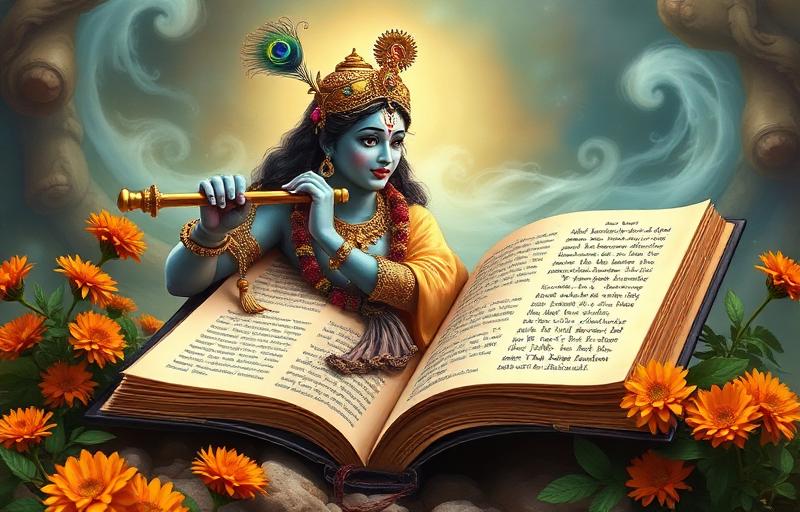
A Test Meant to Settle a Divine Argument
The sages once fell into a dispute over which of the three principal deities, Brahma, Vishnu or Shiva, was the greatest, and agreed to settle the question by testing each one's temperament, sending the sage Bhrigu to visit all three in turn and provoke a reaction. Brahma, approached without the proper respect Bhrigu deliberately withheld, reacted with irritation. Shiva, similarly tested, responded with anger sharp enough that Bhrigu had to flee for his safety.
Arriving at Vaikuntha, Vishnu's own abode, Bhrigu found the deity resting with Lakshmi and, without any greeting or announcement, kicked him directly in the chest to provoke the strongest reaction he could manage, treating this final test as the decisive one.
A Question Instead of Anger
Rather than reacting with anger, Vishnu rose calmly and asked Bhrigu whether his foot had been hurt striking a chest as hard as his own, and, in some tellings, proceeded to gently massage the sage's foot himself out of genuine concern. Bhrigu, confronted with this complete absence of ego or offense from a deity he had just physically struck, declared Vishnu the greatest of the three for his boundless patience and humility, settling the sages' dispute decisively in his favour.
Lakshmi, however, was not willing to let the insult pass so easily. She considered the kick, delivered directly to her husband's chest, an intolerable disrespect regardless of how graciously Vishnu himself had absorbed it, and, offended that Vishnu had not defended his own honour or hers more forcefully, left Vaikuntha, choosing to take up residence on earth instead.
A Search That Ends at Kolhapur
This episode is closely connected, in South Indian and Maharashtrian tradition especially, to the temple geography of Vishnu's search for Lakshmi after her departure, and to the eventual establishment of the Mahalakshmi temple at Kolhapur, one of the Shakti Peethas, as well as to the wider tradition around Tirupati's Venkateswara temple, where some tellings connect Vishnu's own extended penance and eventual second marriage to Padmavati to this same period of separation from Lakshmi.
The story is told today less as a cautionary tale about anger and more as an illustration of Vishnu's specific quality of unwavering equanimity, sama-darshana, treating insult and honour with identical composure, contrasted directly with Brahma and Shiva's more human reactions in the same test. It is also, quietly, a story about Lakshmi's own agency: rather than simply accepting her husband's chosen response to the insult, she makes an independent decision about what she is and is not willing to tolerate.
What People Ask Most
Why did Lakshmi leave if Vishnu himself was not angry?+
The tradition frames it as Lakshmi's own independent judgment that the insult to her husband deserved a stronger response than his patient acceptance of it, an act of her own agency rather than simply following his lead.
Is the Kolhapur Mahalakshmi temple connected to this story?+
Yes, tradition closely associates the Kolhapur Mahalakshmi temple, one of the recognized Shakti Peethas, with the site connected to Lakshmi's residence on earth following her departure from Vaikuntha in this episode.
Did Bhrigu test Brahma and Shiva the same way?+
Not identically. He withheld customary respect from Brahma, provoking irritation, and directly angered Shiva enough to have to flee, before finally physically striking Vishnu, an escalating series of tests rather than one repeated identically each time.
About the author
Anjali Mehta · Editor, M.A. Religious Studies
Anjali is the managing editor for Vandnaa and oversees the festival and vrat coverage. She holds an M.A. in Religious Studies and reviews every published article for accuracy, accessibility, and tradition-fidelity.
Meet the Vandnaa editorial team →