What Is the Brahmavaivarta Purana
The Brahmavaivarta Purana is counted among the eighteen Maha Puranas and stands out for the way it brings together several major strands of Hindu devotion within a single text. Its name is traditionally understood to point to the transformation connected with Brahma, hinting at its focus on creation and the divine forces behind it.
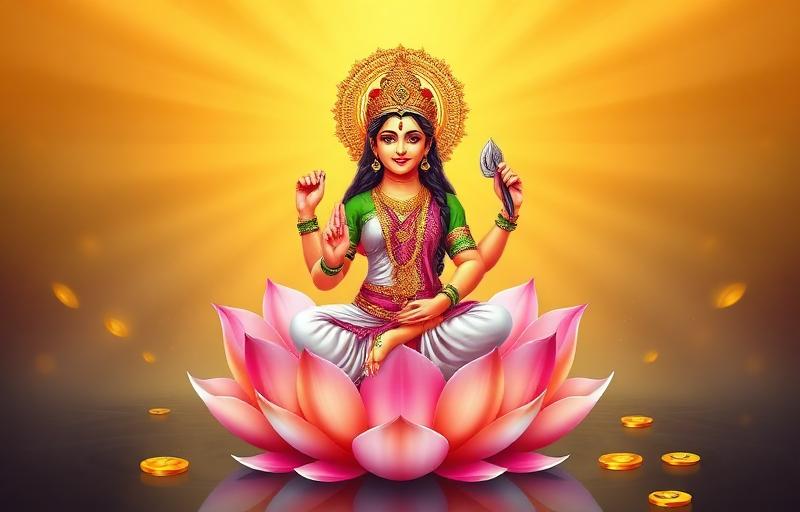
Unlike Puranas that centre on one deity alone, the Brahmavaivarta Purana moves across the worship of Krishna and Radha, Ganesha, and the Divine Mother as Prakriti, the primordial creative energy, treating each with equal devotional seriousness.
Its Four Khandas
The Brahmavaivarta Purana is traditionally divided into four khandas, or sections. The Brahma Khanda deals with creation and cosmology. The Prakriti Khanda is devoted to the Goddess in her form as Prakriti, describing various goddesses as her manifestations. The Ganapati Khanda centres on Lord Ganesha, his birth and glory. And the largest section, the Krishna Janma Khanda, is devoted almost entirely to the life and divine love of Krishna and Radha.
This fourfold structure is part of why the text feels less like a single narrative and more like a treasury of devotional material, each khanda capable of standing on its own for a devotee drawn to that particular form of worship.
Radha and Krishna's Divine Love
The Krishna Janma Khanda is where the Brahmavaivarta Purana leaves its deepest mark on Hindu devotion. It elaborates on the eternal, divine relationship between Radha and Krishna, presenting their bond not as an ordinary human romance but as the union of divine love itself, a theme that would go on to shape centuries of Vaishnava poetry, music and philosophy.
This section is considered one of the important scriptural sources for the theology that sees Radha as inseparable from Krishna, the embodiment of devotion meeting the embodiment of the divine.
Ganesha and the Divine Mother

The Ganapati Khanda offers devotees a devotional account of Lord Ganesha, complementing the more widely known stories found elsewhere in Puranic literature. The Prakriti Khanda, in turn, honours the Goddess in her many forms, describing her as the creative energy underlying the entire universe, the shakti without which creation itself could not proceed.
Together, these two khandas show that the Brahmavaivarta Purana holds Ganesha's grace and the Goddess's creative power in the same reverence it gives to Radha and Krishna's love, reflecting a broad and inclusive vision of devotion.
Its Significance for Devotees Today
For devotees today, the Brahmavaivarta Purana is valued less as a single continuous story and more as a wellspring, drawn upon by those devoted to Krishna and Radha, by families that begin ceremonies with Ganesha's name, and by worshippers of the Goddess in her many forms. Its portions on Radha and Krishna in particular continue to influence bhajans, katha traditions and Vaishnava thought.
Approaching this Purana, even through a single story from one of its khandas, offers a devotee a glimpse of how vast and varied Hindu devotion can be, while still remaining rooted in the same underlying faith. As tradition reminds us, worship in any of these forms is ultimately an act of faith and love, not a transaction.
Common Questions From Devotees
What are the four khandas of the Brahmavaivarta Purana?+
Its four traditional sections are the Brahma Khanda on creation, the Prakriti Khanda on the Goddess, the Ganapati Khanda on Lord Ganesha, and the Krishna Janma Khanda on Radha and Krishna.
Why is the Brahmavaivarta Purana important for Radha-Krishna devotion?+
Its Krishna Janma Khanda gives one of the fullest scriptural accounts of the divine love between Radha and Krishna, treated as the union of devotion and the divine, which later shaped much of Vaishnava poetry and thought.
Does the Brahmavaivarta Purana include stories of Ganesha?+
Yes, its Ganapati Khanda is devoted to Lord Ganesha, describing his birth and glory alongside the text's wider devotional themes.
About the author
Anjali Mehta · Editor, M.A. Religious Studies
Anjali is the managing editor for Vandnaa and oversees the festival and vrat coverage. She holds an M.A. in Religious Studies and reviews every published article for accuracy, accessibility, and tradition-fidelity.
Meet the Vandnaa editorial team →