A King Freed From Grief by Narada
Chitraketu, a king of the Shurasena kingdom in the Bhagavata Purana's telling, had a thousand wives but no children, a grief that consumed him until the sage Angira performed a ritual that granted him one son through his chief queen, Kritadyuti. That son quickly became the object of intense favouritism from his mother, provoking jealousy severe enough among the other co-wives that they eventually poisoned the child.
Devastated, Chitraketu found himself unable to move past his grief until the sage Narada and Angira visited and taught him a form of higher spiritual knowledge, revealing the illusory and temporary nature of worldly relationships including parenthood itself. Through this teaching, Chitraketu attained a level of realization that lifted him beyond ordinary grief entirely and eventually made him a great Vidyadhara, a celestial being of considerable spiritual accomplishment.
A Question, an Insult, and a Curse
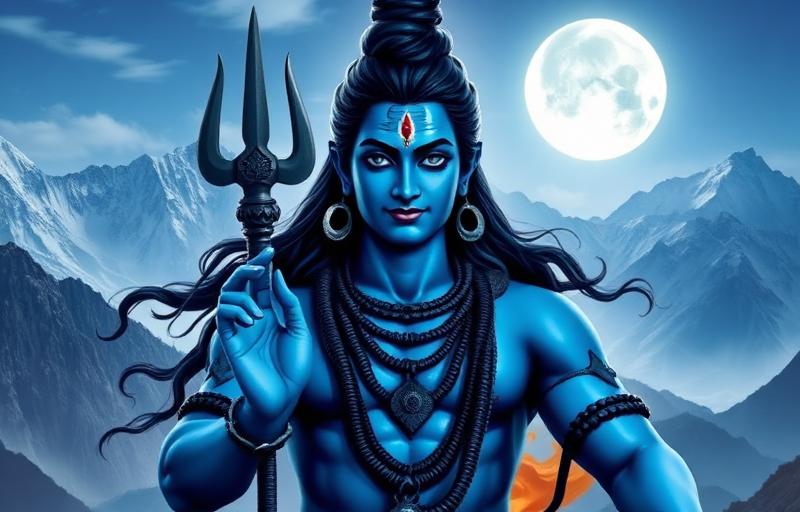
As a spiritually advanced Vidyadhara, Chitraketu one day encountered Shiva seated with Parvati in an intimate posture and, from a place of genuine philosophical curiosity rather than malice, questioned aloud how a supposedly detached, ascetic deity like Shiva could be found in what looked like an ordinary embrace with his wife, comparing this apparent inconsistency to standards Chitraketu himself had come to hold after his own spiritual training. When Shiva responded with equanimity rather than offense, Chitraketu, still not fully grasping the deeper answer being offered, laughed.
Parvati, offended on her husband's behalf by what she read as genuine disrespect rather than innocent inquiry, cursed Chitraketu that he would be born as a demon. Shiva, according to the tradition, did not overturn his wife's curse but accepted it as deserved given the real insult contained in Chitraketu's laughter, regardless of the philosophical sincerity behind the original question. Chitraketu accepted the curse without protest, having already attained enough realization to understand that even this fate could not touch his true, liberated self, and was reborn as the demon Vritrasura.
The Demon Who Was Never Really Trapped
This backstory gives Vritrasura's later battle with Indra, told elsewhere on this site, an added layer of meaning: the demon Indra eventually kills with Dadhichi's bone-weapon is, underneath the monstrous form, a being who had already attained genuine spiritual realization before the curse, and Vritra's own conduct during that later war is described in the Bhagavata Purana with unusual nobility and restraint for a demon, fighting according to strict codes of honourable combat even against Indra, a detail some commentators read as the residue of Chitraketu's earlier spiritual attainment surviving inside the demonic form.
The episode is frequently cited in devotional commentary as a caution about the danger of intellectual pride even in a genuinely advanced practitioner, and as an example of how a question asked without full humility, however sincere its underlying curiosity, can still carry real consequence, distinct from a lesson about curiosity itself being wrong.
Frequently Asked Questions
Is this the same Vritrasura that Indra fights with Dadhichi's bones?+
Yes, this story is presented in the Bhagavata Purana as the backstory explaining who Vritrasura was before that battle, a once-realized king named Chitraketu cursed by Parvati into demonic form.
Why didn't Shiva stop Parvati's curse if the question was sincere?+
The tradition presents Shiva as accepting the curse's fairness given the disrespect in Chitraketu's laughter specifically, separate from the sincerity of his underlying question, suggesting the manner of asking mattered as much as the question's content.
Did the curse actually harm Chitraketu, given his spiritual attainment?+
The tradition suggests it did not touch his liberated inner state even as it changed his outer form and circumstances, and his conduct as Vritrasura, described with unusual honour for a demon, is sometimes read as evidence that his realization persisted through the transformation.
About the author
Anjali Mehta · Editor, M.A. Religious Studies
Anjali is the managing editor for Vandnaa and oversees the festival and vrat coverage. She holds an M.A. in Religious Studies and reviews every published article for accuracy, accessibility, and tradition-fidelity.
Meet the Vandnaa editorial team →