Daily Puja at Home: Why It Transforms Your Life
Daily puja is not merely a religious ritual - it is a structured morning practice that aligns your circadian rhythm, activates gratitude pathways in the brain, and creates a sacred container for your intentions each day. Research from the University of California shows that morning gratitude rituals reduce cortisol levels by up to 23% within 4 weeks of consistent practice. Hindu tradition has understood this for millennia - the daily puja routine is essentially a scientifically designed stress-reduction and intention-setting protocol wrapped in devotion.
The Sanskrit word 'puja' derives from the root 'puj' meaning to honor, worship, and attend to. When you perform puja daily, you are training your mind to find something worthy of reverence each morning - a powerful antidote to the anxiety and negativity that modern life generates. The physical acts of lighting a lamp, offering water, and chanting mantras engage multiple sensory systems simultaneously, making the practice deeply immersive and neurologically impactful.
For busy people, the question is not whether to do puja but how to integrate it without adding stress. The good news: a complete, spiritually valid home puja requires only 15–20 minutes in the morning and 5 minutes in the evening. This guide gives you the complete framework - from setting up your puja space to managing time on your busiest days.
Setting Up Your Sacred Puja Space at Home
The direction your puja space faces determines the quality of energy it receives. According to Vastu Shastra, the Northeast corner (Ishaan kona) is the most auspicious zone for worship - this corner receives the morning sun's first rays and is associated with the element of water and spiritual energy. The East-facing direction is the second best choice, as your prayers face the rising sun. Avoid placing your mandir in the South direction, bedroom, or directly above a toilet.
Essential items for your home puja space:
Murti or Photo: Choose your Isht Dev (personal deity). Keep the photos/idols clean and at eye level when seated. Do not place broken idols - replace them immediately.
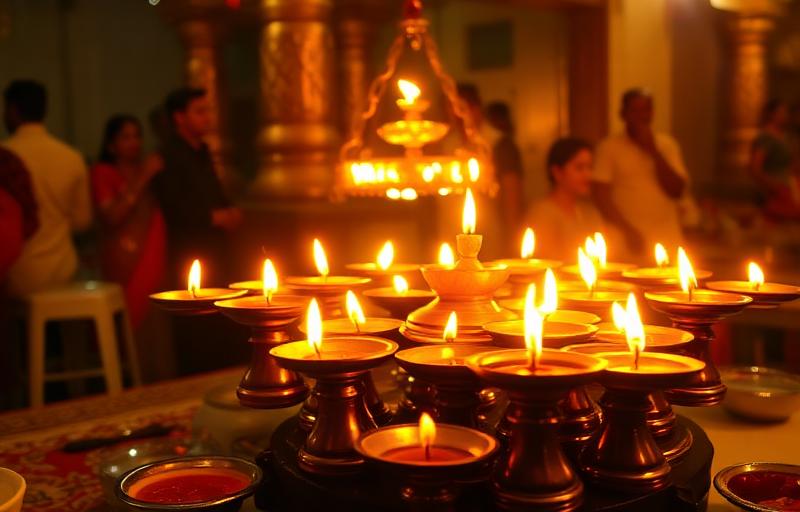
Deepak (Lamp): A ghee diya is ideal. Sesame oil (til ka tel) is used for Shani puja. A simple camphor (kapur) lamp works for daily worship.
Incense (Agarbatti): Sandalwood, jasmine, or rose fragrances are universally auspicious. Avoid synthetic fragrances.
Puja Thali: A copper or brass plate with small containers for roli (red powder), akshat (unbroken rice), flowers, and water.
Kalash: A copper or brass pot for water offerings.
Keep the space clean daily - dust accumulates quickly and a dirty puja space inverts the energy. Cover with a clean cloth when not in use.
Complete Morning Puja Vidhi: Step-by-Step Guide
The morning puja follows a beautiful logical sequence - from physical purification to mental purification to divine communion. Here is the complete vidhi:
Step 1 – Snanam (Purification): Take a bath or wash hands, face, and feet. Wear clean clothes. White, yellow, or saffron colored clothes are auspicious.
Step 2 – Sankalpam (Intention): Sit facing East or Northeast. Take water in your right palm and say: 'Aum tatsat adya [your name] puja karomi' (Om, today I, [your name], perform this puja). Let the water fall.
Step 3 – Ganesh Puja First: Always begin with Ganesha - he removes obstacles. Chant: 'OM Gam Ganapataye Namaha' 21 times.
Step 4 – Avahana (Invitation): Invite the deity's presence: 'Aagaccha deva! Pujam grihna.' (Come, O Lord! Accept my worship.)
Step 5 – Panchamrit Snan: Offer 5 things symbolically: milk, curd, honey, ghee, sugar. Even a drop of each on a tulsi leaf works.
Step 6 – Pushpam (Flowers): Offer flowers or tulsi leaves. Say the deity's name with each offering.
Step 7 – Deepam (Lamp): Light the lamp, rotate it clockwise 3 times before the deity while chanting the aarti.
Step 8 – Dhupam (Incense): Wave incense 7 times clockwise.
Step 9 – Naivedhyam (Food Offering): Offer a small piece of fruit, sweet, or food.
Step 10 – Pradakshina & Namaskara: Do 3 clockwise circles and prostrate fully (Sashtanga Namaskar).
Total time: 15–20 minutes.
The 16 Upacharas: Complete Offering Ritual Explained

The Shodashopachar puja (16-step offering) is the complete form of worship prescribed in the Agamas and Puranas. Each step represents an offering to the deity as if they were a royal guest in your home. For daily home worship, a simplified version works perfectly.
The 16 Upacharas (simplified for home):
1. Avahana – Invitation: 'Deva, agaccha' (Lord, please come) 2. Asana – Seat offering: Place a clean cloth or offer mentally 3. Padya – Water for feet: Offer water in a small bowl 4. Arghya – Water for hands: Fresh water in cupped hands 5. Achamana – Drinking water: Offer water 3 times 6. Snanam – Bathing: Panchamrit or plain water 7. Vastra – Clothing: Offer a small piece of new cloth or visualize 8. Yagnopavita – Sacred thread: Offer a thread or visualize 9. Gandha – Sandalwood paste: Apply chandan to the idol 10. Pushpam – Flowers: Offer fresh flowers 11. Dhupam – Incense: Wave agarbatti 12. Deepam – Lamp: Wave ghee diya 13. Naivedhyam – Food: Offer fruit or sweet 14. Tambulam – Betel leaves: Offer symbolically 15. Dakshina – Offering: Place a coin 16. Pradakshina & Namaskar – Circumambulation and prostration
You don't need to do all 16 physically every day. On Mondays, Tuesdays, or special occasions, try the full 16. On regular days, steps 1, 3, 6, 10, 11, 12, 13, and 16 are the minimum.
Essential Mantras for Each Stage of Daily Puja
Using the correct mantras at each stage of puja amplifies its spiritual potency. Here are the key mantras:
Opening Mantra (Sankalpa): ॐ अपवित्रः पवित्रो वा सर्वावस्थां गतोऽपि वा। यः स्मरेत् पुण्डरीकाक्षं स बाह्याभ्यन्तरः शुचिः॥ (Whether pure or impure, whoever remembers Vishnu becomes internally and externally clean.)
Diya Prajna (Lamp Lighting): दीपज्योति परब्रह्म दीपज्योति जनार्दनः। दीपो हरति पापानि संध्यादीपं नमोऽस्तु ते॥ (The lamp's light is the Supreme Being. This lamp destroys all sins. I bow to this evening lamp.)
Pushpanjali (Flower Offering): माल्यादीनि सुगन्धीनि मालत्यादीनि वै प्रभो। मया ह्रतानि पुष्पाणि पूजार्थं प्रतिगृह्यताम्॥ (O Lord, please accept these fragrant flowers I offer for your worship.)
Naivedhya (Food Offering): नैवेद्यं गृह्यतां देव भक्तिं मे ह्यचलां कुरु। ईप्सितं मे वरं देहि परत्र च परां गतिम्॥ (O Lord, accept this offering. Make my devotion steady. Grant my desired wish and liberation.)
Closing Prayer (Kshamapana): आवाहनं न जानामि न जानामि विसर्जनम्। पूजां चैव न जानामि क्षम्यतां परमेश्वर॥ (I don't know how to invite or dismiss you properly. I don't know how to worship correctly. O Lord, please forgive my mistakes.)
Puja in 5, 10, or 20 Minutes: Plans for Every Day
Not every day allows for a full 20-minute puja. Here are three tiers:
The 5-Minute Express Puja (for extremely busy days): 1. Light one diya and one agarbatti (30 sec) 2. Say 'OM Namah Shivaya' or your deity's mantra 11 times (2 min) 3. Offer a flower or tulsi leaf (30 sec) 4. Bow and say 'Aum Shanti' (30 sec) 5. Sit quietly for 1 minute This is spiritually complete. The deity accepts sincere, brief worship.
The 10-Minute Standard Puja (for regular days): 1. Sankalpa + Ganesh mantra (2 min) 2. Lamp + incense + water offering (3 min) 3. Flower offering + main mantra 21 times (3 min) 4. Aarti (listen on Vandnaa App) + namaskar (2 min)
The 20-Minute Full Puja (for weekends, Mondays, Tuesdays, festivals): Complete 16 Upacharas + 108 mantra repetitions + full aarti + Kshamapana prayer.
Weekly schedule suggestion:
- Monday, Tuesday: Full 20-minute puja (Shiv and Hanuman days)
- Wednesday, Thursday, Friday: 10-minute standard
- Saturday, Sunday: 15 minutes with extended mantra
- Any day you're ill or traveling: 5-minute express - never skip entirely.
8 Common Home Puja Mistakes That Block Blessings
Avoiding these mistakes ensures your puja is effective and complete:
Mistake 1 – Broken Idols: Never worship a broken or cracked idol. The Agamas state that a broken idol cannot hold divine energy properly. Immerse it in a river or donate to a temple.
Mistake 2 – Wrong Items for Shiva: Never offer Tulsi to Lord Shiva (except on Shivaratri as an exception in some traditions). Never blow conch (shankh) during Shiva puja - Shankha is associated with Vishnu's victory over Shankhasura, which is painful to Shiva.
Mistake 3 – Offering Ketaki Flower: The Ketaki (screw pine) flower is permanently banned from all puja - Brahma used it to falsely claim victory in a divine competition, angering Shiva.
Mistake 4 – Cutting Nails/Hair on Puja Days: Avoid on Tuesdays (Hanuman), Saturdays (Shani), and Ekadashi.
Mistake 5 – Impure State: Never enter the puja room after eating non-vegetarian food, alcohol, or without washing hands. Menstruating women should not touch the main idol (though they can pray from outside - this is scriptural, not superstition).
Mistake 6 – Distracted Mind: Doing puja while watching TV or checking phone completely negates the practice. Even 5 minutes of fully present worship exceeds an hour of distracted ritual.
Mistake 7 – Skipping Kshamapana: Always end with the forgiveness prayer. No one performs perfect puja - this prayer acknowledges our limitations and invites grace.
Mistake 8 – Inconsistency: The single biggest mistake is inconsistency. A simple 5-minute daily puja beats an elaborate once-a-month ceremony.
The 40-Day Commitment: Making Puja Your Lifelong Practice
Neuroscience tells us habits form in 21 days. But in Hindu tradition, 40 days (Chalisa) is the sacred number for transformation - Hanuman Chalisa is 40 verses, Lent is 40 days, and many vratas run for 40 days. This is because 40 days allows the practice to move from conscious effort to automatic behavior.
Here is your 40-day commitment plan:
Days 1–7: 5-minute express puja only. Do it at the same time every day - right after brushing your teeth works well. The goal is just to show up.
Days 8–21: Upgrade to 10-minute standard puja. Add the mantras. Start using Vandnaa App for aarti audio.
Days 22–40: Full 20-minute puja on special days (Monday, Tuesday, festivals). Maintain 10-minute puja on other days.
After Day 40: You will notice that missing puja feels deeply uncomfortable - that is when the practice has become a genuine habit.
The benefits accumulate exponentially: in 40 days you will feel calmer, more purposeful, and more connected to something larger than your daily worries. Multiple scientific studies confirm that regular spiritual practice (regardless of tradition) improves resilience, reduces anxiety, and increases life satisfaction. Start your 40-day commitment today - even if imperfectly. The divine is infinitely patient with sincere seekers.
Reader Questions Answered
What is the ideal time to do daily puja at home?+
The ideal time is Brahma Muhurta (4:24 AM to 5:12 AM) or shortly after sunrise. If that's not possible, any time before 8 AM after bathing is acceptable. The key is consistency - perform puja at the same time every day so your body-mind system develops a natural rhythm. Evening puja (Sandhya time, around sunset) is also traditional and very beneficial.
Can I do puja without a bath on busy mornings?+
Yes, on busy mornings you can perform puja after washing your hands, face, and feet thoroughly. The scriptures recognize this as an emergency substitute (apat-dharma). However, avoid touching the main idol directly without bathing if possible. You can offer namaskar, light a lamp, and chant mantras from a distance. Never let perfect conditions prevent you from showing up.
Which direction should the puja room face in a home?+
According to Vastu Shastra, the Northeast corner (Ishaan kona) is most auspicious for a home temple. The second best option is East-facing, as prayers go toward the rising sun. Avoid the South direction, placing the mandir inside the bedroom, or positioning it directly above or below a toilet or bathroom. If you have limited space, a clean East-facing shelf or corner works perfectly.
Is it okay to use electric diyas instead of ghee lamps?+
Traditional ghee or oil lamps are always preferred as they purify the air (ghee combustion produces negative ions) and have specific spiritual effects described in the Agamas. However, electric diyas are acceptable as a substitute, especially for people with breathing difficulties or in dorm rooms where open flames are prohibited. The intention (bhav) behind the act matters more than the medium - God accepts sincere worship in any form.
What should I do if I miss my daily puja?+
Do not feel guilty or perform extra penance - that creates negative associations with puja. Simply resume the next day. The scriptures are compassionate: if puja is missed due to illness, travel, or genuine emergency, offer a mental prayer (manas puja) - visualize the full puja in your mind and the merit is equal to physical performance. What matters is your intention to maintain the practice, not perfect execution every single day.
How do I choose which deity to worship daily at home?+
Your Isht Dev (personal deity) is the best choice - this is the deity you feel most naturally drawn to, often the one your family has worshipped for generations. If you're unsure, begin with Lord Ganesha (removes all obstacles) or the Panchayatana puja which includes five deities: Shiva, Vishnu, Shakti, Surya, and Ganesha. You can also worship different deities on different days as prescribed: Monday for Shiva, Tuesday for Hanuman, Friday for Lakshmi, etc.
About the author
Dr. Suresh Iyer · Vastu Shastra & Jyotish, 18+ years
Dr. Suresh has practiced traditional Vastu and basic Vedic Jyotish for over 18 years across South India. He contributes the Vastu, direction, and home-puja layout guides on Vandnaa.
Meet the Vandnaa editorial team →Explore on Vandnaa
Related Articles
Morning Prayer for Positive Energy (सुबह की प्रार्थना – सकारात्मक ऊर्जा)
12 min read
Night Prayer for Peaceful Sleep (सोने से पहले की प्रार्थना)
12 min read
Short Prayers for Busy Life (व्यस्त जीवन के लिए छोटी प्रार्थनाएं)
12 min read
How to Build Daily Bhakti Habit (रोज़ भक्ति की आदत कैसे बनाएं)
12 min read