
The Island Temple
Dhabaleswar stands on a small island in the Mahanadi, near Cuttack in Odisha, and it is one of the most distinctive settings for a temple anywhere in the state.
What is there:
- The Shiva linga in the sanctum, worshipped as Dhabaleswar
- A temple complex on the island, with subsidiary shrines and an open area around
- A hanging bridge connecting the island to the bank, which replaced the earlier boat crossing
- The Mahanadi on all sides, wide and slow at this stretch
- Views of the river and the surrounding country from the island
The island setting is the whole character of the place. Temples on islands are not common, and the approach across water changes what the visit feels like.
Before the bridge was built, devotees crossed by boat, and older residents of the area remember that arrangement well. Boats still operate for those who prefer the crossing.
The temple serves Cuttack, Athagarh and the surrounding districts, and is busiest during Shravan and on Mahashivratri.
The Katha
The local account of the temple's origin is told in a settled form around Cuttack.
As it is told:
- A cowherd noticed that one of his cows would go to a particular spot on the island and let down her milk on a stone
- On investigating, a Shiva linga was found at the spot
- Worship began there, and the temple grew around the find
- The name Dhabaleswar is connected in local understanding with the white colour of the cow, dhabala, and with Shiva
This is the single commonest temple origin story in India, and it recurs from Kashmir to Kerala. A cow pours milk on a stone in a field or a forest, someone digs, a linga is found.
Why that story and not another. Cows were the most valuable property a village had, and the cowherd knew every animal's behaviour. If a cow did something unaccountable, it was noticed, and the explanation available was that something was there.
The story also does something socially. It gives the discovery to a cowherd rather than to a king or a priest, which is true of a very large number of these accounts, and it means the temple's own origin lies with someone who worked with animals.
Worship and the Year
Worship follows the Odia Shaiva pattern.
- Jalabhishek on the linga, with Mahanadi water carried up from the river
- Bel patra, dhatura, flowers and akshat as offerings
- Milk, curd and honey in abhishek on major days
- Rudrabhishek performed by families
- Prasad distributed at the temple
The calendar:
- Mahashivratri, the greatest occasion, with night long worship and enormous crowds crossing to the island
- Shravan Mondays, when devotees carry water from the river
- Kartik Purnima, when Odisha keeps Boita Bandana, the launching of small boats commemorating the state's maritime past, which has particular resonance at a river temple
- Makar Sankranti, with snan in the Mahanadi
- Somvati amavasya
The island setting shapes practice in a specific way. The river surrounds the temple, so the water for abhishek is drawn from immediately below the shrine rather than carried from a distance, and the bathing that usually precedes darshan happens at the river's edge on the island itself.
On ordinary days, the temple is quiet and the island is a pleasant place to spend an hour, which is what a considerable number of Cuttack families use it for.
Temples of the Mahanadi
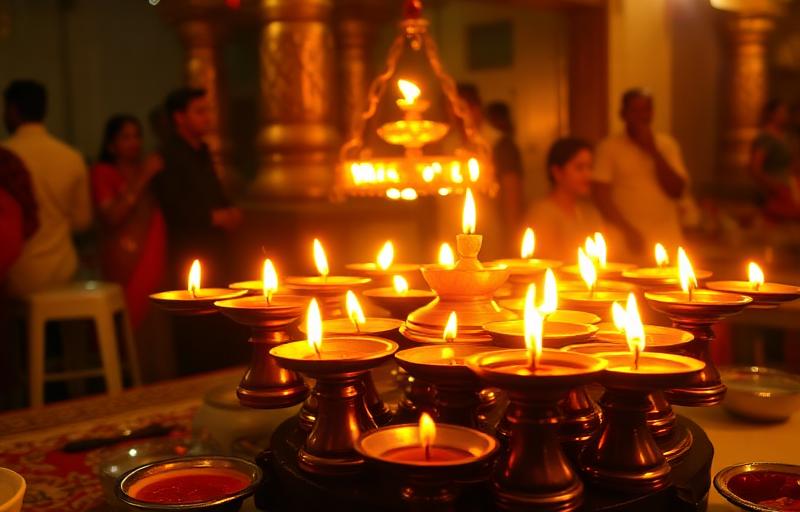
The Mahanadi carries a line of significant shrines along its course, and Dhabaleswar is one of them.
Along the river:
- Rajim in Chhattisgarh, at the confluence of the Mahanadi, Pairi and Sondur, with the Rajiv Lochan temple
- Sambalpur in western Odisha, with Samaleswari, the presiding Devi
- Huma, near Sambalpur, with its famously leaning Shiva temple
- Bhattarika at Baramba, on the river
- Dhabaleswar near Cuttack
- Cuttack itself, at the point where the river divides
- The delta, where the Mahanadi reaches the Bay of Bengal
What rivers do in Indian sacred geography is organise it. Shrines cluster along them, pilgrims move between them by the river route, and the river itself is a deity as well as a road.
The Mahanadi is central to Odisha in every sense. It waters the state's agriculture, it built the delta on which the coastal districts sit, it carried the trade that made Odisha a maritime power, and its floods have shaped the region's history repeatedly.
A temple on an island in that river is not incidental. It is a statement about where the state's life comes from.
Boita Bandana and the River
One Odia observance is worth explaining because it connects directly to river shrines like this one.
Boita Bandana, kept on Kartik Purnima:
- Small boats made of banana stem, paper or cork are set afloat on rivers, tanks and the sea at dawn
- Lamps and offerings are placed in them
- The words Aa Ka Ma Bai are chanted, understood as marking the months of the sailing season
- The observance commemorates the Sadhabas, the Odia merchant mariners who sailed to Southeast Asia
The historical background is real. Odisha, as Kalinga, was a maritime power with trade links across the Bay of Bengal to Java, Sumatra, Bali and Sri Lanka, and the cultural traces of that contact are visible across Southeast Asia today.
Bali Jatra at Cuttack, held on the banks of the Mahanadi at Kartik Purnima, is the large public festival that grew from the same memory, and it is one of the biggest fairs in eastern India.
For Dhabaleswar and the river temples, Kartik Purnima brings both the religious observance and this civic memory together, with families setting boats afloat within sight of the shrine.
It is one of the few festivals anywhere in India that commemorates commerce and seafaring rather than a deity's episode, and Odisha has kept it for centuries.
Visiting Dhabaleswar
Practical notes.
Getting there
- Dhabaleswar is on an island in the Mahanadi near Cuttack, in the Athagarh direction
- It is roughly 35 to 40 km from Cuttack by road, and about 70 km from Bhubaneswar
- Bhubaneswar airport and Cuttack Junction serve the region
- The island is reached by the hanging bridge, and boats also operate
When to go
- Mahashivratri, the greatest occasion, with night long worship and very large crowds
- Shravan Mondays
- Kartik Purnima, for Boita Bandana on the river
- Winter mornings for a quiet visit, which is when the island is most pleasant
At the temple
- Offerings are water, bel patra, dhatura, milk and flowers, available at the approach
- Dress modestly and remove footwear at the designated place
- The bridge can be crowded on festival days, and crossing is managed in phases
- Do not enter the river beyond the shallows, since the Mahanadi has currents and depth
Combining the visit
- Cuttack, with the Chandi temple, Barabati fort and the silver filigree market
- Bhubaneswar, with Lingaraj, Mukteswar, Rajarani and Hirapur
- Ratnagiri, Udayagiri and Lalitgiri, the Buddhist sites
- Puri and Konark, for a longer coastal circuit
A closing suggestion. Take the boat rather than the bridge if it is running. The temple was reached that way for most of its history, and arriving across water is a different thing from walking over it.
Reader Questions Answered
Where is the Dhabaleswar temple?+
On a small island in the Mahanadi near Cuttack in Odisha, in the Athagarh direction, roughly 35 to 40 km from Cuttack and about 70 km from Bhubaneswar. The island is reached by a hanging bridge, and boats also operate.
What is the katha of the temple?+
A cowherd noticed that one of his cows would go to a particular spot on the island and let down her milk on a stone. Investigating, a Shiva linga was found there, worship began, and the temple grew around it. The name is connected with dhabala, white, and with Shiva.
When is the temple busiest?+
Mahashivratri is the greatest occasion, with night long worship and very large crowds crossing to the island, followed by Shravan Mondays and Kartik Purnima. Winter mornings are quiet and are when the island is most pleasant.
What is Boita Bandana?+
An Odia observance on Kartik Purnima where small boats of banana stem, paper or cork are set afloat at dawn with lamps and offerings, commemorating the Sadhabas, the Odia merchant mariners who sailed to Southeast Asia. Bali Jatra at Cuttack grew from the same memory.
Can the island still be reached by boat?+
Yes. Boats still operate for those who prefer the crossing, though the hanging bridge is now the usual way. Before the bridge was built devotees crossed only by boat, and older residents of the area remember that arrangement.
Which other temples lie along the Mahanadi?+
Rajim in Chhattisgarh at the confluence with the Rajiv Lochan temple, Samaleswari at Sambalpur, the leaning Shiva temple at Huma, Bhattarika at Baramba, and Dhabaleswar near Cuttack, before the river reaches the delta.
About the author
Pandit Ravindra Sharma · Vedic Rituals & Bhakti, 22+ years
Pandit Ravindra is the Vandnaa editorial team's resident specialist on aarti, chalisa, and daily devotion. He has performed home and temple pujas across Varanasi and Delhi for over two decades and contributes the bhakti-focused articles on this site.
Meet the Vandnaa editorial team →Explore on Vandnaa
Related Articles

Cuttack Chandi: The Devi of a Silver City and Her Sixteen Day Durga Puja
8 min read
Rajiv Lochan of Rajim: The Vishnu Who Stands Where Three Rivers Meet
8 min read
Nilamadhava of Kantilo: The Blue Deity Who Was Worshipped Before Jagannath
8 min read

Dev Diwali / Kartik Purnima - Significance, Snan and Vidhi
9 min read