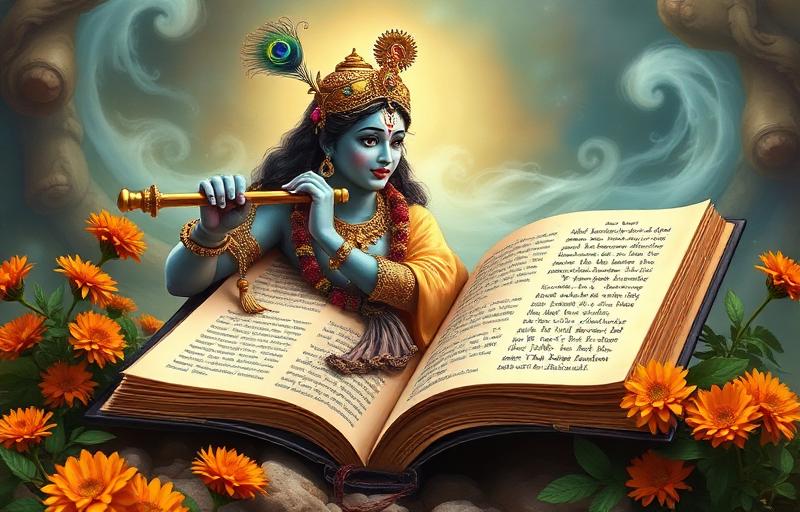
A Cut, a Strip of Cloth, and a Debt Krishna Chose to Remember
During Yudhishthira's Rajasuya Yajna, when Krishna kills the invited king Shishupala with the Sudarshana Chakra in front of the entire assembly, the discus, freshly loosed, grazes back across his own hand as it returns. Krishna's finger is cut and bleeding, in the middle of a hall full of kings, priests and attendants, none of whom react quickly enough.
Draupadi does. Without ceremony, without asking, she tears a strip from the end of her own sari and binds the wound herself. It is a small, unplanned, entirely physical act - the kind a person does before they have time to think about status or protocol.
Krishna notices what it cost her and what it cost her not at all. In popular devotional retellings, more than in the strict critical text, he tells her that he will not forget this, that a single strip of cloth, freely given, creates a debt he intends to repay a hundred times over, whenever she needs it.
Years pass. Draupadi is dragged into the assembly hall after the dice game, and Dushasana begins pulling at her sari to disrobe her before the entire court. The cloth will not end. However much is pulled away, more remains, until Dushasana simply cannot finish what he started and the attempt collapses into her rescue instead of her humiliation. Devotional tradition draws a direct line between the two scenes: the debt of one small strip of cloth, repaid at the exact moment repayment mattered most.
Devotional Elaboration More Than Strict Textual Sequence
A reader coming to this from the critical edition of the Mahabharata should know something the popular retelling usually skips: the causal link presented here, that the cloth-binding directly and explicitly causes the endless-cloth miracle years later, is a beloved elaboration of oral and regional tradition more than an explicit chain the Sanskrit text spells out in one place.
The Sabha Parva does narrate Krishna cutting his finger during the Shishupala episode, and it does narrate Draupadi's endless cloth during the Vastraharan as a miracle attributed to Krishna's grace. What varies between tellings is how tightly the text ties the two together as cause and effect - some retellings, especially in Bengali, Marathi and other regional devotional literature, make the connection central and explicit; the pan-Indian critical Sanskrit recension is more restrained, letting Krishna's protection appear as a general consequence of Draupadi's devotion and his own dharma rather than a specific transactional repayment.
This is worth saying plainly rather than glossing over, because it does not make the story less true in the way that matters to a devotee. Hagiography and devotional literature routinely draw threads between events that a purely historical reading treats as separate - and the emotional logic of a debt repaid, small kindness answered with limitless protection, is exactly the kind of connection a living tradition keeps making because it says something the strict chronology cannot say as well.
A Small Act Devotees Still Point To
Some communities loosely connect this episode to the spirit behind Raksha Bandhan, the festival in which a woman ties a protective thread on a brother's wrist in exchange for his vow of protection - not as the festival's textual origin, which lies elsewhere, but as a resonant devotional parallel: cloth or thread offered without calculation, met with a vow of protection that outlasts the moment it was made.
The episode is often cited in bhakti teaching as an example of nishkama seva - service or care given with no expectation of return - being precisely what draws the most extravagant divine response. Draupadi does not bind Krishna's finger hoping for future protection; she does it because a person she loves is bleeding in front of her. The theology built on top of that ordinary instinct is that grace notices what generosity does not calculate for itself.
It is also, structurally, one of the clearest illustrations in the epic of Krishna's own stated principle from elsewhere in the tradition - that he keeps account of even the smallest offering made with real feeling, more carefully than of grand ritual performed without it.
Quick Answers
Does the Mahabharata explicitly say Krishna promised to repay Draupadi for the cloth?+
The critical Sanskrit text narrates both events - the cut finger and the endless cloth - but does not spell out an explicit spoken promise connecting them as directly as popular retellings do. The connection is a widely loved devotional tradition rather than a single verse a reader can point to.
Why did no one else in the assembly help Krishna's bleeding finger before Draupadi?+
The assembly had just watched a king killed in front of them; the retellings suggest everyone else was frozen by the shock of the moment, while Draupadi, seated close by, reacted on instinct rather than protocol.
Is this the same episode as the famous Vastraharan or Cheer Haran scene?+
No - this is the earlier, smaller episode at the Rajasuya Yajna. The Vastraharan is the later dice-hall scene it is devotionally connected to, and that later scene has its own separate telling elsewhere on this site.
About the author
Pandit Ravindra Sharma · Vedic Rituals & Bhakti, 22+ years
Pandit Ravindra is the Vandnaa editorial team's resident specialist on aarti, chalisa, and daily devotion. He has performed home and temple pujas across Varanasi and Delhi for over two decades and contributes the bhakti-focused articles on this site.
Meet the Vandnaa editorial team →