Giriraj Ji - The Hill That Is Krishna Himself
Govardhan, lovingly called Giriraj ji - the king of mountains - is no ordinary hill. The Bhagavata Purana tells how the young Krishna persuaded the Brajwasis to worship Govardhan instead of Indra, and when the humiliated rain-god unleashed seven days of torrential storms, Krishna lifted the entire hill on the little finger of His left hand, sheltering every villager and cow beneath it. From that day, Govardhan and Krishna became inseparable - the tradition is emphatic that Giriraj ji is not merely Krishna's favourite hill but His very swaroop, a form of the Lord Himself. This is why devotees do not climb the hill; they walk around it. Stretching about 8 km through the Braj countryside near Mathura, its sacred stones, kunds and groves are woven with leela memories. Our separate Govardhan Puja article covers the festival story in depth; this guide is for the parikrama - the walk of love around the Lord.
The 21 km Parikrama Route - What the Walk Looks Like
The full Govardhan Parikrama is a roughly 21 km circuit around Giriraj ji, traditionally walked clockwise so the hill always remains on your right. Most pilgrims begin near Mansi Ganga in Govardhan town or at Daan Ghati, though Radha Kund and Jatipura are also common starting points - what matters is completing the full circle back to where you began. The path is largely flat and paved, passing through the villages of Anyor, Jatipura, Poonchhri ka Lautha and Radha Kund, with temples, kunds and resting spots along the way. A steady walker completes it in about 5 to 7 hours; with darshans and rest, many take longer, and that is perfectly fine - this is japa on foot, not a race. Devotees keep the divine name going throughout: 'Radhe Radhe', 'Shri Radhe Shyam' or their own japa. On full-moon nights the path glows with lamps and an unbroken river of walkers.
Mansi Ganga, Daan Ghati and the Mukharvind
Three spots anchor the Govardhan town stretch of the parikrama. Mansi Ganga is the sacred lake that tradition says Krishna manifested from His own mind (man) so the Brajwasis would not need to travel to the distant Ganga; a snan or simple achaman here traditionally begins the parikrama, and on Diwali evening, deepdaan turns its waters into a bowl of floating flames. A short walk away is Daan Ghati, the pass where Krishna playfully demanded daan - a toll of butter and curd - from Radha Rani and the gopis carrying their pots; today its temple sits right on the parikrama road and is among the busiest darshans of Giriraj ji. At Jatipura, pilgrims gather before the Mukharvind, the revered 'lotus face' shila of Govardhan, where milk abhishek is offered in a continuous, glistening stream. Watching simple villagers and far-travelled pilgrims pour milk side by side captures the spirit of Govardhan perfectly.
Radha Kund and Shyam Kund - The Holiest Waters of Braj
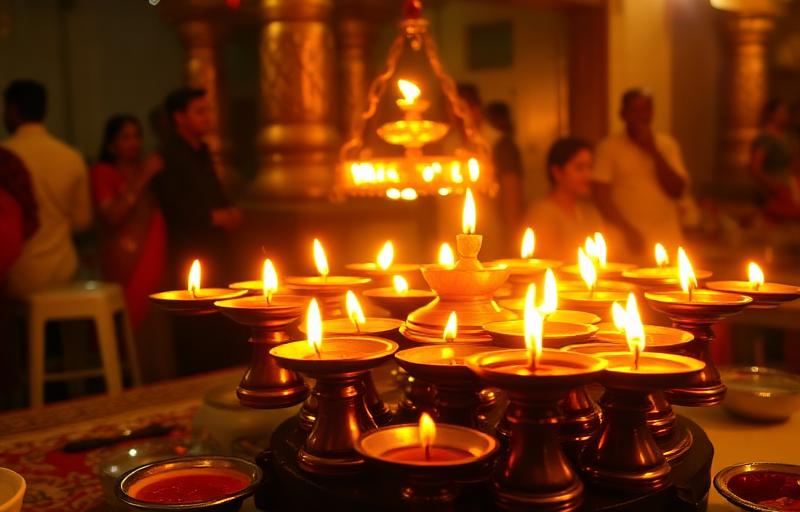
On the northern arc of the parikrama lie two adjoining kunds that Gaudiya tradition reveres above every other tirtha: Radha Kund and Shyam Kund. The story goes that after Krishna slew the bull demon Arishtasura, Radha Rani teasingly reminded Him that killing a bull - even a demon in bull form - required purification by bathing in all the holy rivers. Krishna struck His heel into the earth, summoned every sacred river into the pool that became Shyam Kund, and bathed. Not to be outdone, Radha and the gopis dug their own kund with their bangles, which Krishna lovingly filled - Radha Kund, considered the very embodiment of Radha Rani's prema. The midnight snan here on Ahoi Ashtami draws lakhs, particularly couples praying for children, and Bahulashtami marks the kund's appearance day. Even on quiet days, sit a while on the steps; sevayats say no place in Braj holds sweeter stillness.
Parikrama Rules and Traditions Every Pilgrim Should Know
The parikrama has its own gentle discipline, shaped by centuries of devotion: 1. Walk barefoot if you can. Since Giriraj ji is the Lord's swaroop, the entire path is treated as His body; barefoot walking is the honoured tradition, though those with health concerns may use simple footwear without guilt. 2. No shortcuts. The circle must be complete - crossing over the hill or trimming the route breaks the parikrama's meaning. 3. Never take Govardhan shilas home. The stones belong to Giriraj ji; tradition firmly discourages removing them as souvenirs. 4. Keep the hill on your right and walk clockwise, ideally completing the parikrama in one continuous effort. 5. Avoid leather items, keep the path clean, and maintain japa or kirtan rather than idle chatter. 6. Offer respect at kunds and temples along the way, and give way kindly to dandavat pilgrims. None of this is policed - it is maryada, the loving etiquette of walking around the Lord.
The Dandavat Parikrama - Devotion Measured in Body Lengths
Along the route you will see devotees performing the dandavat parikrama - circling Giriraj ji not by steps but by full-body prostrations. The pilgrim lies flat in dandavat pranam, marks the point reached by their fingertips with a stone or shila, rises, moves to that mark, and prostrates again - thousands upon thousands of times around the entire 21 km. Done steadily, it takes weeks; some sadhakas perform 108 prostrations at each spot before advancing, a sadhana that can stretch across months or even years. It begins with a sankalp (vow) and is usually undertaken under the guidance of a guru or seasoned Braj sevayat. Most pilgrims will never attempt it, and that is fine - simply watching this devotion humbles the heart. If you pass dandavat pilgrims, give them space, never step over their marker stones, and offer a quiet 'Radhe Radhe' of respect.
Best Days for Parikrama and How to Reach Govardhan
Parikrama may be done on any day, but some days carry special glory. Every Purnima (full moon) draws large crowds for moonlit walking, with Guru Purnima - the Mudiya Poono mela - the single biggest occasion, when lakhs circle Giriraj ji over a few days. Ekadashi days, Govardhan Puja (the day after Diwali, when annakut mountains of food are offered), and the entire month of Kartik are also cherished. For comfort, October to March offers the kindest weather; in summer, walk at dawn or after sunset and carry water. Govardhan town lies about 25 km from Mathura, reachable by taxi, bus or auto; Mathura Junction is the nearest major railhead, and Delhi (about 150 km) the nearest big airport hub. E-rickshaws ply sections of the route for elderly pilgrims who cannot walk the whole way. Keep meals light and sattvik, rest at the kunds, and let 'Radhe Radhe' set your rhythm - check official local sources for mela-day arrangements.
Frequently Asked Questions
How long does the Govardhan Parikrama take?+
The full 21 km circuit takes about 5 to 7 hours at a steady walking pace. With darshans at Daan Ghati, Mukharvind, Radha Kund and rest stops, many devotees take 8 to 10 hours. There is no prescribed speed - completing the circle with devotion matters more than how fast you walk.
Can the parikrama be done in parts over two days?+
The honoured tradition is to complete it in one continuous effort. However, elderly devotees and those with health limitations do split it, resuming from exactly where they stopped. The bhav of completion matters most; if splitting, take guidance from local sevayats on the customary way to pause and resume.
Is the Govardhan Parikrama done barefoot?+
Barefoot walking is the cherished tradition, since the path encircles what devotees revere as the Lord's own form. It is not a forced rule - pilgrims with diabetes, foot conditions or other health concerns may wear simple non-leather footwear. In summer, barefoot walkers should go at dawn or evening when the path is cooler.
What is the dandavat parikrama?+
It is the parikrama performed through continuous full-body prostrations instead of walking. The devotee prostrates, marks the spot their fingertips reached, moves to it and prostrates again, all around the 21 km. It takes weeks or months, begins with a sankalp, and is usually done under a guru's guidance. Most pilgrims simply offer it their respect.
Which days are most auspicious for the parikrama?+
Purnima (full moon) days, Ekadashi, Guru Purnima's Mudiya Poono mela, Govardhan Puja after Diwali and the whole of Kartik month are the most celebrated. These days bring lakhs of pilgrims, so for a quieter walk choose an ordinary weekday and begin at dawn. Any day walked with devotion is auspicious.
Can I take a Govardhan shila home as a memento?+
No. Tradition firmly holds that the shilas of Giriraj ji belong to the hill and should not be picked up as souvenirs. Authentic Giriraj seva at home is undertaken only with proper sanction and guidance within a tradition. The right memento from Govardhan is the japa carried in your heart, plus prasad from Daan Ghati.
About the author
Pandit Ravindra Sharma · Vedic Rituals & Bhakti, 22+ years
Pandit Ravindra is the Vandnaa editorial team's resident specialist on aarti, chalisa, and daily devotion. He has performed home and temple pujas across Varanasi and Delhi for over two decades and contributes the bhakti-focused articles on this site.
Meet the Vandnaa editorial team →