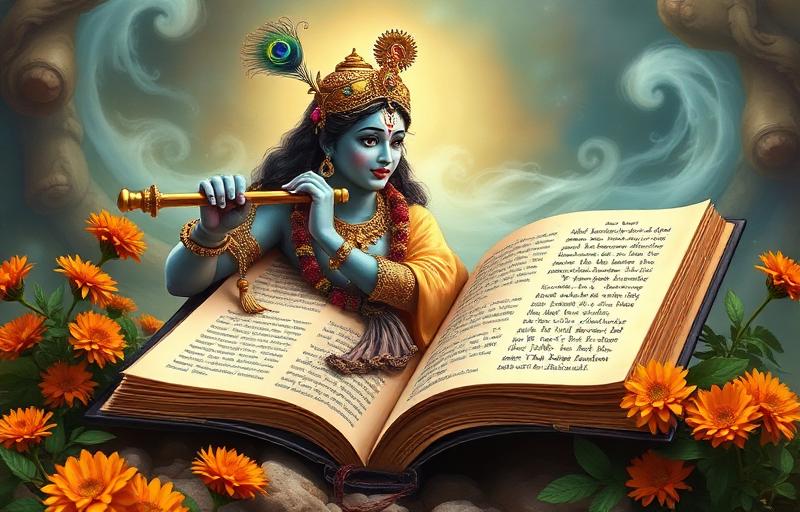
The Creator's Own Doubt
The Bhagavata Purana's eleventh canto tells of a moment early in the cosmic cycle when Brahma, tasked with the entire work of creation, found himself genuinely unable to answer a basic question about his own nature and origin: what he was, where his own knowledge came from, and how a being tasked with creating everything could be so uncertain about the ground he stood on.
This is not presented as a minor lapse. Brahma is the creator, the source in ordinary cosmology of the Vedas themselves, and the text's willingness to show him stuck on a first-principles question sets up exactly how serious the answer needs to be.
Brahma performed tapas seeking clarity, and Vishnu, in response, appeared before him not in a four-armed form or as a reclining figure on Shesha, but as Hamsa, a swan of extraordinary radiance and stillness, gliding on the causal waters.
The choice of a swan carries its own layered meaning in Indian thought quite apart from this story: the hamsa is traditionally credited with the mythical ability to separate milk from water when the two are mixed, which later Vedantic writing uses repeatedly as an image for discrimination, viveka, the capacity to separate the real from the apparent. Vishnu arriving in exactly that form to answer a question about the real and the apparent is not incidental.
The Hamsa Gita
What follows is known in the tradition as the Hamsa Gita, a compact but dense teaching in which Vishnu, as the swan, explains to Brahma the nature of the self, its relationship to the body and senses, and the difference between the eternal witness and the temporary forms it inhabits.
The core of the teaching is that confusion about one's own nature arises from identifying the self with what is actually only its covering: the body, the mind, the accumulated impressions of past experience, all of which change and dissolve, none of which is what actually observes those changes.
Brahma's own confusion, in this framing, was not a special failure but the standard condition of any being who has not yet made this discrimination, regardless of how vast that being's other powers might be. Even the creator of the universe needed to be shown the difference between what creates and what merely appears to be created.
Having received the teaching, Brahma is able to proceed with the work of creation with a settled understanding of his own place within it, rather than the earlier confusion, and the text presents this as the necessary first step before any of the subsequent cosmology described elsewhere in the Puranas could properly begin.
Why a Minor Avatar Still Gets Named
Hamsa is counted among Vishnu's lesser-known avatars, rarely given temples of his own and absent from the popular Dashavatara lists most households recite, which typically run from Matsya through Kalki without pausing for this one.
But the teaching attributed to this form survives independently of the narrative, cited in later Vedantic literature as an early, authoritative statement of the distinction between the seer and the seen, and the term paramahamsa, the supreme swan, becomes in later Hindu monastic tradition an honorific for a renunciate who has achieved exactly the discrimination this story describes Brahma finally receiving.
A sannyasi given the title Paramahamsa, a designation still used today for the most advanced order of Vedantic monks, is being named, whether the recipient thinks of it this way or not, after this exact story: someone credited with the same capacity Vishnu demonstrated by becoming a swan on the causal waters at the very start of things.
Quick Answers
What is the Hamsa avatar of Vishnu?+
Hamsa is a lesser-known avatar in which Vishnu appeared as a swan to teach Brahma, who was confused about his own origin and nature, before the full work of creation could properly proceed.
What is the Hamsa Gita?+
The teaching Vishnu, as Hamsa, gave Brahma, found in the Bhagavata Purana's eleventh canto, distinguishing the eternal self from the body, mind and senses it temporarily inhabits.
Why are Vedantic monks called Paramahamsa?+
The title honours a renunciate who has achieved the same discrimination between the real and the apparent that this story attributes to Vishnu's swan form - the hamsa traditionally symbolising the ability to separate the true from the illusory.
About the author
Anjali Mehta · Editor, M.A. Religious Studies
Anjali is the managing editor for Vandnaa and oversees the festival and vrat coverage. She holds an M.A. in Religious Studies and reviews every published article for accuracy, accessibility, and tradition-fidelity.
Meet the Vandnaa editorial team →