Janmashtami 2026 Date & Nishita Muhurat
Krishna Janmashtami is celebrated on the Ashtami (8th day) of Krishna Paksha in Bhadrapada month. In 2026, it falls on Friday, 4 September 2026.
Nishita Puja Muhurat (the most important time): Approximately 11:57 PM on 4 September – 12:43 AM on 5 September 2026 (about 46 minutes around midnight).
This is the EXACT moment Krishna was born - under Rohini nakshatra, at midnight, when Vasudev carried him across the flooded Yamuna from the Mathura prison.
Vrat Parana (breaking the fast): After 5:30 AM on 5 September 2026, once Ashtami tithi and Rohini nakshatra both end.
Smarta sampradaya (most households) celebrate on 4 September. Vaishnav sampradaya (ISKCON, Pushtimarg) usually celebrates one day later. Both are correct - follow your family tradition.
Complete Janmashtami Midnight Puja Vidhi at Home
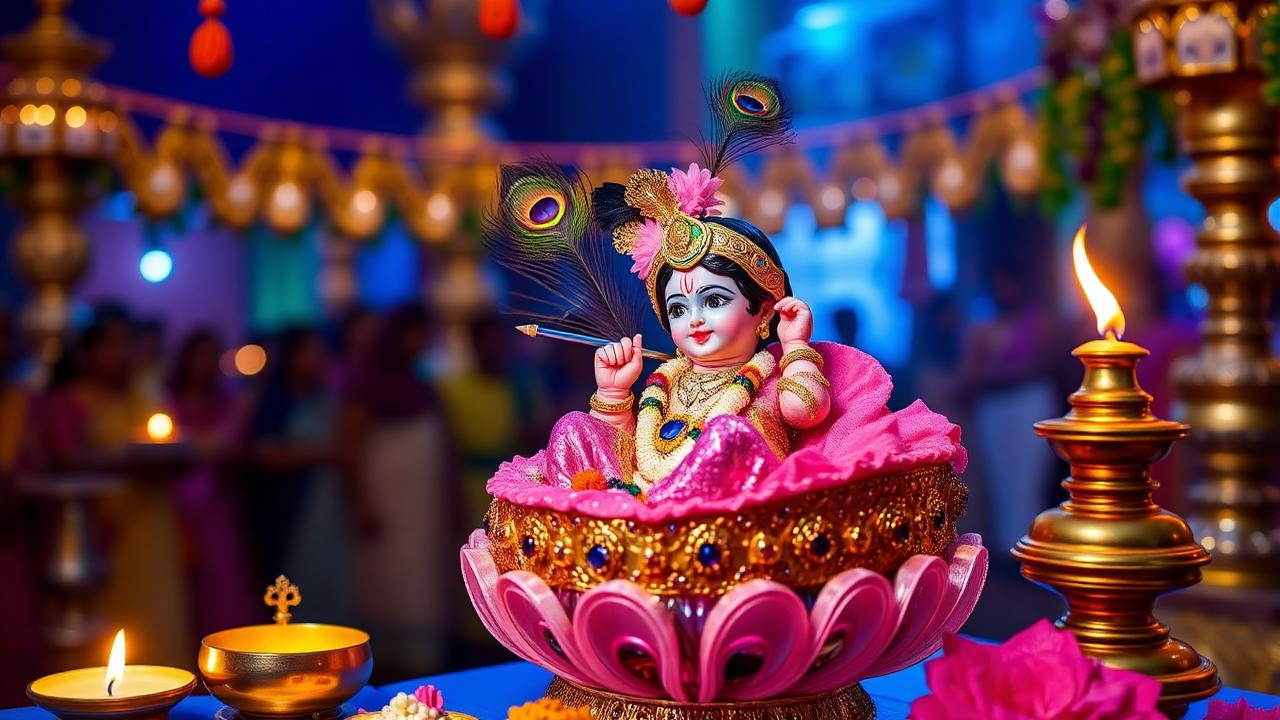
Day preparation: Clean the home, especially the puja area. Decorate the temple with flowers, colourful drapes, peacock feathers, and bansuri (flute). Set up a small jhula (cradle) for Bal Krishna.
Vrat: Begin morning Sankalp. Eat only fruits, milk, and phalahari food. No grains, salt, onion, garlic.
11:30 PM (preparation for Nishita puja): Bathe again, wear yellow or blue clothes (Krishna's favourite colours).
At midnight (12:00 AM exactly):
Step 1: Place Bal Krishna's idol/photo in a small clean tray.
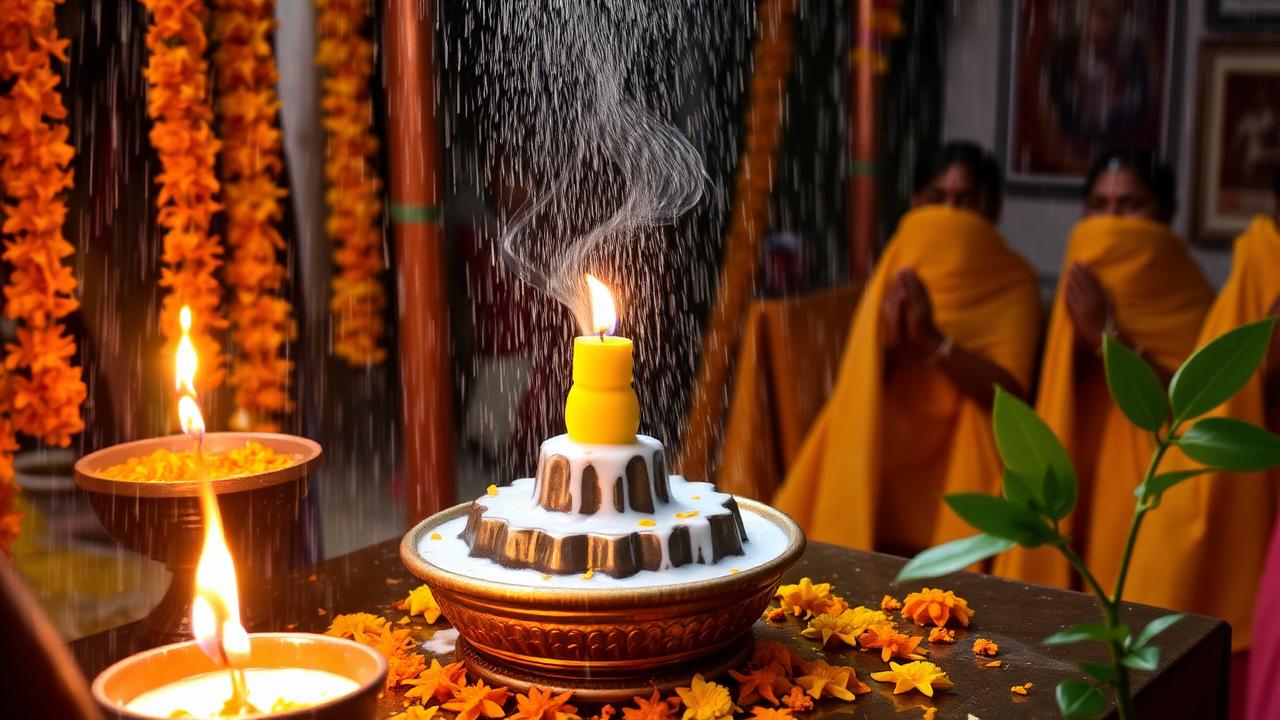
Step 2: Perform abhishek in this order - Panchamrit (milk + curd + ghee + honey + sugar mixed), then pure water, then Gangajal. Wipe gently and place in the cradle.
Step 3: Dress Krishna in new yellow/blue clothes, place a tiny crown, peacock feather, bansuri, and butter (makhan) in his hand.
Step 4: Apply chandan tilak. Offer tulsi leaves (essential - Krishna does not accept any bhog without tulsi), yellow flowers, and garland.
Step 5: Offer 56 bhog (chappan bhog) - at minimum: makhan-mishri (butter + sugar), panjiri, kheer, fruits, sweets, dhaniya panjiri (special Janmashtami prasad), and milk.
Step 6: Light diya, dhoop, and ring the bell. Sing 'Nand ke Ghar Anand Bhayo, Jai Kanhaiya Lal Ki' and rock the cradle gently.
Step 7: Read Bhagavad Gita Chapter 10 (Vibhuti Yog) or the Krishna Janma chapter from Bhagavatam Skand 10.
Step 8: Distribute prasad to all family members. Break vrat next morning after sunrise.
7 Most Powerful Krishna Mantras for Janmashtami
1. Hare Krishna Mahamantra (108 × 16 = 1,728 times for full effect): 'Hare Krishna Hare Krishna, Krishna Krishna Hare Hare / Hare Rama Hare Rama, Rama Rama Hare Hare.' The Yuga Mantra of Kali Yuga - the single mantra that grants liberation today.
2. Krishna Beej Mantra (108 times): 'Om Kleem Krishnaya Namah.' For love, attraction, marriage, and removal of relationship blocks.
3. Vasudev Mantra - Krishna's father's name (108 times): 'Om Namo Bhagavate Vasudevaya.' The 12-syllable mantra of Krishna - for moksha and total surrender.
4. Govinda Mantra (108 times): 'Om Shri Krishna Govindaya Gopijana Vallabhaya Namah.'
5. For children & family bliss (108 times): 'Om Devakinandanaya Vidmahe Vasudevaya Dhimahi, Tanno Krishna Prachodayat.' (Krishna Gayatri)
6. For wealth & abundance (108 times): 'Om Kleem Krishnaya Govindaya Gopijanavallabhaya Swaha.'
7. Most simple mantra for those who cannot remember Sanskrit: 'Radhe Radhe' - chant continuously. Krishna himself said this name is dearer to him than his own.
Janmashtami Vrat Rules & What to Eat

Janmashtami vrat is one of the strictest fasts - comparable to Nirjala Ekadashi in merit. There are 3 levels:
Level 1 - Nirjala (without water): From sunrise on 4 September till after midnight Krishna puja. Only attempt if healthy.
Level 2 - Phalahari (most common): Only fruits, milk, water, dry fruits, lassi, coconut water through the day. After midnight puja, prasad only.
Level 3 - Sattvik vrat (for elderly/children/ill): One sattvik meal of phalahari food (sabudana khichdi, kuttu paratha, singhara halwa, makhana kheer, fruits) once during the day.
Allowed: Sabudana, kuttu (buckwheat), singhara, makhana, sendha namak, ghee, milk, curd, paneer, all fruits, dry fruits, peanuts, potato, sweet potato, ginger, green chilli, lemon, coriander leaves.
Forbidden: All grains (wheat, rice, dal), regular salt, onion, garlic, oil (use only ghee), turmeric in food, mustard, fenugreek, asafoetida, alcohol, non-veg.
Parana (breaking fast): After 5 September sunrise, take Krishna's prasad first (panchamrit + bhog), then have a sattvik meal. Do NOT break fast with non-veg, alcohol, or heavy fried food on the same day.
7 Most Powerful Krishna Mantras to Chant on Janmashtami
Mantras chanted on Janmashtami carry 1,000× their usual power - because the astral presence of Krishna himself is strongest at this time:
1. Maha Mantra (most sacred of all): हरे कृष्ण हरे कृष्ण कृष्ण कृष्ण हरे हरे। हरे राम हरे राम राम राम हरे हरे॥ Chant 108 times on a Tulsi mala. This is the one mantra that removes all past karma in Kali Yuga - confirmed in Kali Santarana Upanishad.
2. Krishna Beej Mantra: ॐ क्लीं कृष्णाय नमः॥ - 108 times daily for love, relationships, and abundance.
3. Govinda Mantra (for joy and liberation): ॐ श्री कृष्णः शरणं मम॥ - Surrender mantra. The most direct path to Krishna's grace.
4. Krishna Gayatri: ॐ देवकीनन्दनाय विद्महे। वासुदेवाय धीमहि। तन्नो कृष्णः प्रचोदयात्॥
5. For removing enemies and obstacles: ॐ नमो भगवते वासुदेवाय॥ - The Dvadasakshari (12-syllable) mantra of Vishnu-Krishna. Chant 108 times.
6. For attracting love (partner, family harmony): ॐ क्लीं गोपालाय नमः॥
7. For moksha (liberation): 'श्री कृष्ण गोविन्द हरे मुरारे। हे नाथ नारायण वासुदेवे॥' - The death-bed mantra. Chanting this at the moment of death, or at a dying person's bedside, is said to liberate the soul directly.
Janmashtami special count: On Janmashtami night, during Nishita Muhurat (midnight), try to complete 1,008 rounds of the Maha Mantra on your Tulsi mala - that is exactly 10 malas of 108.
🙏 Vandnaa App has all 7 Krishna mantras in audio - with a mala counter, so you can track your 1,008-count on Janmashtami night.
Krishna's 8 Most Significant Leelas and Their Inner Meaning
Krishna's life is not biography - it is scripture. Every event carries multiple layers of meaning:
1. Prison birth: Born in a prison, in chains, at midnight. Meaning: The divine is born even in the most confined, darkest circumstances. Your worst moment may be your awakening.
2. The Yamuna crossing: Vasudev carrying baby Krishna through a flooded Yamuna - the river parting for them. Meaning: When you carry the divine in your heart, every obstacle parts before you.
3. Kaliya Naga dancing: Krishna dancing on Kaliya's hoods without fear. Meaning: The master does not destroy the toxic - he tames it through joy, not violence.
4. Lifting Govardhan Hill: Krishna lifting an entire mountain on one finger to shelter his people from Indra's floods. Meaning: Dharmic duty (protecting one's community) is always stronger than institutional power (Indra's authority).
5. The Bhagavad Gita: Delivered between two armies, to a broken warrior, in 18 chapters. Meaning: The greatest wisdom is given in the moment of crisis - not in peaceful retreats.
6. Sudama and Krishna: The childhood friend who came with only a handful of beaten rice, too embarrassed to ask for anything - and received everything. Meaning: Pure friendship and love are received exactly as they are given.
7. Rukmini's swayamvar: Rukmini wrote to Krishna asking him to come for her - and he did. Meaning: The devotee who reaches out completely to Krishna is always answered.
8. Mahabali and the cosmic game: Krishna orchestrated the entire Mahabharata not to 'win' a war but to restore dharma. Meaning: The divine is not concerned with your comfort - it is concerned with your evolution.
On Janmashtami, meditate on which of these leelas speaks most directly to your current life situation - because that is the teaching Krishna is giving you today.
Dahi Handi and Nandotsav - What Happens the Day After Janmashtami
Janmashtami is a two-day celebration. The festivities continue into Nandotsav:
Nandotsav (5 September 2026): The day after Janmashtami is Nandotsav - the celebration of Nanda Baba (Krishna's foster father) and the entire Gokul village celebrating the birth. In this festival:
- Sweets and curd are distributed freely to everyone
- Bhajans and kirtan continue throughout the day
- Gopastami (celebration of cowherds) is observed - cows are worshipped and fed specially
Dahi Handi (Maharashtra, Gujarat): Dahi Handi - the 'pot of curd' - recreates Krishna's childhood mischief of breaking clay pots of butter. Young men (Govindas) form human pyramids to break a pot of curd and buttermilk suspended high above the street. The tradition dates back to Peshwa era (18th century) and is now a state-sponsored festival in Maharashtra.
The Dahi Handi in 2026 falls on 5 September 2026 (Nandotsav).
How to celebrate at home:
- Hang a small earthen pot filled with curd, butter, and milk mixed, at a height in the house
- Children can try to break it with a soft stick (playful recreation)
- The prasad (curd and butter) is distributed to all family members
- This is one of the most joyful domestic rituals - deeply loved by children
Krishna's favourites to offer on both days:
- Makhan (fresh white butter)
- Mishri (sugar crystals)
- Panchamrit
- Tulsi leaves
- Yellow marigold flowers
- Bansuri (flute) decoration near his idol
🙏 Vandnaa App has the complete Nandotsav bhajans and Dahi Handi celebrations playlist - available offline.
Bhagavad Gita: 5 Core Teachings Krishna Wants You to Live By
The Bhagavad Gita was spoken on a battlefield - not in a meditation hall. It is a guide for action, not escape. Here are the 5 teachings most relevant to modern life:
1. Nishkama Karma (Chapter 3): 'कर्मण्येवाधिकारस्ते मा फलेषु कदाचन।' 'You have the right to action only - never to its fruits.' This is not fatalism. It is the greatest performance principle: focus 100% on the process, remove anxiety about the outcome. Every modern peak performance researcher - from flow state researchers to sports psychologists - validates this principle.
2. The Eternal Self (Chapter 2): 'न जायते म्रियते वा कदाचिन्।' 'The soul is never born and never dies.' If you understand this - truly - then fear of death diminishes, fear of loss diminishes, fear of failure diminishes. You are not the body. You are the witness. Whatever happens to the body or the mind, your true nature is untouched.
3. Equanimity (Chapter 6): 'समः शत्रौ च मित्रे च तथा मानापमानयोः।' The Gita calls for Samatvam - equal-mindedness in success and failure, honor and insult, heat and cold. This is not emotional flatness - it is stability. The tree bends in wind but its roots hold.
4. Devotion (Chapter 9): 'पत्रं पुष्पं फलं तोयं यो मे भक्त्या प्रयच्छति।' 'Whoever offers me a leaf, flower, fruit, or water with devotion - I accept it.' God accepts the size of your heart, not the size of your offering. Your sincerity is the temple.
5. Complete Surrender (Chapter 18): 'सर्वधर्मान्परित्यज्य मामेकं शरणं व्रज।' 'Abandon all religious duties and surrender to me alone.' This is the last teaching - and the hardest. Not abandoning dharma, but placing yourself so completely in God's hands that even the duty to choose is released.
How to start with the Gita today: Pick ONE shloka - any of the 5 above. Write it down. Reflect on one situation in your life where this teaching applies. That is the Gita practice.
🙏 Vandnaa App has the complete Bhagavad Gita in audio - chapter by chapter, with meaning - free to stream or download.
Reader Questions Answered
Why is Janmashtami celebrated at midnight and not in the morning?+
Lord Krishna was born exactly at midnight (Nishita kaal) under Rohini nakshatra in the prison of Kansa in Mathura, while his father Vasudev simultaneously carried him across the flooded Yamuna to safety in Gokul. The midnight puja recreates that exact divine moment. Worshipping at the same hour Krishna took birth multiplies devotional merit infinitely. This is why Janmashtami is the only major festival celebrated at midnight.
Can I do Janmashtami puja if I cannot stay awake till midnight?+
Yes - Krishna is the most forgiving deity. Do a complete puja in the Pradosh kaal (evening 6:30–8:30 PM) with the same vidhi, offer bhog, ring the bell as if welcoming his birth, and chant the Hare Krishna mantra 108 times before sleeping. Set an alarm to wake at midnight just for 2 minutes - light one diya, ring the bell once, say 'Jai Shri Krishna' and sleep again. The intent matters more than the duration.
What is Dahi Handi and is it part of Janmashtami?+
Dahi Handi is celebrated on the day AFTER Janmashtami (5 September 2026 in 2026), called Nandotsav or Gokulashtami. It re-enacts young Krishna's makhan-chori - boys form human pyramids (Govindas) to break a clay pot of curd and butter hung high above the streets, especially in Maharashtra. It is celebratory, not part of the strict Janmashtami vrat. You can watch and enjoy after breaking your vrat in the morning.
About the author
Acharya Vinaya Kapoor · M.A. Sanskrit, Mantra & Stotra Studies
Acharya Vinaya holds an M.A. in Sanskrit from Banaras Hindu University and writes the mantra and stotra commentary on Vandnaa. Her focus is on accurate pronunciation, traditional context, and helping modern readers connect with classical texts.
Meet the Vandnaa editorial team →