What He Did
Kannappa Nayanar is among the sixty three, and he is the one every account of the Nayanars ends up telling.
Who he was:
- Born Thinnan, son of Nagan, the chief of a hunting community
- At Uduppur, in the forest country near what is now Sri Kalahasti in Chittoor district, Andhra Pradesh
- A hunter by occupation and by community
- He could not read, had no knowledge of ritual, and had never been in a temple
How he found the linga:
- He was hunting on the hill at Kalahasti with companions
- He came upon a linga on the hill, the deity called Kudumitheva
- He was, in the tradition's word, overwhelmed
- He would not leave
- He sent his companions away and stayed
How he worshipped. This is the substance of the story, and every detail is wrong by the standards of the shastra.
Water: he had no vessel. So he carried water from the stream in his mouth and sprayed it over the linga.
Flowers: he had no basket. So he gathered flowers and stuck them in his hair, and took them out and put them on the linga.
Food: he had no cooked offering. So he hunted, cooked the meat, tasted it himself first to make sure it was good, and offered what was best.
Approach: he came in his shoes, and used one foot to clear the old offerings off the linga.
By the book, every one of those is a serious violation:
- Water from the mouth is ucchishta, already tasted and therefore polluted
- Flowers from the hair are the same
- Meat is not offered
- Tasting an offering before giving it disqualifies it entirely
- Footwear in the presence of the deity is a gross violation
- Using the foot on the linga is unthinkable
And he did all of it, every day, for six days.
The priest. Sivagochariar, a brahmana who performed the daily worship at the linga.
- He came each morning and found the linga covered in meat, with water and flowers scattered
- He was distressed and cleaned it thoroughly and performed the proper worship
- The next morning it was the same
- He prayed to Shiva about it
What Shiva told him:
- To hide and watch
- That what he was calling defilement was something he did not yet understand
So on the sixth day the priest hid behind the linga and watched.
The Eye
What happened on the sixth day.
- Thinnan came, as usual, with water in his mouth, flowers in his hair and cooked meat
- And blood was flowing from one eye of the linga
- He stopped
- He tried everything he knew: herbs from the forest, the treatments a hunter would use on a wound
- Nothing stopped the bleeding
And then he worked it out:
- The remedy for an eye is an eye
- He took an arrow, took out his own eye, and applied it to the linga
- The bleeding stopped
And then the other eye began to bleed.
- He was, by then, blind in one eye
- If he took out the second, he would not be able to see to place it
- So he set his foot on the linga's second eye, to mark the spot, so that he could find it after he was blind
- And he raised the arrow to his remaining eye
And Shiva stopped him:
- A hand came out of the linga and held his
- And the voice said: Kannappa
Kannappa. Kan is eye. Appa is the one who gave, or fixed, or applied.
The one who gave his eye. That is the name, and it is the only name he has.
What the priest saw. He was hiding behind the linga throughout.
He watched the whole thing, understood what he had been calling defilement, and the tradition holds that he was shown this precisely so that he would understand.
Why this story is the one everybody tells. Because of what it does to the rules.
Every element of Kannappa's worship is a ritual violation, and the tradition's own most authoritative telling, the Periya Puranam, describes each violation in detail rather than glossing over it.
And then it has the deity prefer it.
The doctrinal point. It is stated across Indian traditions and this is its sharpest illustration.
- Bhava over vidhi: the interior state over the procedural rule
- The offering is what the offerer is, not what is in the hand
- The rules exist to produce a state; where the state is present the rules have done their work and are not required
How the tradition avoided the obvious problem. It is worth noticing, because a doctrine like that could dissolve all ritual.
It did not, and the reason is that the tradition treats Kannappa as an exception justified by his condition, not as a licence.
He did not know the rules. He had never been taught. He had nothing else to offer. And what he did offer, his eye, was the most he had.
A person who does know the rules and disregards them is not in Kannappa's position. That is the distinction the tradition draws and it is a reasonable one.
Shankara's verse. Adi Shankara, in the Shivananda Lahari, refers to Kannappa directly, and the reference is often quoted.
He writes, in substance, that where devotion is present, meat is fit food, water from the mouth is fit water, and a hunter is the fit devotee; and asks what the Lord will not accept from one who is genuinely his.
That an Advaita acharya writing formal Sanskrit stotra should cite an illiterate forest hunter as the standard is the tradition making its own point about itself.
What the Story Argues
This story does specific work in the tradition and it is worth setting out what it does and does not establish.
One. Ritual competence is not the qualification.
Kannappa knew nothing. No mantras, no procedure, no scripture. He had never seen worship performed.
And the tradition places him among the sixty three and, in the general estimation, at the top of them.
Two. The offering is the offerer.
He gave water from his mouth because he had no vessel, flowers from his hair because he had no basket, and meat because that is what he had.
And he tasted the meat first, which by the rules ruins it entirely, because he wanted to make sure the Lord got the good part.
The tradition reads that as the highest act in the sequence: he was treating the deity the way he would treat somebody he loved and was feeding.
Three. Community is not the qualification either.
He was a hunter, from a forest community, doing what would have been regarded as a polluting occupation, and the tradition places him above the brahmana priest who was doing everything correctly.
The priest is not condemned. He is shown, which is a different thing, and the tradition treats his understanding as the point of the episode.
Four. And the limits of the reading.
This is where care is needed, because the story is sometimes used to argue against ritual altogether.
What the tradition actually holds:
- Kannappa did not know the rules. A person who knows them and discards them is not in his position
- The rules are not arbitrary; they exist to produce and sustain a state
- Most people are not in a state of overwhelming absorption and the rules are what carries them
- The story is about the sufficiency of devotion, not the worthlessness of form
Five. On meat offering specifically.
Since the story involves it, it should be addressed plainly.
- Meat offering to deities exists in many living Indian traditions, particularly to village deities and in Shakta practice, described in earlier entries in this series
- It is not offered in the great majority of temple worship, and mainstream Shaiva and Vaishnava temple practice is vegetarian
- Kannappa's meat offering is presented as exceptional, arising from his ignorance and his circumstances
- The story is not an argument that meat should be offered generally, and no tradition reads it that way
Six. On the eye.
The self mutilation in the story requires a clear statement.
What it is: a hagiographic account of an extreme act of devotion, told to illustrate a doctrinal point about the sufficiency of what is genuinely given.
What it is not: a model, an instruction, or a suggestion that harm to your own body has religious value.
No Indian tradition asks a person to injure themselves, and the story itself has Shiva stop him before the second eye. The stopping is part of the story, and it is the part that is frequently forgotten.
If you have thoughts of harming yourself, that is worth speaking to somebody about. Tele MANAS is 14416 in India, free, in many languages, and it is answered by people trained for exactly that.
Kannappa in other traditions. The story travelled.
- The Sri Kalahasti temple in Andhra Pradesh is the site
- He appears in Telugu literature as Bhakta Kannappa, and the 1976 Telugu film of that name is how many people in the south know the story
- Adi Shankara cites him in the Shivananda Lahari
- The story is told across Shaiva India
- A recent Telugu film has brought it to a new audience
Where he sits among the sixty three. There is a general sense in the tradition that if you had to name one Nayanar, it is him.
Appar wrote three thousand verses. Sambandar wrote four thousand. Sundarar made the list.
Kannappa wrote nothing, said nothing that survives, and could not have read any of it. He put an eye on a stone.
Sri Kalahasti
Where it is:
- Sri Kalahasti, in Tirupati district, Andhra Pradesh, formerly Chittoor district
- On the Swarnamukhi river, at the foot of the hills
- Around 36 kilometres from Tirupati
- A Paadal Petra Sthalam, sung by the Tevaram poets
The name. Sri Kalahasti is composed of three:
- Sri, the spider
- Kala, the serpent
- Hasti, the elephant
Three creatures who are said to have worshipped the linga there, each in its own way, and each of whose worship interfered with the others'.
The story of the three:
- The spider wove a web over the linga to protect it
- The serpent brought a gem and placed it on the linga
- The elephant brought water in its trunk, washed the linga, and in doing so destroyed the web and washed off the gem
- The spider, enraged, entered the elephant's trunk and killed it, and died itself
- Shiva appeared and gave all three liberation, and the temple carries their names
What the temple is:
- One of the Pancha Bhoota Sthalams, representing vayu, air or wind
- The lamp in the sanctum is said to flicker constantly although there is no draught, which is the sign of the element
- Very old, with Chola and Vijayanagara period building
- The gopuram and the temple structure
The Pancha Bhoota Sthalams. The five Shiva temples of the elements, listed once since they recur:
- Thiruvanaikaval, near Tiruchirappalli, water
- Kanchipuram Ekambareswarar, earth
- Thiruvannamalai, fire
- Sri Kalahasti, air
- Chidambaram, space
Kannappa at Kalahasti:
- The hill above the temple has the Kannappa shrine
- Steps lead up
- The site where the story is placed is shown
- Kannappa's image is at the temple
The temple's other practice. Sri Kalahasti is well known for a specific ritual observance associated with Rahu and Ketu, the two shadow grahas described in the Navagraha entry.
Large numbers of people come specifically for it. It involves a formal ritual performed by the temple priests at appointed times.
How this guide handles that. Factually and within scope.
The observance exists, it is performed at that temple, and people find it meaningful. Vandnaa does not offer chart readings, predictions or personal forecasts, and this entry will not tell you whether you should perform it or what it will do.
What can be said plainly: do not let anybody frighten you into it. Temple ritual performed at published rates by temple priests is one thing. Somebody telling you that a calamity awaits unless you pay them to arrange something is another, and the second is a well documented pattern around temples that have this reputation.
If you go, go through the temple's own official channels, at the published rate.
Visiting:
- Around 36 kilometres from Tirupati, easily combined with it
- Tirupati airport and railway station
- The temple opens early and closes late with a midday break; check current timings
- The Kannappa shrine on the hill involves a climb
- October to March for weather
- Maha Shivaratri is the principal festival and is very crowded
Combining:
- Tirumala Tirupati, 36 kilometres
- Kanipakam Vinayaka temple
- Chandragiri fort
- Nagalapuram, the Vedanarayana temple with its solar alignment
- Chennai is around 100 kilometres
The Swarnamukhi. The river the temple sits on, which is seasonal and frequently dry.
Its name means golden faced, and it is one of the rivers of the region that flows only in the monsoon, which is worth knowing before you go expecting water.
Rules and When They Matter
Since this is the story about breaking every rule, it is a good place to set out what the rules are for.
The ordinary rules of puja. Most people know some of these and are anxious about them.
- Bathe before worship
- Do not offer anything already tasted
- Do not use flowers that have fallen on the ground, or that are wilted
- Do not enter with footwear
- Do not turn your back on the deity while leaving, in some traditions
- Do not touch the linga or the image in certain temples
- Menstruating women traditionally do not enter, in many places
- Certain offerings for certain deities and not others
What they are for. Three functions, and it is worth separating them.
One. Attention. A procedure that requires care produces care. Bathing, changing clothes, preparing the offering and doing things in order all serve to mark that this is different from the rest of the day.
Two. Hospitality. The shodashopachara, the sixteen services, is the protocol for receiving an honoured guest: seat, water for the feet, water to drink, bath, clothes, food, and so on.
The rules about not offering tasted food, or wilted flowers, are the rules you would follow for any guest you respected.
Three. Continuity. Shared procedure is what allows a practice to be transmitted, performed collectively and maintained across generations without a text.
When they stop mattering. This is the Kannappa point.
Where the state the rules exist to produce is already present, and where the person genuinely does not have the means or the knowledge, the tradition holds that the rules are satisfied.
What this means practically, for ordinary anxious people:
- If you cannot bathe because you are ill, worship anyway
- If you have no flowers, offer water; if you have no water, offer the name
- If you do not know the mantras, say the name in your language
- If you are in a hospital, a train, an office or a foreign country, do what you can
- If a child breaks something or does it wrong, that is not a problem
- If you have never been taught, begin
The standing rule the tradition actually enforces. Only one, and it is repeated in every tradition in this series.
Do not treat other devotees with contempt.
The texts are unambiguous that failure of ritual is minor and contempt for a bhagavata is major. Thondaradippodi Alvar, Sundarar, the Srivachana Bhushanam and the Periya Puranam all say it.
A person doing puja incorrectly is not a problem. A person correcting them publicly and making them feel unfit is doing the thing the tradition actually forbids.
On menstruation. Since it is the rule that causes the most distress, it deserves an honest note.
- The practice of women not entering temples or performing puja during menstruation is widespread and old
- It is not uniform: many communities, temples and households do not observe it, and practice varies enormously by region and by family
- The reasons given vary and include ritual purity concepts, and older readings connecting it to rest
- The Sabarimala litigation brought the question into the courts and it remains contested
- Many women continue their household practice throughout and many do not
What can be said usefully: this is a family and community question, positions within Hinduism differ genuinely, and nobody should be made to feel that their devotion is invalid either way.
What Kannappa's story establishes, whatever your household practice, is that the deity's judgment about who is fit is not the same as the community's, and that the tradition itself put that story in its canon.
What to Do With It
One. Begin, without knowing anything.
The practical instruction from this story is that not knowing the procedure is not a reason to wait.
If you have never been taught, have no mantras, do not know the order of things and are worried about doing it wrong: begin. A lamp, a name, a few minutes.
The tradition's own most celebrated devotee could not have named the deity he was worshipping.
Two. Give what you have.
Kannappa gave what was available: water carried in the mouth, flowers out of his hair, the best of what he had hunted.
The transferable version is ordinary: what you have is what is offered, and there is no minimum.
Three. Check that it is good.
He tasted the meat first to make sure it was fit. By the rules that ruined it. By the tradition's reading it was the best thing he did.
The household version: the offering is the good part, not the leftover, and the same rule applies to how you treat people.
Four. And the limit.
The story stops before the second eye. Shiva holds his hand.
That matters. The devotion is honoured and the harm is stopped, and the stopping is in the text.
Nothing in this tradition asks you to damage yourself, and anybody who suggests otherwise is not teaching you the tradition.
Places
Sri Kalahasti:
- Tirupati district, Andhra Pradesh, 36 kilometres from Tirupati
- The Pancha Bhoota Sthalam of air
- The Kannappa shrine on the hill
- Maha Shivaratri, very crowded
Mylapore, Chennai:
- The Arupathimoovar in Panguni, where he is carried with the other sixty two
Practice
- Namah Shivaya, as throughout
- Pradosham, the thirteenth tithi at twilight, the fortnightly Shiva observance
- Somvar, Monday
- Maha Shivaratri
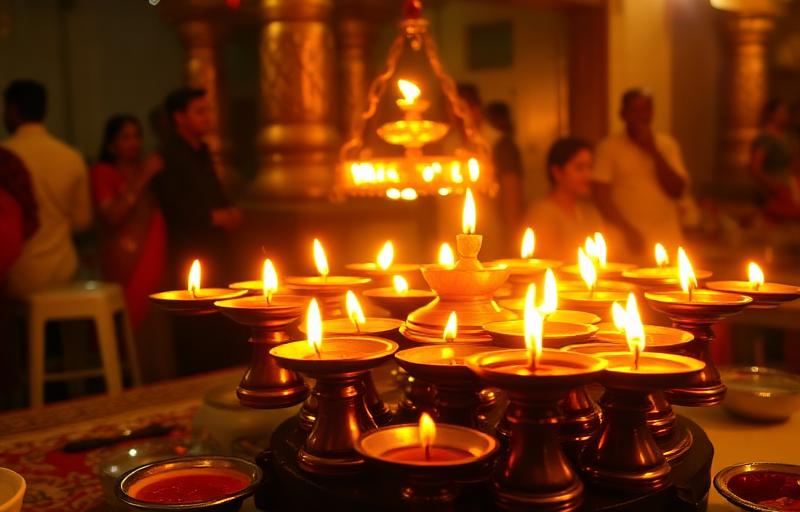
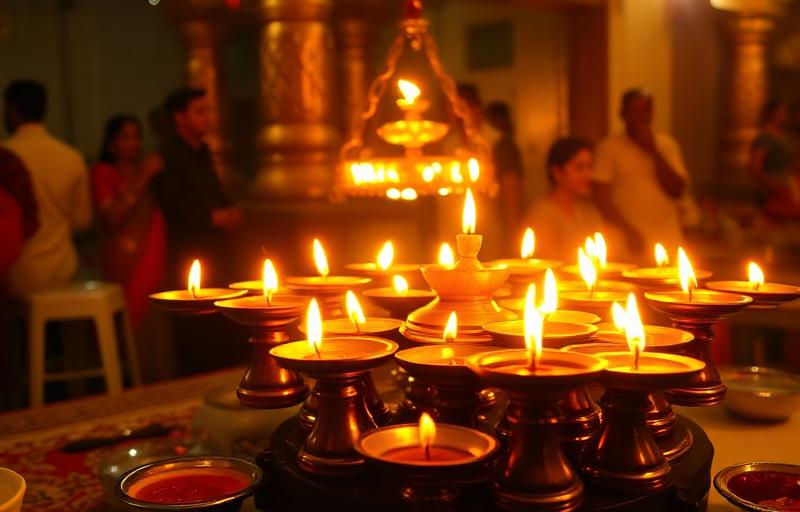
- A lamp, daily, which is the smallest complete offering
Reading:
- The Periya Puranam of Sekkizhar, in translation, for the full account
- Adi Shankara's Shivananda Lahari, verse 63, which cites him
A closing thought. A man who could not read, had never seen a temple and did not know a single mantra found a stone on a hill and could not leave it.
He brought it water in his mouth because he had no pot, flowers out of his hair because he had no basket, and the best part of what he killed, tasted first to be sure.
A trained priest cleaned up after him every morning in distress.
And when the stone bled, the hunter did the only thing a hunter would know to do with an injury, which was to replace the damaged part, and used his own.
Then he put his foot on the second eye so he could find it once he was blind, and raised the arrow again.
That is the point at which the hand came out and stopped him, and the name he was given is the only one he has.
Reader Questions Answered
Who was Kannappa Nayanar?+
One of the sixty three Nayanars, born Thinnan, son of Nagan, chief of a hunting community at Uduppur in the forest country near Sri Kalahasti. He could not read, had no knowledge of ritual and had never been in a temple. Hunting on the hill at Kalahasti he came upon a linga, was overwhelmed, and would not leave, and worshipped it daily in the only way he knew.
How did he worship?+
With water carried from the stream in his mouth because he had no vessel, flowers stuck in his hair because he had no basket, and cooked meat which he tasted first to make sure it was good. He came in his footwear and used one foot to clear the old offerings. Every one of those is a serious ritual violation by the standards of the shastra, and the Periya Puranam describes each in detail rather than glossing over it.
What is the story of the eye?+
On the sixth day, blood was flowing from one eye of the linga. He tried forest remedies and nothing worked, so he reasoned that the remedy for an eye is an eye, took out his own with an arrow and applied it, and the bleeding stopped. Then the other eye began to bleed. Being now blind in one eye, he set his foot on the linga's second eye to mark the spot so he could find it afterward, and raised the arrow again. A hand came out of the linga and stopped him, and the voice said Kannappa, the one who gave the eye.
Does the story mean ritual rules do not matter?+
No, and the tradition is careful about this. Kannappa did not know the rules and had never been taught, and a person who knows them and discards them is not in his position. The rules are not arbitrary; they produce attention, follow the protocol of hospitality to a guest, and allow a practice to be transmitted. The story is about the sufficiency of devotion where the means and knowledge are genuinely absent, not the worthlessness of form.
Where is Sri Kalahasti and what is it?+
In Tirupati district, Andhra Pradesh, on the Swarnamukhi river, around 36 kilometres from Tirupati. It is one of the Pancha Bhoota Sthalams, representing vayu or air, and the lamp in the sanctum is said to flicker constantly although there is no draught. The name comes from the spider, the serpent and the elephant who worshipped there. The Kannappa shrine is on the hill above, reached by steps.
Should I be worried about doing puja wrong?+
No. If you cannot bathe because you are ill, worship anyway. If you have no flowers, offer water, and if you have no water, offer the name. If you do not know the mantras, say the name in your language. If a child breaks something, that is not a problem. The one rule the tradition actually enforces is not treating other devotees with contempt: the texts are unambiguous that failure of ritual is minor and contempt for a devotee is major.
About the author
Pandit Ravindra Sharma · Vedic Rituals & Bhakti, 22+ years
Pandit Ravindra is the Vandnaa editorial team's resident specialist on aarti, chalisa, and daily devotion. He has performed home and temple pujas across Varanasi and Delhi for over two decades and contributes the bhakti-focused articles on this site.
Meet the Vandnaa editorial team →