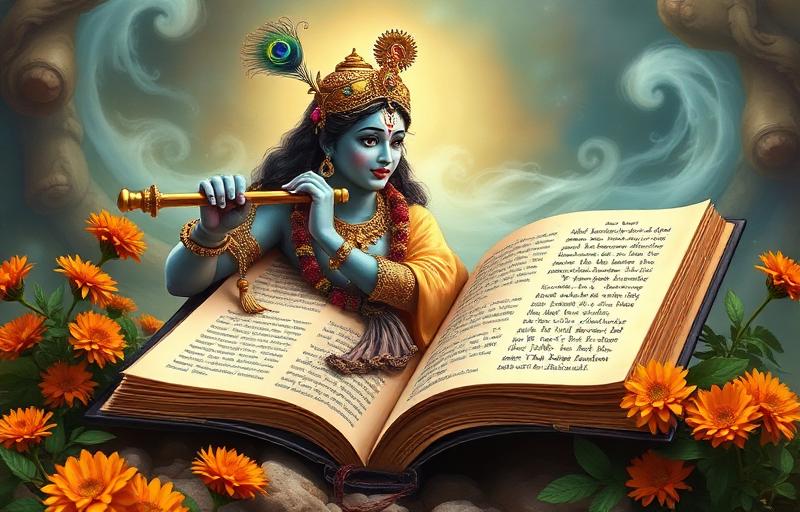
A Father's Bargain Before Leaving for the Forest
The Bhagavata Purana's third canto tells the story of Kardama, a sage who married Devahuti, daughter of Swayambhuva Manu, on the explicit understanding that once she had borne him children old enough to look after her, he would leave for the life of a renunciate he had always intended.
Kardama kept his end of it generously while he stayed: using yogic power to build Devahuti a flying palace of extraordinary luxury, and fathering nine daughters with her along with one son.
That son, Kapila, is described in the text as no ordinary child but a direct avatar of Vishnu, born specifically to fulfil a particular purpose: to give his mother, once his father had departed as promised, a complete teaching that would let her achieve liberation on her own, without needing to follow Kardama into the forest or depend on any other guide.
Kardama did leave once Kapila had grown, exactly as agreed, and Devahuti was left in the company of her son, who at that point revealed both his divine nature to her and his reason for staying: to become, in effect, his own mother's guru.
The Teaching Itself
What Kapila gives Devahuti, in the portion of the Bhagavata Purana that follows, is a systematic exposition of Sankhya, one of the oldest philosophical systems in Indian thought, laid out here in a specifically devotional register rather than as dry metaphysics.
The teaching distinguishes Purusha, the conscious self, from Prakriti, the material nature that the self mistakenly identifies with, and walks through the process by which a soul entangled in matter can, through discernment and devotion together, disentangle itself and recognise its own true nature.
Kapila does not present this as pure intellectual philosophy detached from devotion. Bhakti runs through the entire teaching as the practical means by which the abstract discernment Sankhya describes actually becomes lived experience, which is characteristic of how the Bhagavata Purana treats philosophical material generally: theory in service of a devotee's actual transformation, not theory for its own sake.
Devahuti, receiving this teaching directly from her own son, is said to have practised it with full dedication at the very hermitage her husband had built for her, and to have attained liberation in that same lifetime, in that same palace Kardama's yogic power had constructed as, of all things, a wedding gift.
A Teaching Line That Outlasted the Story
Kapila's Sankhya, as distinct from the classical Sankhya system attributed to a philosopher of the same name in a separate, more strictly secular philosophical tradition, is specifically the devotional version transmitted in the Bhagavata Purana, and the tradition is careful to treat these as related but not simply identical, since the philosophical Sankhya school as it developed independently does not centre bhakti the way Kapila's teaching to Devahuti does.
The place associated with Devahuti's liberation, Siddhapur in Gujarat on the banks of the Saraswati river, remains a pilgrimage site tied to this story specifically, and shraddha rites performed there are held by some to carry particular significance because of the account of a mother attaining liberation there through her own son's guidance.
The story stands, within this series, as an unusual counterpoint to nearly every other rishi narrative told here: not a father passing knowledge to a son, nor a guru testing a disciple, but a son, born expressly for the purpose, giving his own mother the entire path out of the world he had only just entered.
What People Ask Most
Who was Kapila in the Bhagavata Purana?+
Kapila was the son of the sage Kardama and Devahuti, described as a direct avatar of Vishnu born specifically to teach his mother the Sankhya path to liberation after his father departed for renunciation as promised.
What is the Sankhya philosophy Kapila taught?+
It distinguishes Purusha, the conscious self, from Prakriti, material nature, teaching that liberation comes from discerning the difference between them - presented in the Bhagavata Purana in a devotional register that weaves bhakti into the philosophical framework.
Where is Devahuti said to have attained liberation?+
At Siddhapur in Gujarat, on the banks of the Saraswati river, at the same hermitage Kardama had originally built for her - a site still associated with this story and visited for shraddha rites.
About the author
Anjali Mehta · Editor, M.A. Religious Studies
Anjali is the managing editor for Vandnaa and oversees the festival and vrat coverage. She holds an M.A. in Religious Studies and reviews every published article for accuracy, accessibility, and tradition-fidelity.
Meet the Vandnaa editorial team →