Who Mallanna Is
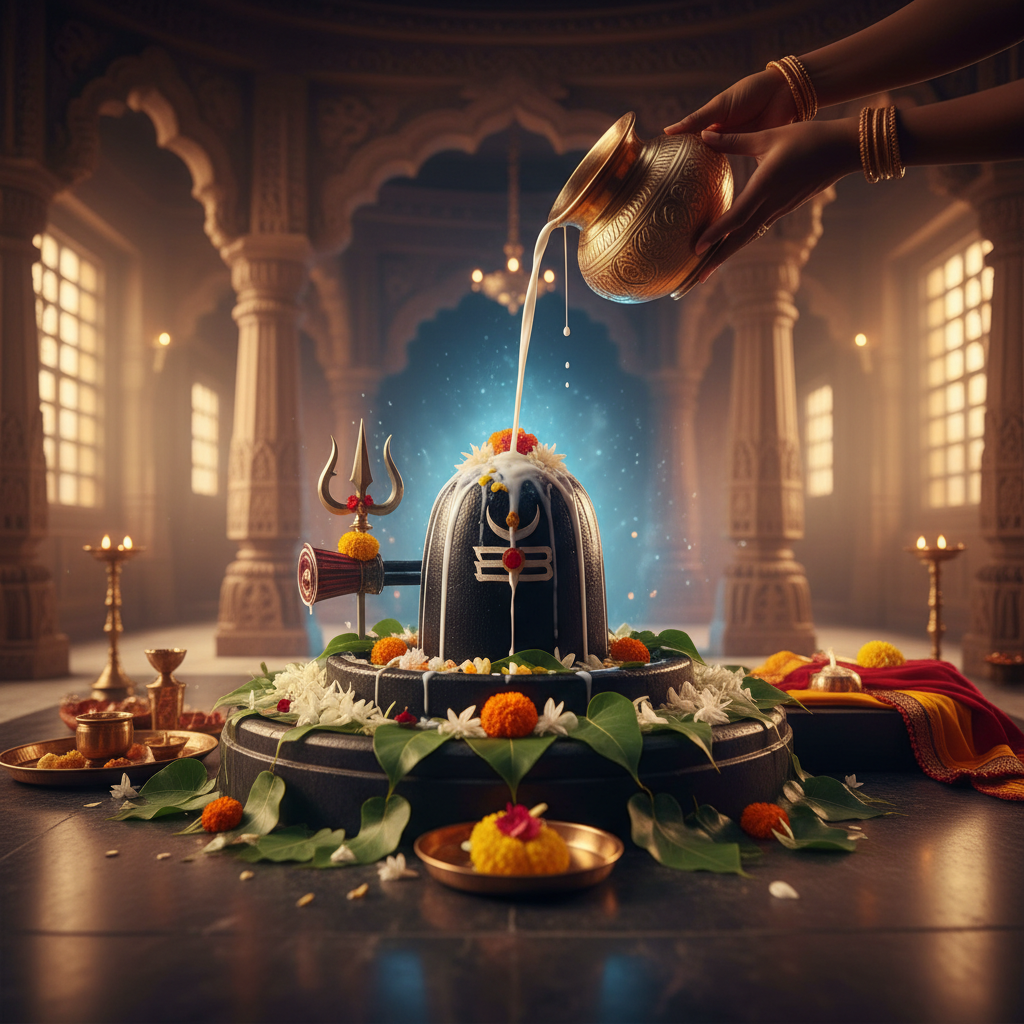
Mallanna, worshipped at Komuravelli in Siddipet district of Telangana as Sri Mallikarjuna Swamy, is a folk form of Shiva and one of the most followed deities of the Telangana plateau.
He belongs to a category of deity that recurs across the Deccan: a Shiva who has left the Himalaya and the temple town, taken up a horse and a sword, married into the pastoral communities of the region and settled on a hill among them. His devotees are drawn overwhelmingly from the farming, shepherd and working communities of Telangana, and the character of his worship reflects that entirely.
What marks him out:
- He is worshipped with bandaram, turmeric, offered and smeared in quantity, so the shrine and devotees turn yellow
- His main offering is the patnam, a design laid out on the floor rather than an item handed over
- His story is carried by Oggu Katha, a ballad tradition performed by singers of the communities who worship him
- He is worshipped alongside his consorts Ketamma and Medalamma, whose presence ties him directly to those communities
- His season runs from Sankranti to Ugadi, with Sundays as the main day
Mallanna is part of a wider Deccan family that includes Khandoba in Maharashtra and Mailara in Karnataka, and devotees on all three sides are aware of the connection.
Bandaram: Worship Measured in Turmeric
The first thing anyone notices at Komuravelli during the season is the colour. Everything is yellow.
Bandaram, turmeric, is the characteristic offering here, and it is not offered in pinches. Devotees bring it in bags, offer it at the shrine, apply it to themselves and to each other, and carry it home as prasad.
Why turmeric:
- It is auspicious and protective across Indian household practice, used at weddings, on newborns and at thresholds
- It is antiseptic and cooling, and in a farming society it is a household medicine as much as a spice
- It is grown locally, which matters for a deity whose worship is built entirely out of what the region produces
- The colour marks the devotee visibly, so that anyone returning from Komuravelli is recognisable on the road home
The practice is shared with the wider Deccan family of this deity. At Jejuri in Maharashtra, Khandoba's devotees shower bhandara, the same turmeric, until the hill turns yellow. At Mailara shrines in Karnataka the same substance is central.
What this tells you about the deity is worth stating. A god worshipped with turmeric rather than with sandal, silk and gold is a god of the household kitchen and the field, and his devotees describe him in exactly those terms.
Patnam: An Offering Laid Out on the Ground
The patnam is Komuravelli's most distinctive ritual, and it is unlike the offerings made at most temples.
Rather than handing over an item, devotees have a patnam laid out for them. It is arranged on the ground before the deity, using turmeric, kumkum, rice and other materials, in a prescribed design, and the ritual is performed by the temple's traditional specialists on behalf of the family.
What it involves:
- A family books a patnam in their name, often as the fulfilment of a vow
- The design is laid out and the ritual performed with the family present
- Offerings are placed and the deity invoked over the arrangement
- The materials are afterwards distributed, and turmeric from it is carried home
The patnam is closest in spirit to Kerala's kalamezhuthu and to the various floor drawing rituals found across India, where the sacred is composed on the ground, used, and then dispersed. Nothing permanent is created.
For devotees, the patnam is what marks the visit as complete. Darshan can be had in a few minutes. A patnam takes time, is done in the family's name, and produces the material that goes home with them, which is why families plan their Komuravelli trip around getting one done rather than around reaching the sanctum.
Oggu Katha: The Singers Who Carry His Story
Mallanna's story is not preserved in a Sanskrit text. It is preserved in Oggu Katha, one of Telangana's major oral traditions.
- Oggu performers come traditionally from the Kuruma and Golla communities, the shepherd and pastoral groups of the region, and hold hereditary ritual roles in Mallanna's worship
- A performance is given by a lead narrator with accompanists, using drum, cymbals and costume, and combines narration, song, dialogue and enactment
- The kathas cover Mallanna's origin, his exploits, his marriages to Ketamma and Medalamma, and his relationship with the communities who worship him
- Performances run through the night, at the temple during the season and in villages when families commission them
Oggu Katha is not only Mallanna's. The same tradition carries the stories of Beerappa and other regional deities, and it has been documented as one of the significant folk performance forms of the Telugu speaking region.
What is worth noticing is the role this gives the performers. They are not entertainers attached to a temple. They are the tradition's priesthood in the sense that matters most: without them, the story that explains the deity does not exist in any other form.
Devotees at Komuravelli treat an Oggu performance as part of the worship rather than as an accompaniment to it, and families frequently sponsor one as a vow.
The Season: Sankranti to Ugadi
Komuravelli does not run on the usual temple calendar. Its year has a defined season.
- The season opens around Sankranti in Magh, after the harvest
- It runs through to Ugadi, the Telugu new year in Chaitra
- Sundays through this period are the main days, and the temple and approach roads fill from before dawn
- Oggu performances, patnams and bandaram offerings run continuously through the season
- Outside this period the temple is open but quiet
The agricultural logic is straightforward. Sankranti follows the harvest, which is when farming families have both grain and time. Ugadi begins the new year and the next cycle. The season occupies the gap between them, which is exactly when a rural community can travel.
This is worth noting because it is true of village deity worship across India. Festival calendars that look arbitrary from outside almost always track the agricultural year, and the deities of farming communities are worshipped when the fields allow it.
For visitors, the practical consequence is simple. Come between Sankranti and Ugadi if you want to see this tradition at full strength, and specifically on a Sunday. Come outside that window if you want a quiet darshan and time to look at the shrine itself.
Visiting Komuravelli
The temple is within reach of Hyderabad and Warangal, and most devotees come for the day.
- Location - Komuravelli, Siddipet district, Telangana, off the Hyderabad to Warangal route, about two hours from Hyderabad
- Best time - Sundays between Sankranti and Ugadi for the full experience, weekdays outside the season for a calm visit
- What to carry - turmeric, which is also sold at the base in quantity, along with coconut, flowers and cash for the patnam booking
- Wear - clothes you do not mind turning yellow, because you will, and footwear you can remove and carry
- Booking a patnam - done at the temple, and during the season it is best to arrive early
- Nearby - Vemulawada, another major Shiva shrine of the region, and Warangal with the Bhadrakali temple and the Ramappa temple further on
The Ketamma and Medalamma shrines should not be skipped. Their presence in the complex is the part of this tradition that ties Mallanna to the communities who worship him, and devotees complete darshan at both.
One last note. If you have the opportunity to sit through an Oggu Katha performance, take it, even for an hour. It is the tradition's own account of the deity, delivered by the people who have kept it, and there is no written substitute for it anywhere.
Quick Answers
Who is Komuravelli Mallanna?+
Mallanna is a folk form of Shiva worshipped as Sri Mallikarjuna Swamy at Komuravelli in Siddipet district, Telangana. He is a rider deity of the plateau, worshipped alongside his consorts Ketamma and Medalamma.
Why is turmeric offered at Komuravelli?+
Bandaram, turmeric, is the characteristic offering, brought in quantity, offered at the shrine and applied by devotees to themselves and each other. It is auspicious, protective, locally grown and used as a household medicine, which fits a deity of the field and the kitchen.
What is a patnam?+
A patnam is an offering laid out on the ground before the deity using turmeric, kumkum, rice and other materials in a prescribed design, performed by the temple's traditional specialists in a family's name, usually to fulfil a vow.
What is Oggu Katha?+
Oggu Katha is a Telangana oral performance tradition in which singers of the Kuruma and Golla communities narrate the stories of Mallanna and other regional deities through the night, using drum, cymbals, song and enactment.
When is the main season at Komuravelli?+
From Sankranti in Magh to Ugadi in Chaitra, with Sundays through that period being the main days. The timing follows the agricultural year, falling between the harvest and the start of the next cycle.
How far is Komuravelli from Hyderabad?+
About two hours by road, off the Hyderabad to Warangal route in Siddipet district. Vemulawada and Warangal, with the Bhadrakali and Ramappa temples, can be combined on the same trip.
About the author
Pandit Ravindra Sharma · Vedic Rituals & Bhakti, 22+ years
Pandit Ravindra is the Vandnaa editorial team's resident specialist on aarti, chalisa, and daily devotion. He has performed home and temple pujas across Varanasi and Delhi for over two decades and contributes the bhakti-focused articles on this site.
Meet the Vandnaa editorial team →