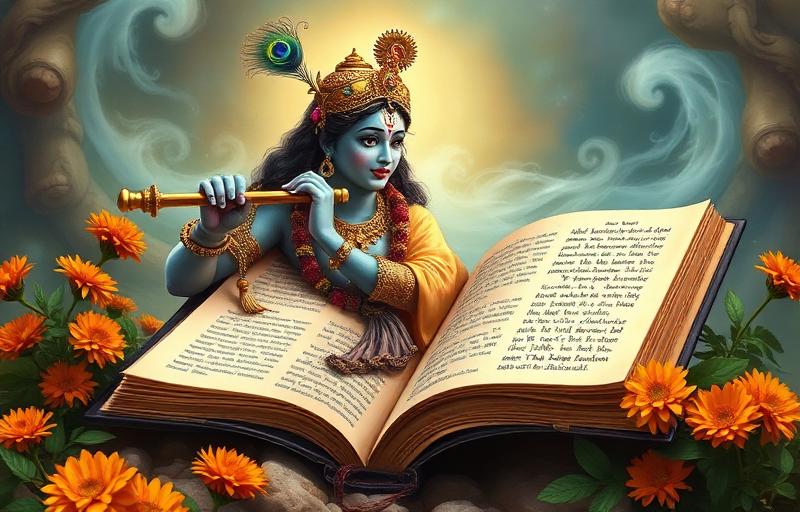
Leela 1 & 2: Putana Vadh + Maakhan Chori (Butter Theft)
1. PUTANA VADH - The Demoness Who Came as a Nurse
When Kamsa learned a child born in Mathura would kill him, he commissioned the demoness Putana to murder every newborn boy. Putana could shape-shift; she disguised herself as a beautiful young mother with breast-milk laced with deadly poison. She visited the homes of newborn boys offering to feed them. Most died in seconds. When she reached Yashoda's house and offered her breast to baby Krishna, Yashoda was bedazzled by her motherly form and consented. Krishna, recognising the poison instantly, began suckling - but he did not suckle milk; he suckled out her life-force. Putana screamed, her body expanded to its massive original demonic form, and she fell dead in the courtyard.
The profound twist: Krishna granted Putana the same liberation he gives to mothers who feed him with love. Why? Because she had momentarily offered her breast as a mother (even if with murderous intent), and Krishna's love does not measure the heart - only the form. Lesson: Even a tiny act with the right outer form, however polluted the inner intent, touches the divine and bears fruit. This is the most consoling theology in Hinduism - the door is always slightly open.
2. MAAKHAN CHORI - The Butter Thief
Little Krishna, with friends Sudama, Madhumangal and Subala, raided the gopis' (cowherd women's) homes daily for butter and curd. The gopis hung butter pots from the ceiling thinking the children could not reach; Krishna made a human pyramid (the origin of Mumbai's Dahi-Handi). The gopis complained to Yashoda; she tried to scold Krishna but he denied with widened eyes - 'I didn't eat, mother; the butter just walked into my mouth.' Even his denial was performance.
Why did Krishna steal? The gopis had been making butter the entire night while remembering him - every churn, every spoon was charged with their love for him. He literally could not stay away from butter that had been made with such love. When devotees today offer butter to Krishna on Krishna Janmashtami, they are continuing this leela. Lesson: God is hungry only for love. He does not want grand temples - he wants the home-churned butter of a heart that remembers him.
Leela 3 & 4: Kalia Naag + Govardhan Dharan
3. KALIA NAAG - Dancing on the Serpent's Head
The Yamuna had a deep pool that no one dared enter. A 1000-headed black serpent named Kalia had taken residence there with his wives and offspring. His venom was so potent that birds flying overhead fell dead; the river water was poisoned for miles. Cowherd boys playing with Krishna lost a ball into the pool. Krishna jumped in from a kadamba tree to retrieve it. Kalia surrounded him, wrapping all 1000 hoods. The villagers on the bank watched in terror - was their boy dead?
Krishna expanded himself, broke free, leapt onto Kalia's central hood, and began to dance. Each step crushed one hood; Kalia coughed up venom and blood. His wives ran out of the water with hands folded: 'Lord, we have known you only as our husband - please spare him.' Krishna stopped dancing. He told Kalia: 'Leave the Yamuna. Go to the Ramanaka Dweep ocean. Stay there.' Kalia, his hoods marked with Krishna's footprints (which became his protection - Garuda would no longer attack him because of these marks), left peacefully.
Lesson: Ego is not to be killed; it is to be danced upon until it surrenders. The hoods of pride were not destroyed - they were marked with divine footprints. Once you bear the mark of God's dance on your ego, the same ego can no longer harm anyone. This is the entire path of bhakti compressed into one image.
4. GOVARDHAN DHARAN - Lifting the Mountain
For centuries, the cowherds of Vrindavan worshipped Indra during the monsoon to ensure rain. Young Krishna interrupted: 'Why worship someone who gives reluctantly? Worship Govardhan hill - it directly provides grass for our cows and shelter for us. That is real seva.' The villagers, charmed by Krishna's logic, switched the puja from Indra to Govardhan. Indra, insulted, summoned the Pralaya-megha (apocalyptic rain clouds) and sent a 7-day deluge to drown Vrindavan.
The rain was unstoppable. Villagers panicked. Krishna calmly walked to Govardhan hill and lifted the entire mountain on the little finger of his left hand. He held it as a giant umbrella. All of Vrindavan - every man, woman, child, cow, goat - sheltered underneath. The downpour fell on the mountain's outer surface; not one drop reached the people. After 7 days, Indra exhausted his rain. He realised he was challenging the divine itself. He descended, washed Krishna's feet with the milk of the divine cow Surabhi (a ritual called Govinda-pattabhisheka), and apologised.
Lesson: Real religion is not propitiating distant powers - it is honoring the immediate. Govardhan was 'God-on-earth' for the cowherds. When you worship what feeds you, what shelters you, what works for you daily, the cosmic powers cannot overrule that wisdom. Also: God will lift mountains for those who trust him, but only after they have done the courageous act of breaking with conventional fear.
Leela 5 & 6: Yashoda Bandhan + Sudama Bhent
5. YASHODA BANDHAN - When the Infinite Was Tied to a Mortar
One morning Yashoda was churning butter. Little Krishna woke hungry and crawled to her, tugging at her saree. She wanted to finish the batch first but the milk on the stove began boiling over. She left Krishna to attend to the milk; Krishna, furious, broke a butter pot with a stone. He ran to share the butter with a monkey in the courtyard. Yashoda returned, saw the broken pot and the smug toddler with butter on his face, and decided to discipline him by tying him to the heavy wooden grinding mortar (ulukhal).
She tried with a small rope - it was 2 inches short. She added more rope - still 2 inches short. She kept adding ropes; no matter how much she added, every length came up 2 inches short of going around his waist. Yashoda began sweating in confusion. Hours passed. Krishna watched her struggle with tears in his eyes - tears of love for her devotion. Finally, seeing she was about to faint, Krishna simply allowed himself to be tied. The rope went around easily.
Why 2 inches short every time? Sage Sanaka explains: one inch represented Krishna's own infinity, the other inch represented Yashoda's effort. Only when both were combined - Krishna's grace meeting devotee's effort - could the binding happen. This is why Krishna in this form is called Damodara (Dama = rope, udara = belly).
Lesson: God cannot be 'tied' (controlled, possessed) by effort alone. He cannot be tied by grace alone (then everyone would be tied without working). It is the meeting of effort and grace, in equal measure, that brings God into our lives. Damodara is the holiest form because he represents not power, not wisdom - but the willingness of God to be bound by love.
6. SUDAMA BHENT - When a Poor Friend Visited the Lord of Dwarka
Sudama, Krishna's childhood friend from Gurukul days, lived in extreme poverty. His wife, watching their children cry from hunger, suggested he visit Krishna in Dwarka - surely the Lord would help. Sudama was reluctant; he had nothing to offer. His wife gathered four handfuls of beaten rice (poha) from a neighbour, tied it in an old cloth, and pressed him to take it as gift.
Sudama walked barefoot for days. Reaching Dwarka, the guards laughed at the dishevelled brahmin and tried to send him away. But Krishna, recognising the energy of his friend's love, ran out of his palace, embraced Sudama in front of his queens, washed his feet personally, and refused to let him sit anywhere but on Krishna's own throne. Sudama, embarrassed by his poverty, hid the beaten rice in his armpit. Krishna saw it. He pulled it out, exclaimed 'You brought me food!', and ate it. The first handful - Sudama's wealth multiplied by 100. The second handful - Sudama's house became a palace. Sudama, in his shyness, blocked Krishna from eating the third handful - if he had eaten it, Sudama would have rivalled Kubera.
When Sudama returned home, his hut had become a mansion; his wife wore silks; his children were playing in a courtyard of marble. No words had been exchanged about poverty. Krishna had given everything without being asked.
Lesson: True friendship with God does not require asking. He sees the four handfuls of beaten rice and responds with palaces. We ruin the gift by demanding articulated outcomes. Sudama got more by saying nothing than most people get by asking everything.
Leela 7: Draupadi Vastra Haran - When Krishna Was Her Saree
Of all the Krishna leelas, none is more cited in moments of despair than this one. After the Pandavas lost everything in the dice game - kingdom, wealth, themselves, and finally Draupadi - Dushasana dragged her by the hair into the Kaurava court and attempted to disrobe her in full view of elders. The Pandavas, having gambled themselves into slavery, could not move. Bhishma, Drona, Vidura - all silent or weeping. Karna and Duryodhana laughed.
Draupadi cried out to her husbands; they could not help. She cried to Krishna's elder brother; he was not there. Finally she stopped looking left or right and folded her hands above her head, calling silently: 'Govinda, Madhava, Keshava - Krishna, You are my only friend now.' Dushasana pulled her saree. It came loose - but underneath was another saree. He pulled again - another. Again - another. He pulled until his arms gave out. The pile of unwound sarees mounted to the ceiling. The court watched in disbelief. Draupadi remained covered.
Krishna was not physically present in Hastinapura. He was in Dwarka. But the moment Draupadi truly let go - calling not as 'queen needing rescue' but as 'soul recognising its only refuge' - Krishna manifested in the most intimate form possible: he literally became her clothing. He could not save her standing outside; he saved her by becoming inseparable from her.
Later, when Krishna met Draupadi, she asked: 'Why did you come so late?' Krishna replied: 'I did not come late. I came the second you stopped trying to save yourself and called me purely. As long as you held one hand on your saree, my hand could not be there. The moment you raised both hands above your head and surrendered, the saree-protection became mine.'
Lesson 1: God's help is calibrated to surrender, not to suffering. Many devotees suffer enormously but never fully surrender - they keep one hand on their own saree of effort. Lay down everything, and the impossible protection arrives.
Lesson 2: Krishna does not come to defeat your enemies - he comes to make you safe within the situation. He did not strike Dushasana down; he made Draupadi's saree infinite. Sometimes the answer to a crisis is not its removal but the discovery that you cannot be touched within it.
Lesson 3: When you cry 'God why?' He is already the cloth covering you. The form changes; the protection is constant. Look for him in the smallest thing that has kept you whole - that is where he has been all along.
What People Ask Most
Which Krishna leela should I read first if I am new to Krishna bhakti?+
Begin with Maakhan Chori (butter theft) - it is the easiest entry. Krishna in this leela is approachable, naughty, lovable; it removes the 'distant God' barrier. Then Yashoda Bandhan, which softens you with maternal-love theology. Then Sudama Bhent for friendship-bhakti. Govardhan and Kalia introduce power and dharma. Save Draupadi for last - it is profound but requires the previous leelas as foundation. Reading in this order builds bhakti the way Bhagavatam itself was structured: vatsalya (parental) first, sakhya (friendship) next, then aishvarya (divine majesty).
Where can I read the complete Bhagavatam in Hindi or English?+
Gita Press, Gorakhpur publishes the most-recommended Hindi Srimad Bhagavatam (red hardcover, ~1200 pages, Rs 350). For English, A.C. Bhaktivedanta's ISKCON translation is verse-by-verse and exhaustive (12 books). Online: vedabase.io (ISKCON), gitapress.org (free PDF download), Sacred-texts.com (older but free Bhagavata). For audio: Gyanvani podcasts in Hindi by Pundrik Goswami and Bhakti Charu Swami on YouTube. Reading the 10th Canto (which contains all Krishna leelas) takes about 90 days at one chapter per day.
Are these stories historical or symbolic?+
Hindu tradition treats them as both - actual events that also encode universal truths. Krishna's historical existence as a Yadava prince of Mathura-Dwarka (~3200 BCE) is supported by archaeology (Dwarka's underwater ruins, the Mahabharata war's astronomical dating). Whether every miracle happened exactly as described or some details are devotional poetry layered over time, the symbolic layer is unquestionable: each leela teaches something timeless. The mature bhakta does not get caught in the historical-or-symbolic debate; he simply lets the story do its work on his heart.
Can I tell these stories to my children - at what age?+
Yes - these are the original Indian children's stories, told for over 3000 years. Maakhan Chori, Govardhan, Kalia naag, Sudama can be told from age 3 onwards - children adore them. Yashoda Bandhan is best from age 5 (the metaphor needs slight maturity). Draupadi Vastra Haran is for age 10+ because the courtroom violence requires context. Avoid scary versions with overly demonic Putana imagery for under-5s - focus on Krishna's love rather than the demoness's terror. The bedtime version (5 minutes per leela) is the most beloved gift one generation can give the next.
About the author
Anjali Mehta · Editor, M.A. Religious Studies
Anjali is the managing editor for Vandnaa and oversees the festival and vrat coverage. She holds an M.A. in Religious Studies and reviews every published article for accuracy, accessibility, and tradition-fidelity.
Meet the Vandnaa editorial team →