Who Nanda Devi Is
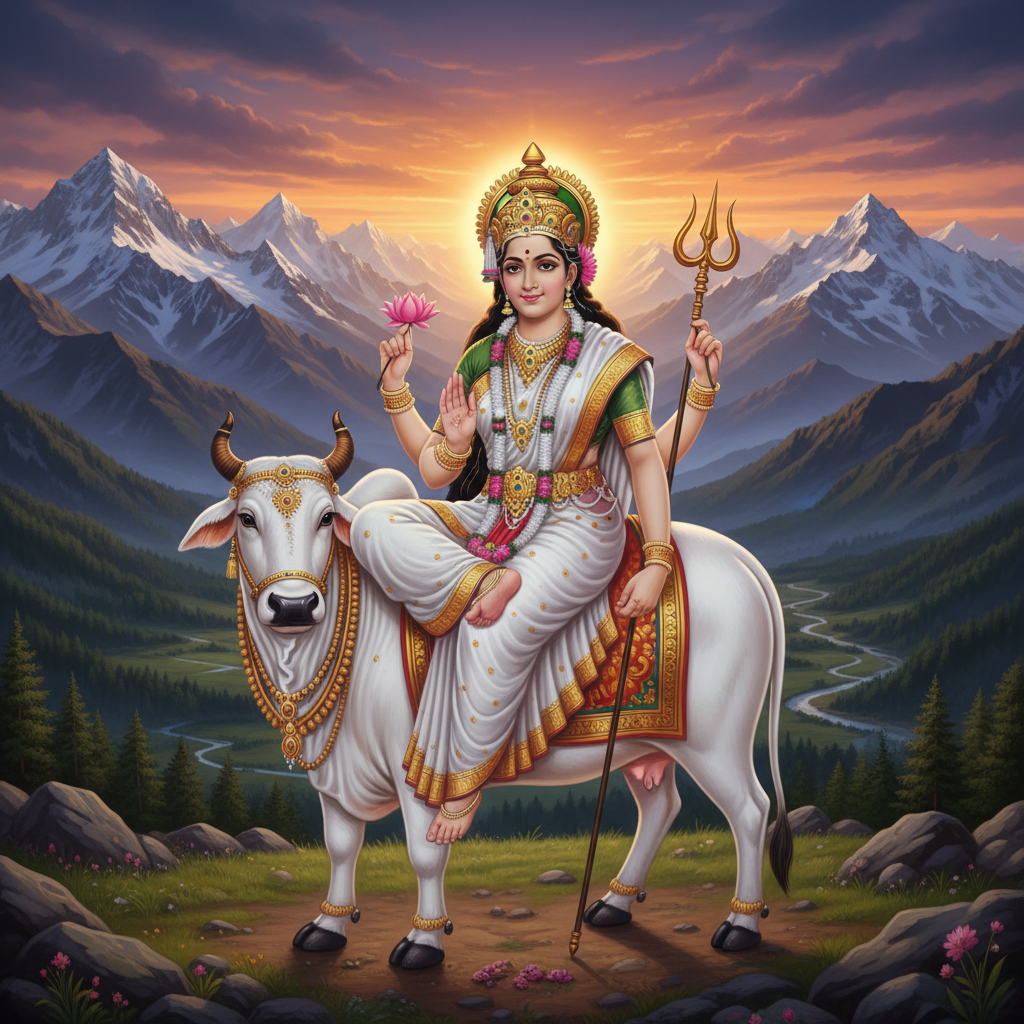
Nanda Devi is the presiding goddess of Kumaon and Garhwal, worshipped across Uttarakhand as a form of Parvati, the daughter of the Himalaya who married Shiva.
What makes her devotion distinct is the relationship the region claims with her. She is not addressed only as a cosmic mother. She is addressed as dhiyan, the daughter of the house, who was married far away into the high mountains and who returns to her maternal home for a few days each year before being sent back with gifts, tears and songs.
This shapes everything about her worship:
- Her festivals are structured like a daughter's visit and vidai, not like a deity's darshan
- Her songs, called jagar and Nanda ke geet, are sung in the voice of a family missing her
- She is worshipped alongside Sunanda, described as her sister, and the two are made together in leaf and clay images
- India's second highest peak carries her name, and the mountain itself is treated as her abode
Her temples are spread across the hills, at Almora, Nainital, Ranikhet, Kot Bhramari, Nauti and Kurur, and each holds a part of the same devotional cycle.
The Katha and the Mountain
The kathas of Nanda Devi combine Puranic identity with intensely local memory.
As Parvati, she is the daughter of Himavan, the personification of the Himalaya. Her marriage to Shiva takes her to Kailash, which in the hill imagination is her sasural, the husband's home beyond the high passes. The annual and twelve yearly festivals re enact her journey there.
Local katha adds a harder layer. In one widely told version, Nanda takes refuge in the hills while fleeing a hostile king, and is protected by the villagers of the region, which is why particular villages retain hereditary rights and duties in her worship to this day. Another version links her to the Bhramari form of the Devi, worshipped at Kot Bhramari in Bageshwar.
The mountain itself, Nanda Devi peak, is treated as her physical abode. Indian mountaineering tradition has long regarded it with a caution that goes beyond technical difficulty, and the core area around it is now a protected biosphere reserve, closed to general access. For local families, that protection is understood in devotional terms as much as ecological ones.
The Nanda Devi Raj Jat: A Yatra Held Every Twelve Years
The Nanda Devi Raj Jat is the largest and most demanding devotional journey in Uttarakhand, held roughly once every twelve years. It is often described as the Himalayan equivalent of a wedding procession, because that is exactly what it enacts: the Devi being escorted from her maternal home to her husband's home.
- The yatra sets out from Nauti village near Karnaprayag, where the hereditary rights of the ceremony are held
- It covers roughly two hundred and eighty kilometres on foot over about three weeks, climbing to Roopkund and finally to Homkund
- At its head walks a four horned ram, which tradition holds appears for the occasion and which carries the Devi's offerings
- Villages along the route join with their own palanquins and deities, so the procession grows as it climbs
- At Homkund the ram is released to continue alone across the high snow, and the yatris turn back
The last Raj Jat was held in 2014, and the next is awaited according to the traditional reckoning of its custodians. Because the route crosses glacial terrain above fourteen thousand feet, participation requires serious preparation and official coordination, and dates are announced well in advance.
Nanda Ashtami and the Annual Melas

Most devotees meet Nanda Devi not at the Raj Jat but at the annual melas held in Bhadrapada, around Nanda Ashtami.
- Almora Nanda Devi Mela - held at the Nanda Devi temple in the old town, one of the oldest continuous fairs in Kumaon
- Nainital Nanda Devi Mela - held at the temple near the lake, drawing large crowds from across the region
- Ranikhet, Bageshwar, Kot Bhramari and Nauti - each with their own observances
- Garhwal melas at Kurur and other villages that hold hereditary roles in her worship
The central ritual is the making of the Nanda and Sunanda images from kadali, the banana plant. The plants are cut with ceremony, brought in procession, and the two forms are shaped, dressed and worshipped for the days of the mela. On the final day they are taken for visarjan, and the songs sung at that moment are farewell songs, sung by women as if seeing a daughter off after her visit.
Offerings include red cloth, bangles, sweets, local grain, and the seasonal produce of the hills. Jagar singers perform through the nights, narrating the Devi's katha in the local dialect.
How She Is Worshipped in Homes
In Kumaoni and Garhwali households, Nanda Devi worship is woven into ordinary family life rather than kept for festival days.
- Many families keep her as kul devi, and no wedding is considered complete without her worship
- Jagar is held when a family faces a persistent difficulty. A jagariya sings through the night, the Devi's katha is recited, and the family's concerns are placed before her.
- Ashtami vrat in Bhadrapada is kept by women, with red cloth and bangles offered
- Aipan, the traditional red and white floor and wall art of Kumaon, is drawn at the doorway and around the puja space for her festivals
- Local produce is offered first - the season's first grain, walnuts, and hill fruit
For families who have left the hills for Delhi, Dehradun or further, the practice usually reduces to two things: attending the Nanda Ashtami observance wherever their community gathers, and returning to the village temple for weddings and mundan. Elders in the region are clear that the songs matter as much as the ritual, and there is a quiet effort under way to record jagar and Nanda geet before the older generation of singers is gone.
Visiting Nanda Devi's Shrines
You do not need to wait for the Raj Jat to have darshan. Her temples are open through the year and are easy to combine with other Uttarakhand travel.
- Nanda Devi Temple, Almora - in the heart of the old bazaar, best visited during the Bhadrapada mela but calm otherwise
- Nanda Devi Temple, Nainital - a short walk from the lake, busy during the mela days
- Kot Bhramari, Bageshwar - associated with the Bhramari form, set above the Gomti valley
- Nauti and Kurur, Chamoli - the villages that hold hereditary rights in the Raj Jat
- Kasar Devi and Dunagiri, nearby shrines usually included in a Kumaon devotional trip
Practical notes: hill temples close earlier than plains temples, monsoon travel in Chamoli and Bageshwar can be disrupted by landslides, and the mela weeks fill accommodation quickly. Warm clothing is needed even in Bhadrapada at higher villages.
For devotees who want to understand the tradition rather than only see it, plan around Nanda Ashtami. Watching the kadali images being made, and hearing the visarjan songs, explains the devotion far better than a description can.
Frequently Asked Questions
Who is Nanda Devi?+
Nanda Devi is the presiding goddess of Kumaon and Garhwal, worshipped as a form of Parvati, the daughter of the Himalaya. In Uttarakhand she is addressed as a daughter of the household who was married into the high mountains.
What is the Nanda Devi Raj Jat?+
It is a yatra held roughly once every twelve years, starting from Nauti village near Karnaprayag and covering about two hundred and eighty kilometres on foot to Homkund. It enacts the Devi being escorted from her maternal home to her husband's home.
Why is a four horned ram part of the Raj Jat?+
Tradition holds that a four horned ram appears for the occasion and leads the procession, carrying the Devi's offerings. At Homkund it is released to continue alone into the high snow while the yatris turn back.
When is Nanda Ashtami celebrated?+
Nanda Ashtami falls in Bhadrapada, and the melas at Almora, Nainital, Ranikhet, Bageshwar and other towns are held around it. Images of Nanda and Sunanda are made from the kadali plant and taken for visarjan on the final day.
Who is Sunanda, worshipped with Nanda Devi?+
Sunanda is described in the tradition as Nanda's sister, and the two are worshipped together. Their images are made side by side from the banana plant during the Bhadrapada melas and immersed together.
Can devotees visit Nanda Devi temples any time of year?+
Yes. The temples at Almora, Nainital, Ranikhet, Bageshwar and Chamoli are open through the year. Bhadrapada, around Nanda Ashtami, is the most active period, while monsoon travel in the higher districts can be affected by landslides.
About the author
Anjali Mehta · Editor, M.A. Religious Studies
Anjali is the managing editor for Vandnaa and oversees the festival and vrat coverage. She holds an M.A. in Religious Studies and reviews every published article for accuracy, accessibility, and tradition-fidelity.
Meet the Vandnaa editorial team →