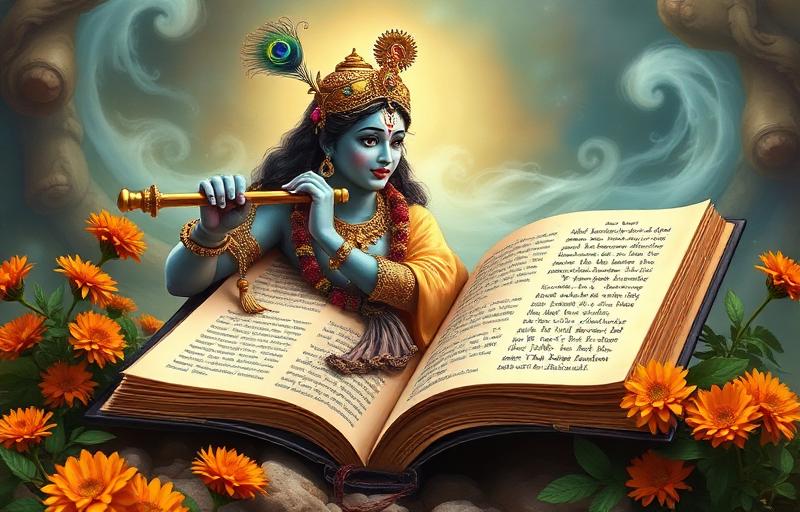
One Deity, Deliberately Made Two
Nara and Narayana are described across the Puranas as twin sages, both understood as partial or joint manifestations of Vishnu himself, deliberately taking dual form specifically to undertake and demonstrate the most rigorous possible tapasya as an example for both devas and mortals to follow. Rather than existing as two entirely separate beings competing or complementing each other in the ordinary sense, Nara and Narayana are treated as functionally a single divine principle expressing itself through paired, mutually reinforcing austerity, one performing penance while the other is understood as its constant, inseparable companion and witness.
The two settled at a specific location in the Himalayas near the Alaknanda river, a site associated with badri trees, wild berries, that gives the location its name, Badrinath, and undertook tapasya there of such depth and duration that it remains, in the tradition's own understanding, still ongoing in some sense, an eternal or continuously renewed penance rather than a completed, historically closed event.
The Same Pair, Reborn as Arjuna and Krishna
Nara and Narayana's most significant appearance beyond their own standalone story comes through their identification, within the Mahabharata's own theological framework, as the earlier incarnations of Arjuna and Krishna respectively, meaning the entire relationship between the Pandava warrior and his divine charioteer is understood as a continuation, in a new age and new form, of this original pair of eternally bonded sage-companions. This framing gives added weight to Krishna and Arjuna's own closeness throughout the epic, treating their partnership not as a novel friendship formed within the story's own timeline but as the latest expression of a bond that predates the Mahabharata's events entirely.
The Bhagavad Gita itself, delivered by Krishna to Arjuna on the Kurukshetra battlefield, gains a particular resonance under this reading: understood as one half of an eternally paired divine principle instructing the other half, rather than simply a teacher instructing a separate pupil, the dialogue becomes an internal conversation within a single underlying divine reality as much as an external one between two distinct warriors.
One of the Char Dham, Still Standing at Their Meditation Site
The Badrinath temple, built at the site traditionally associated with Nara and Narayana's tapasya, is one of the four sacred Char Dham pilgrimage sites in Hindu tradition, alongside Dwarka, Puri and Rameswaram, and remains among the most visited high-altitude pilgrimage destinations in the Himalayas, drawing devotees each year during the temple's limited open season before winter snow closes access to the site.
The Nara-Narayana story is frequently invoked in devotional teaching as a model for the ideal relationship between the individual soul and the supreme divine principle, a bond of companionship and mutual devotion rather than one of hierarchy or distance, a theme carried forward directly into the way Krishna and Arjuna's own relationship in the Bhagavad Gita is popularly understood, less as instructor and student in a conventional sense and more as two expressions of one underlying truth walking through the world together.
Quick Answers
Why are Nara and Narayana considered one deity split in two rather than separate beings?+
The tradition treats them as a joint manifestation of Vishnu deliberately taking dual form to demonstrate paired, mutually reinforcing tapasya, functioning as a single underlying divine principle expressed through companionship rather than as two independently existing gods.
Is Badrinath really connected to this specific story?+
Yes, the temple's traditional siting is directly associated with the location of Nara and Narayana's ongoing tapasya, and the site's name itself derives from the badri, wild berry, trees said to have grown there during their penance.
Does the Krishna-Arjuna connection to Nara-Narayana appear directly in the Mahabharata's text?+
Yes, this identification is referenced within the Mahabharata's own theological framing rather than being a purely later commentarial addition, giving textual grounding to the idea that Krishna and Arjuna's bond in the epic continues a much older, established divine relationship.
About the author
Anjali Mehta · Editor, M.A. Religious Studies
Anjali is the managing editor for Vandnaa and oversees the festival and vrat coverage. She holds an M.A. in Religious Studies and reviews every published article for accuracy, accessibility, and tradition-fidelity.
Meet the Vandnaa editorial team →