Days 1-5: Shailaputri to Skandamata (Mantras + Colours + Offerings)
Day 1 - SHAILAPUTRI (शैलपुत्री)
- Form: Daughter of the Himalaya mountains. Holds a trident in right hand, lotus in left. Rides a bull (Nandi).
- Significance: The pure, virgin form. The Goddess in her childhood/youthful aspect. Represents the beginning of spiritual journey - foundational devotion.
- Colour to wear: Orange/Saffron (red-orange). Symbolises sunrise, freshness, beginnings.
- Prasad/Offering: Ghee, white sweets (peda, barfi). Specifically: pure cow ghee in a small bowl offered to the deity, then distributed.
- Mantra: 'Om Devi Shailaputryai Namah' (108 times) or the longer: 'Vande Vanchhita Labhaya, Chandrardhakritashekharaam, Vrisharudhaam Shuladharaam, Shailaputrim Yashaswinim.'
- What to ask for: Foundation in life - good health, basic prosperity, family welfare, beginning of any new venture.
- Special practice: Ghatasthapana (placing the sacred kalash) is done on Day 1. The kalash with water, mango leaves, and coconut is established with mantras and remains active for all 9 days. This is the most important ritual of Day 1.
Day 2 - BRAHMACHARINI (ब्रह्मचारिणी)
- Form: The ascetic. Holds a rudraksha rosary in right hand, kamandalu (water pot) in left. Walks barefoot.
- Significance: Represents devotion and austerity. The Goddess in her form of doing tapas to win Lord Shiva as husband. Symbolises devotion, study, ascetic practice.
- Colour: White. Symbolises purity, asceticism, surrender.
- Prasad: Sugar, sugar candy, white sweets. Especially: a small bowl of pure white sugar offered then distributed.
- Mantra: 'Om Devi Brahmacharinyai Namah' (108 times) or: 'Dadhana Karapadmabhyam, Akshamala Kamandalu, Devi Prasidatu Mayi, Brahmacharinyanuttama.'
- What to ask for: Patience, perseverance, success in studies and spiritual practice, ability to maintain long commitments.
- Special practice: Begin reading or listening to Devi Mahatmyam (Durga Saptashati) - the 700-verse text praising Durga. Continue for all 9 days.
Day 3 - CHANDRAGHANTA (चंद्रघंटा)
- Form: Wears a half-moon-shaped bell on her forehead. Three eyes. Holds weapons in 10 hands. Rides a tiger/lion. Golden complexion.
- Significance: The protective warrior form. Removes obstacles, fights evil. The moon-bell sound terrifies negative forces.
- Colour: Red. Symbolises courage, strength, fierce protection.
- Prasad: Milk, milk-based sweets (kheer, rasgulla, milk peda).
- Mantra: 'Om Devi Chandraghantayai Namah' (108 times) or: 'Pindaja Pravararudha, Chandakopastrakairyuta, Prasadam Tanute Mahyam, Chandraghanteti Vishruta.'
- What to ask for: Courage in life, protection from enemies/negative forces, removal of mental fears, victory in conflicts.
- Special practice: Visit a Durga temple if possible. Offer a small bell as symbolic ghanta.
Day 4 - KUSHMANDA (कुष्मांडा)
- Form: Has 8 arms holding various weapons + mala + kamandalu. The creator of the universe through her smile - 'Kushmanda' means 'creator of the cosmic egg'. Rides a lion.
- Significance: The creator energy. Source of cosmic energy and light. Lives in the core of the Sun. The most metaphysical of the 9 forms.
- Colour: Royal Blue / Deep Yellow. Symbolises creative power, cosmic vastness.
- Prasad: Malpua, pumpkin (kushmand) dishes - specifically items made of pumpkin honour her name.
- Mantra: 'Om Devi Kushmandaayai Namah' (108 times) or: 'Surasampurna Kalasham, Rudhiraplutameva Cha, Dadhana Hastapadmabhyam, Kushmanda Shubhadaastu Me.'
- What to ask for: Creative power, success in new ventures, health (she rules the central energy of the Sun which gives life), removing of disease.
- Special practice: Light extra diyas (her connection to solar fire). Many devotees do Surya Namaskar in addition on this day.
Day 5 - SKANDAMATA (स्कंदमाता)
- Form: Holds baby Skanda (Kartikeya) on her lap. Four arms - two holding lotuses, one in protection mudra, one holding Skanda. Rides a lion or sometimes sits on lotus.
- Significance: The motherly form. Represents the love of a mother for her child. Especially worshipped by those who want children, want to be good parents, or want to honour motherhood.
- Colour: Royal Blue / Yellow. Symbolises nurturing, motherly love, protection.
- Prasad: Banana - specifically bananas are her favourite. Offered in number of 5 or 9 or 11.
- Mantra: 'Om Devi Skandamatayai Namah' (108 times) or: 'Sinhasanagata Nityam, Padmashritakaradvaya, Shubhadaastu Sada Devi, Skandamata Yashaswini.'
- What to ask for: Children/fertility, family harmony, protection of children, becoming a better parent, wisdom in raising children.
- Special practice: If you have children, do a small puja with them on Day 5 - they receive Skandamata's blessing through your worship.
Days 6-9: Katyayani to Siddhidatri (Mantras + Colours + Offerings)
Day 6 - KATYAYANI (कात्यायनी)
- Form: Fierce warrior goddess with 4 hands - sword, lotus, abhaya mudra, varada mudra. Born to sage Katyayana. Rides a lion. Golden complexion with intense expression.
- Significance: The slayer of Mahishasura (the buffalo demon). Represents fierce justice and overcoming of evil. Specifically the goddess who unmarried girls worship for finding a good husband (the Krishna-gopi story).
- Colour: Red/Maroon. Symbolises power, action, fierce devotion.
- Prasad: Honey, sweets made with honey, jalebi.
- Mantra: 'Om Devi Katyayanyai Namah' (108 times) or: 'Chandrahasojjvalakara, Shardulavaravahana, Katyayani Shubham Dadyad, Devi Danavaghatini.'
- What to ask for: Marriage (especially unmarried women - this is the traditional 'find a good husband' goddess), justice in difficult situations, removal of enemies, fierce protection.
- Special practice: Unmarried women often do a 9-day Katyayani vrat ending on Day 6. They eat one meal a day and ask specifically for marriage.
Day 7 - KALARATRI (कालरात्रि)
- Form: Dark, fearsome appearance. Wild hair, three eyes blazing, weapons in hands. Rides a donkey. Worn around her neck is a mala of skulls. Often shown with fire emerging from her mouth.
- Significance: The destroyer of ignorance and negativity. The fiercest aspect of Durga - terrifying to enemies, protective to devotees. Removes karmic burden.
- Colour: White (this is the irony - the fierce dark goddess is honoured by wearing white, symbolising the pure intent behind destruction). Some traditions wear blue.
- Prasad: Jaggery (gud), jaggery-based sweets, gud-coconut laddoo.
- Mantra: 'Om Devi Kalaratryai Namah' (108 times) or: 'Ekaveni Japakarnapurana, Nagna Kharasthita Lambo Shtkarnika Karni, Tailabhakta Shariri Vama Padollasal, Loha Kantakabhushana Vardhamurdhwaja Krishna Kalaratri Bhayankari.'
- What to ask for: Removal of fears (especially deep psychological fears), protection from accidents and sudden danger, destruction of inner negativity (anger, jealousy, lust), spiritual breakthrough.
- Special practice: Many do night puja (after midnight) on Day 7 specifically for Kalaratri - she is the goddess of dark hours. Light extra diyas to balance her dark nature with light.
Day 8 - MAHAGAURI (महागौरी)
- Form: Pure white complexion (Gauri means 'fair'). 4 arms - trident, damaru (drum), abhaya mudra, varada mudra. Rides a white bull. Wears white clothes.
- Significance: Pure, peaceful, beautiful. The form Durga took after intense tapas - representing the result of spiritual purification. The reward for devoted austerity.
- Colour: Pink. Symbolises purity, love, peace.
- Prasad: Coconut, coconut-based sweets (nariyal laddoo, coconut barfi, modak).
- Mantra: 'Om Devi Mahagauryai Namah' (108 times) or: 'Shwete Vrishesamarudha Shwetambaradhara Shuchih, Mahagauri Shubham Dadyam, Mahadev Pramodada.'
- What to ask for: Forgiveness of past mistakes, purification of mind and heart, peace in relationships, beauty (physical and inner), happy marriage (the goddess of marital harmony).
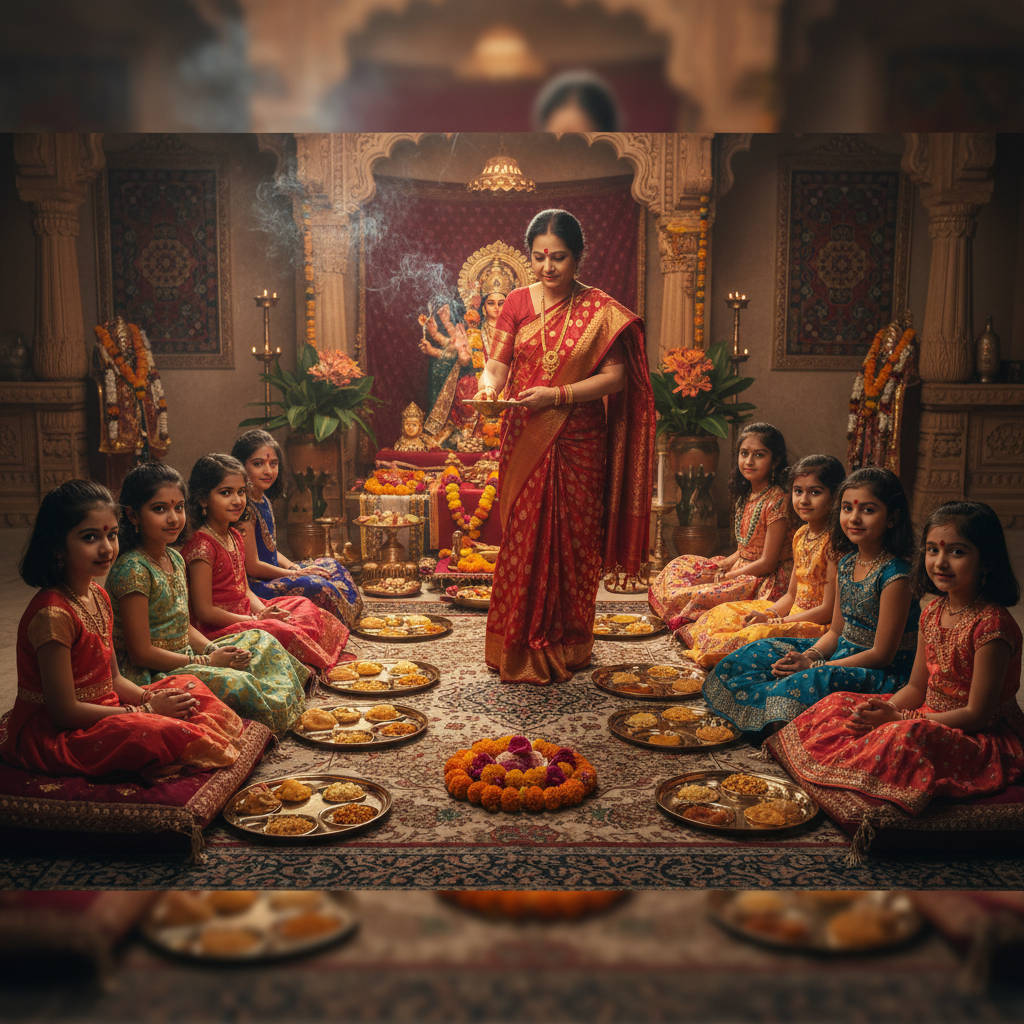
- Special practice: Kanya Puja (Worship of Young Girls) - traditionally done on Day 8 (some do it Day 9). Invite 9 young girls (between ages 2-10) to your home, wash their feet with milk and water, offer them food (puri-chana-halwa is traditional), give them a small gift or money, ask their blessing. The girls represent the 9 forms of Durga.
Day 9 - SIDDHIDATRI (सिद्धिदात्री)
- Form: Sits on a lotus or rides a lion. 4 arms - mace, discus, lotus, conch. Surrounded by gandharvas, yakshas, siddhas, asuras - all worshipping her. Represents the union of all divine powers.
- Significance: Bestower of all 8 siddhis (spiritual perfections): Anima, Mahima, Garima, Laghima, Prapti, Prakamya, Ishitva, Vashitva. The final form - represents spiritual fulfilment. Sun, Moon, even Shiva worship her - Shiva himself attained his half-female form (Ardhanarishvara) through her grace.
- Colour: Sky Blue / Purple. Symbolises infinite, cosmic, transcendent.
- Prasad: Sesame seeds, sesame sweets (til laddoo), traditional sweets like halwa-puri-chana.
- Mantra: 'Om Devi Siddhidatryai Namah' (108 times) or: 'Siddha Gandharva Yakshadyair Asurair Amaair Api, Sevyamana Sada Bhuyat, Siddhida Siddhidayini.'
- What to ask for: Spiritual liberation, attainment of life goals, completion of long-pending projects, deepest spiritual development.
- Special practice: Mahanavami Puja - the most elaborate puja of all 9 days is on Day 9. Many do a full hawan (fire ceremony) at home or temple. The kalash placed on Day 1 (Ghatasthapana) is now formally concluded. Some immerse the puja items in flowing water on this day (others wait until next morning, Dussehra).
Day 10 - VIJAYADASHAMI / DUSSEHRA (October 2, 2026):
Not technically Navratri but the conclusion. Celebrates:
- Victory of Durga over Mahishasura.
- Victory of Rama over Ravana (Ramleela ends with burning of Ravana effigies).
- Vidyarambham - first formal learning ceremony for children traditionally done on this day (writing first letters on rice).
Visit temples, perform Visarjan (immersion) of Durga idol (in Bengal especially), exchange sweets, distribute prasad.
Complete 9-Day Vidhi: How to Actually Do Navratri at Home

Preparation (day before Day 1):
1. Clean the puja room thoroughly. 2. Buy supplies: kalash (copper), mango leaves (5), coconut, raw rice (1 kg), barley seeds, red cloth, akshat (turmeric-coloured rice), red flowers, vermillion (kumkum), turmeric, ghee, cotton wicks, oil/ghee for diya, incense. 3. Print or buy a Durga Saptashati book (Devi Mahatmyam) - the main text for Navratri reading. 4. Decide your fast level (see below). 5. Get 9 colours of bindis/dupattas if you'll wear the daily colour theme.
Ghatasthapana (Day 1 morning, very important):
1. Time: During Brahma Muhurta (4-6 AM) or within the Abhijit Muhurta (around noon). Avoid Rahu Kaal of that day. Check panchang for exact muhurat. 2. Setup: Place a wooden plank (chowki) covered with red cloth in your puja room facing east. 3. Sow barley seeds: In a small clay or copper pot, place sand or soil. Sow barley (jau) seeds. Sprinkle water. This pot will grow green sprouts over 9 days - symbolises the goddess's vegetative aspect. 4. Establish the kalash: On a small pile of raw rice on the chowki, place the kalash (copper or clay pot). Fill with water from a clean source. Place 5 mango leaves inside the mouth, then a coconut on top (wrapped in red cloth optionally). Tie a sacred thread (kalava) around the kalash neck. 5. Invocations: Chant invocation mantras to invite all 9 forms of Durga + Lord Ganesha + the 9 planets to bless the kalash. A priest can be called for this; if doing yourself, follow a Navratri puja book. 6. First aarti: Do the first aarti to Durga. Light the akhand jyot (continuous flame diya) that should burn for all 9 days - refill with oil/ghee as needed.
Daily practice (Days 1-9):
Morning: 1. Bath and clean clothes (preferably the day's colour). 2. Open puja room, refill akhand jyot with ghee/oil. 3. Sprinkle water around the kalash. 4. Offer fresh flowers, akshat, kumkum. 5. Today's specific mantra (108 times with mala). 6. Read one chapter of Durga Saptashati (the text has 13 chapters - readers can do 1 chapter per day = 9 chapters minimum; serious devotees do all 13 daily). 7. Offer the day's specific prasad (see daily list above). 8. Brief aarti with the day's colour and flowers. 9. Distribute prasad - first to deity, then to family. 10. If you're fasting (see fasting types below), have your single sattvic meal at this point or as per your chosen schedule.
Evening: 1. Refill akhand jyot. 2. Evening aarti with full energy - sing Durga Aarti, Mahishasura Mardini stotra, or other devotional songs. 3. Read another portion of Durga Saptashati if morning reading was brief. 4. Personal meditation on the day's specific form (visualise the goddess in her described form for 5-10 minutes). 5. Sleep with the day's mantra mentally repeating.
Special practices on specific days:
- Day 1: Ghatasthapana (as above).
- Day 5 (or family-specific): Lalita Sahasranama recitation (some traditions).
- Day 7 (Kalaratri): Night puja after midnight.
- Day 8: Kanya Puja (invite 9 young girls).
- Day 9: Mahanavami main puja + hawan if doing.
- Day 10 (Vijayadashami): Visarjan (immerse barley sprouts in flowing water or sacred area), prepare for next year.
Fasting types (choose what you can sustain):
1. Full fast (Nirjala): No food, no water for entire 9 days. Only the most experienced spiritual practitioners attempt this. Medical risk - not recommended without guru guidance.
2. Phalahar fast: Only fruits, milk, water, certain sattvic non-grain foods (sabudana/tapioca, kuttu/buckwheat, singhada/water chestnut flour, rajgira/amaranth, plain potatoes, sendha namak/rock salt). No regular grains (rice, wheat, lentils), no onion, no garlic, no regular salt. This is the most common Navratri fast - sustainable for 9 days.
3. One-meal fast: One sattvic meal per day (usually at noon or before sunset). Otherwise milk, fruits, water. Less intense.
4. Sattvic diet only (no fast): Eat normally but strictly sattvic - vegetarian, no onion-garlic, no alcohol, no junk food. Light meals.
5. Strict 2-day fast: Fast on Day 1 (Pratipada) and Day 8 or 9 (Ashtami/Navami). Eat normally other days. The minimum acceptable Navratri observance.
Choose based on: your health, lifestyle, work demands, what your family does. Better to do a lighter fast consistently for 9 days than to do nirjala and break it on Day 4.
Things to AVOID during Navratri:
- Non-vegetarian food (mandatory).
- Alcohol, smoking, intoxicants (mandatory).
- Sexual activity (recommended for serious practitioners; modern householders maintain normal relations).
- Hair cutting, nail cutting, shaving (traditional - some skip the 9 days).
- Leather goods (during puja specifically).
- Watching violent or sexual content.
- Arguing or speaking harshly.
- Watching too much TV or scrolling on phone (defeats the spiritual focus).
Conclusion (Day 10 - Vijayadashami): 1. Final aarti to the goddess. 2. Take the barley sprouts (now grown 6-8 inches) - blessed sprouts represent prosperity. Distribute to family members to keep at home or wear on the head as blessing. 3. Immerse the kalash water in flowing water (river, lake) or sacred area. 4. Distribute final prasad. 5. Eat the first non-fast meal with family - traditionally a small celebration.
Navratri is one of the most spiritually intensive periods in the Hindu calendar. Done with even half-effort, it leaves you measurably changed - more peaceful, more disciplined, more connected to the Divine Feminine. Done with full effort, it can transform your year ahead.
Quick Answers
I'm new to Navratri - what's the minimum I can do that still counts?+
Minimum viable Navratri: (1) Light a diya in your puja room each evening for 9 days. (2) Recite the day's mantra at least 11 times each morning (Om Devi [today's name] Namah). (3) Eat vegetarian and sattvic for all 9 days (no meat, no onion-garlic, no alcohol). (4) Visit a Durga temple on Day 1 and Day 9 if possible. (5) Do Kanya Puja or contribute to one on Day 8 or 9. This minimum takes 10 minutes/day and counts as proper Navratri observance. You can expand in future years.
Can I do Navratri if I'm having my period during the 9 days?+
Traditional rule: skip the active puja, fasting, and entering puja room during your menstrual days (typically the first 3-4 days of cycle). Modern practice varies widely - some women maintain a 'mental' practice (silent mantra, internal devotion) during this time. The 5-6 days you're not on cycle, do full practice. If your period falls exactly during Ashtami/Navami, family elders can do the formal puja and you can participate from outside the puja room. There is no spiritual loss in this - tradition itself provides this accommodation. Personal choice on how strict to follow.
Can men/boys do Navratri or is it primarily a woman's festival?+
Absolutely men can and should participate. Navratri is for all devotees. Men perform Ghatasthapana, do all 9 days of puja, fast, do kanya puja (giving honor to young girls is a deeply male-engaged practice). In Bengal, Durga Puja is celebrated by entire communities including men. Garba dancing in Gujarat is mixed-gender. The goddess is the Divine Mother of all - males are her children too. The misconception that Navratri is 'for women' comes from modern times - traditionally entire families do it together.
What if I can't follow all 9 days due to work/travel - is partial Navratri OK?+
Yes - what you can do is better than nothing. Most committed devotees observe the most important days: Day 1 (Ghatasthapana), Day 7 (Saptami), Day 8 (Ashtami / Kanya Puja), Day 9 (Mahanavami). If you can do at least these 4, you have done substantive Navratri. Even fewer days - Day 1, Day 8, Day 9 - is acceptable observance for very busy modern householders. The most important: don't break the ekagrata (single-pointed focus) by mixing tamasic activities during these days. Even if you only do small puja, maintain sattvic conduct throughout.
About the author
Pandit Mahesh Trivedi · Festival Traditions & Panchang
Pandit Mahesh leads the festival-date and Panchang content on Vandnaa. He cross-references multiple regional panchangs (Drik, Vaishnava, Bengali, Marathi) for every festival date published on the site.
Meet the Vandnaa editorial team →