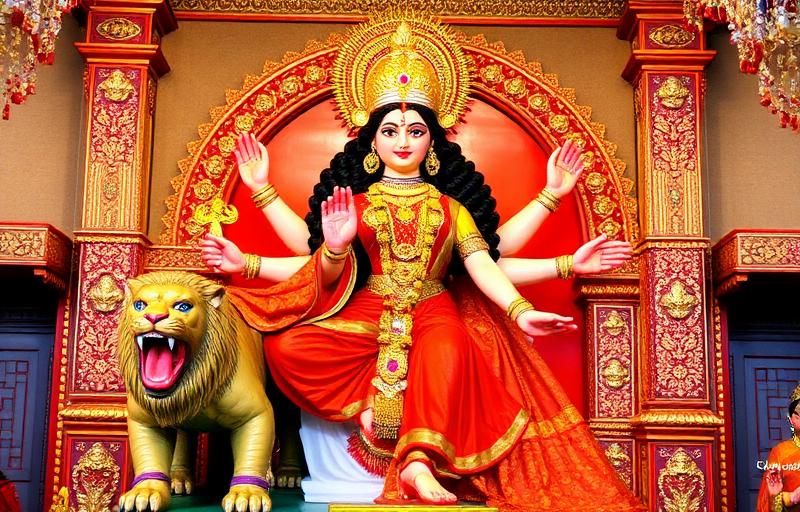
Why 9 Forms - Not 1, Not 108
Maa Durga is the cosmic feminine principle - Shakti - in human-perceivable form. Just as a woman's life passes through nine stages (childhood, youth, marriage, motherhood, maturity, etc.), Devi's journey from her birth to her ultimate form passes through nine distinct stages. Each stage has a name, a story, a specific mantra, a specific power.
These 9 forms are collectively called Navadurga - and they are worshipped sequentially across the 9 nights of Navratri.
The 9 forms in their canonical order: 1. Shailaputri - Daughter of the mountain (Day 1) 2. Brahmacharini - The unmarried ascetic (Day 2) 3. Chandraghanta - She who wears the moon as a bell (Day 3) 4. Kushmanda - The cosmic egg-creator (Day 4) 5. Skandamata - Mother of Skanda/Kartikeya (Day 5) 6. Katyayani - Daughter of sage Katyayan (Day 6) 7. Kalaratri - The dark night who destroys ignorance (Day 7) 8. Mahagauri - The radiantly fair one (Day 8) 9. Siddhidatri - The bestower of all siddhis (Day 9)
All 9 are the SAME goddess - but each form is the specific manifestation suited for specific blessings:
- Need protection? Worship Chandraghanta
- Want children? Worship Skandamata
- Removing enemies? Worship Kalaratri
- Spiritual perfection? Worship Siddhidatri
- Marriage? Worship Katyayani
Why Navratri spans 9 nights specifically: During Navratri, the cosmic Shakti is at its peak. Each night, one form 'descends' to bless devotees. Worshipping the wrong form on the wrong day reduces the punya. Worshipping the right form on the right day amplifies it 10-fold.
This blog details all 9 forms - story, iconography, mantra, color, bhog (sacred food), and specific blessings. Use this as your Navratri 2026 guide (Sep 19 – Sep 27, 2026 - Sharad Navratri) and 2027 (Sep 8 – Sep 16, 2027).
🙏 The Vandnaa App's Navadurga module includes audio of all 9 mantras with proper Sanskrit pronunciation, the Durga Saptashati (700-verse hymn) audio, and a 9-day Navratri puja schedule with reminders for each day's specific Devi.
Forms 1-5: Shailaputri to Skandamata
1. SHAILAPUTRI (Day 1 - Pratipada)
- Story: After Sati immolated herself, she was reborn as the daughter of the mountain king Himavat - hence Shailaputri (daughter of the mountain). She was destined to marry Shiva again.
- Iconography: Standing on a bull (Nandi), holding a trishul in right hand, lotus in left. Crescent moon on forehead.
- Color: Red (or grey)
- Bhog: Pure cow ghee (offer at her feet for good health for the year)
- Mantra: 'Om Devi Shailaputryai Namah.'
- Worship for: New beginnings, foundations, stability, good health (Mooladhara chakra activation)
- Special significance: As the first day, Shailaputri establishes the energy foundation for the entire 9-day Navratri.
2. BRAHMACHARINI (Day 2 - Dwitiya)
- Story: Reborn as Parvati, she did intense tapasya for thousands of years to win Shiva back. During this period of single-pointed devotion (brahmacharya), she ate only fruits, leaves, and finally only air.
- Iconography: Walking barefoot with a kamandalu (water pot) in left hand and a rudraksha mala in right.
- Color: Blue (or white)
- Bhog: Sugar (mishri) - symbolises sweetness of devotion despite hardship
- Mantra: 'Om Devi Brahmacharinyai Namah.'
- Worship for: Self-discipline, focused study (students), success in long-term goals, victory over distractions, Swadhisthana chakra balance
3. CHANDRAGHANTA (Day 3 - Tritiya)
- Story: When Parvati married Shiva, his unkempt appearance with snakes scared the wedding party. Parvati then assumed the Chandraghanta form - a fierce warrior goddess wearing a crescent moon (chandra) like a bell (ghanta) on her forehead. Her presence calmed everyone.
- Iconography: 10 arms holding weapons (sword, mace, bow, arrow, trishul, gada, kamandalu, etc.), riding a tiger, half-moon on forehead
- Color: Yellow
- Bhog: Kheer (milk-rice pudding)
- Mantra: 'Om Devi Chandraghantaayai Namah.'
- Worship for: Protection from danger, removing fear, building inner courage, Manipura chakra activation. Especially powerful for those traveling, in legal trouble, or facing hostile environments.
4. KUSHMANDA (Day 4 - Chaturthi)
- Story: When the universe was nothing but darkness, Devi smiled gently - and from her smile, the cosmic egg (Brahmanda) emerged. From that egg came the entire universe. Hence Kushmanda - 'creator of the cosmic egg'. She is the original creatrix.
- Iconography: 8 arms holding kamandalu, bow, arrow, lotus, jar of nectar, discus, mace, japa-mala. Riding a lion.
- Color: Green (or orange)
- Bhog: Malpua (sweet pancake) or pumpkin (kushmanda literally means pumpkin in Sanskrit)
- Mantra: 'Om Devi Kushmandaayai Namah.'
- Worship for: Creative success, removing infertility (her cosmic creativity blesses with biological creativity), Anahata chakra activation, abundant harvest. Recommended for couples trying to conceive.
5. SKANDAMATA (Day 5 - Panchami)
- Story: Devi gave birth to Skanda (also known as Kartikeya, Murugan, the warrior god who defeated demon Tarakasura). When Skanda was born, Devi was named Skandamata - Mother of Skanda. The image of Skandamata always shows her holding the infant Skanda.
- Iconography: 4 arms - holding lotus in 2, holding infant Skanda in another, blessing-mudra in the 4th. Sitting on a lotus, riding a lion.
- Color: Grey (or white)
- Bhog: Banana (her favorite - also Skanda's favorite)
- Mantra: 'Om Devi Skandamaataayai Namah.'
- Worship for: Children's welfare, healing children's illnesses, education for children, motherly protection. Vishuddha chakra activation. Worshipping Skandamata while pregnant is said to grant a healthy, intelligent child.
Forms 6-9: Katyayani to Siddhidatri
6. KATYAYANI (Day 6 - Shashthi)
- Story: Sage Katyayan performed severe tapasya wishing for Devi to be born as his daughter. Devi appeared as the demon-slaying form of Mahishasura-mardini and was raised in his ashram - hence Katyayani. She killed the buffalo-demon Mahishasura on this day, ending his terror over the three worlds.
- Iconography: 4 arms - sword, lotus, abhaya mudra, varada mudra. Riding a fierce lion. Often shown standing over the slain Mahishasura.
- Color: Orange (red-orange)
- Bhog: Honey (madhu) - sweetness she brings to victorious devotees
- Mantra: 'Om Devi Katyayanyai Namah.'
- Special - for unmarried girls seeking a husband: Katyayani is THE form to worship. The Bhagavata Purana describes how unmarried gopis worshipped Katyayani during Margashirsha month seeking Krishna as husband. Even today, unmarried women fast for 21 days during Navratri (or Margashirsha) chanting 'Katyayani Mahamaayaa Mahaayoginyadhishvari, Nandagopa-suta deveya patim me kuru te namah.' (Katyayani Mahamaaya, Goddess of Yogis, give me [Krishna's name OR my desired husband's qualities] as my husband.)
- Worship for: Marriage, removing relationship blocks, victory over enemies, Ajna chakra activation
7. KALARATRI (Day 7 - Saptami)
- Story: When demons Shumbha and Nishumbha threatened the gods, Devi assumed her most fearsome form - Kalaratri (the dark night). She is depicted as black-skinned, wild-haired, with bulging red eyes, riding a donkey, holding a sword and an iron hook. She is the destroyer of all darkness, ignorance, and evil.
- Iconography: Black/dark blue skin, 4 arms, sword, hook, vara mudra, abhaya mudra. Hair flowing wildly. Wearing skull-garland. Riding a donkey (gardabha) - symbol of humility and destruction
- Color: White (Kalaratri is dark; devotees wear white in contrast)
- Bhog: Jaggery (gud) - to absorb the day's intense energy
- Mantra: 'Om Devi Kalaraatryai Namah.'
- Worship for: Removing severe fear, breaking through paralysis-from-trauma, destroying enemies (visible and invisible), removing black magic. Sahasrara chakra activation begins on this day.
- Special note: Kalaratri is often equated with Kali Maa - but technically they are aspects of the same supreme Shakti. Kalaratri is one specific form within the Navadurga sequence; Kali is a more general/universal manifestation.
8. MAHAGAURI (Day 8 - Ashtami)
- Story: After Kalaratri's intense tapasya in dense forest, Devi's body had become dark from the heat. Shiva, recognizing her unmatched devotion, bathed her in the Ganga himself. Her skin transformed back to a radiant white-gold - she became Mahagauri (the great fair one).
- Iconography: Pure white skin (or fair gold), 4 arms - trident, damaru, abhaya mudra, vara mudra. Riding a white bull. Wearing white silk and many jewels.
- Color: Pink
- Bhog: Coconut (whole, broken before her image) - symbolizes pure devotion
- Mantra: 'Om Devi Mahaagauryai Namah.'
- Worship for: Cleansing past sins, returning to purity, marriage stability for married couples, removing chronic illness. Day 8 (Ashtami) is the most powerful Devi worship day in many traditions - many devotees invite 9 unmarried girls (Kanya) for Kanya Pujan today, treating each as a manifestation of Devi.
- Kanya Pujan ritual: Wash the feet of 9 girls aged 2-10, apply tilak, feed them puri-halwa-chana, give them gifts (clothes, money, fruits). Each girl is the living Devi for that day.
9. SIDDHIDATRI (Day 9 - Navami)
- Story: On the final day, Devi assumes her ultimate form - Siddhidatri, the bestower of all 8 siddhis (supernatural powers): Anima (becoming microscopically small), Mahima (becoming infinitely large), Garima (becoming infinitely heavy), Laghima (becoming feather-light), Prapti (obtaining anything), Prakamya (fulfilling any wish), Ishitva (lordship), Vashitva (control over all). It is said that even Lord Shiva attained his powers from Siddhidatri.
- Iconography: 4 arms - discus, conch, mace, lotus. Sitting on a lotus, riding a lion. Surrounded by Asuras, Devas, Siddhas, Yakshas, and Gandharvas all worshipping her.
- Color: Sky blue (or purple)
- Bhog: Til (sesame) and ghee - for obtaining siddhis
- Mantra: 'Om Devi Siddhidaatryai Namah.'
- Worship for: Spiritual perfection, attaining mastery in chosen path, ultimate moksha, removing the very last karmic obstacles. The day completes Navratri - devotees who completed all 9 days receive cumulative blessings of all 9 forms.
- Day 9 special: Many traditional households also celebrate Mahanavami havan - a fire ritual offering all 9 days' bhog into the fire, releasing accumulated devotional energy back to the cosmic Devi.
- The next day - Vijaya Dashami / Dussehra - celebrates Devi's victory over Mahishasura (and Lord Ram's victory over Ravana). It is the formal end of Navratri.
Complete 9-Day Navratri Puja Schedule (2026)
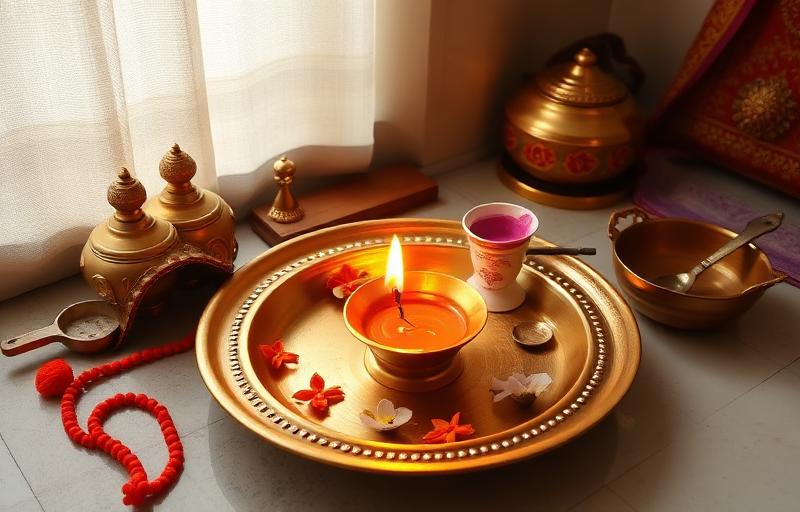
Sharad Navratri 2026: Saturday 19 September – Sunday 27 September 2026
(Vijaya Dashami / Dussehra: Monday 28 September 2026)
| Day | Date | Form | Color (Wear) | Bhog | Worship For | |---|---|---|---|---|---| | 1 | Sat 19 Sep | Shailaputri | Red | Ghee | New beginnings, health | | 2 | Sun 20 Sep | Brahmacharini | Blue | Sugar | Discipline, study | | 3 | Mon 21 Sep | Chandraghanta | Yellow | Kheer | Protection, courage | | 4 | Tue 22 Sep | Kushmanda | Green | Malpua | Creativity, fertility | | 5 | Wed 23 Sep | Skandamata | Grey | Banana | Children's welfare | | 6 | Thu 24 Sep | Katyayani | Orange | Honey | Marriage, victory | | 7 | Fri 25 Sep | Kalaratri | White | Jaggery | Removing fear, evil | | 8 | Sat 26 Sep | Mahagauri | Pink | Coconut | Purity, Kanya Pujan | | 9 | Sun 27 Sep | Siddhidatri | Sky Blue | Til + Ghee | Spiritual perfection |
Daily Puja Vidhi (5-10 minutes minimum):
Morning routine (any time before 12 noon): 1. Bathe and wear the day's color 2. Light a ghee diya before the Devi image 3. Offer that day's specific bhog 4. Apply roli + akshat + kumkum tilak on Devi's image 5. Recite that day's specific mantra 108 times on a tulsi mala 6. Read 1 chapter of Durga Saptashati (the 700-verse hymn) 7. End with 5-minute silent meditation on the form
Akhand Jyoti (continuous flame) - Highly Recommended: Light a ghee diya on Day 1 (Pratipada) at sunrise. Keep it continuously burning for all 9 days using a special long-burning system (large bowl of ghee, multiple wicks rotated, or specially-made akhand jyoti). The flame represents Devi's continuous presence in the home for 9 days. Many devotees report life-changing experiences with consistent akhand jyoti.
Fasting:
- Phalahar fast (fruits, milk, sabudana, makhana, sendha namak only) for the full 9 days - most popular
- Single-meal fast (one satvik meal per day)
- Nirjala fast (no food or water) - only on Ashtami or Navami, not all 9 days (too dangerous)
- No fast (just full mantra and puja) - completely valid for those with health constraints
Special Days within Navratri:
- Day 1 (Ghatasthapana / Kalash Sthapana): Set up the kalash with rice, water, mango leaves, coconut. Plant barley seeds in a separate clay pot - they should sprout by Day 9 (the speed of growth indicates how this year will go for you).
- Day 8 (Ashtami / Mahagauri / Kanya Pujan): Most powerful day. Invite 9 girls (kanya) and 1 boy (langur) for Kanya Pujan. Feed them puri-halwa-chana with great reverence.
- Day 9 (Navami / Siddhidatri): Final day. Many also do Kanya Pujan on this day. Hawan (fire ritual) is performed to release the accumulated energy.
- Day 10 (Vijaya Dashami / Dussehra): Burn Ravana effigy (north India), worship weapons (Shastra Puja), do new business launches, learn a new skill (this is the day of victory - start anything you have been delaying).
🙏 The Vandnaa App's Navratri 2026 module includes day-by-day reminders, color guidance, audio mantras, and a complete Durga Saptashati audio over 9 days.
Durga Saptashati: The 700 Verses Every Devotee Should Know About
The Durga Saptashati (also called Devi Mahatmya or Chandi Path) is a 700-verse text from the Markandeya Purana describing the goddess's victories over various demons. It is the most important sacred text for Devi worship and is traditionally recited during Navratri.
Structure of the Durga Saptashati:
The 700 verses are organized into 13 chapters, grouped into 3 Charitas (episodes):
Prathama Charita (First Episode - Chapters 1): The story of Madhu and Kaitabha. Vishnu asleep on Ananta Shesha. Brahma prays to Mahakali to awaken Vishnu. Devi awakens him; he destroys the two demons. This episode represents Tamas (darkness/inertia) being overcome.
Madhyama Charita (Middle Episode - Chapters 2–4): The story of Mahishasura, the buffalo-demon. He has defeated the gods and driven them from heaven. The gods pool their shakti and create Devi Durga. The great battle. Durga destroys Mahishasura on the 8th day. This is the most famous episode - the origin of Durgashtami. This represents Rajas (passion/aggression) being overcome.
Uttama Charita (Final Episode - Chapters 5–13): The stories of Shumbha and Nishumbha, and the creation of Chanda, Munda, Raktabija, and Kali. This section contains the most esoteric content - including Devi Kali's emergence from Durga's forehead and the Mahakali episode. This represents Sattva (ego/purity) being transcended.
The 3 Most Important Components:
1. Devi Kavach (Protective Armour): Recited before the main text. A prayer asking Devi to protect every body part - eyes, ears, throat, heart. Most useful for daily protection.
2. Argala Stotram: The "bolt" prayer that "opens" Devi's presence. 27 verses that invoke Devi's names and qualities.
3. Keelaka Stotram: The "pin" prayer that seals the effects of the recitation.
For Navratri Recitation:
Complete path (all 700 verses) during Navratri:
- Day 1–3 (Prathama Charita + beginning of Madhyama)
- Day 4–6 (Madhyama Charita)
- Day 7–9 (Uttama Charita)
Short daily practice: Devi Kavach + Argala Stotram + Keelaka + Devi Suktam (25 minutes total).
Vandnaa App's Devi section has the complete Durga Saptashati in audio - you can follow along with text and translation in Hindi and English.
9 Durga Forms as 9 Human Journeys: The Inner Navadurga

Beyond the mythological framework, the Navadurga sequence can be understood as a map of the human soul's journey from earth to liberation. Each form represents a stage of inner development.
The 9 Stages of Inner Transformation:
Shailaputri (Mountain's Daughter) - Stage 1: Groundedness The journey begins with foundation. Before any spiritual progress is possible, you must be rooted - emotionally stable, physically healthy, connected to the earth. Shailaputri is the practice of yoga, walking barefoot on grass, building routines. Many seekers want to jump to "higher" stages without this foundation - they fail.
Brahmacharini (The Disciplined One) - Stage 2: Directed Energy Once grounded, you must direct your energy. Brahmacharini represents the channeling of life-force into a chosen purpose. This includes sexual energy transmutation (traditional brahmacharya), but more broadly it is the principle of putting all your energy into a single direction rather than scattered across desires.
Chandraghanta (Moon Bell) - Stage 3: Courage to Face the Unknown The bell announces arrival and departure. Chandraghanta is the courage to enter the unknown - to face fears, to speak truth, to begin the journey despite not knowing the outcome. This is the courage of Arjuna standing on Kurukshetra.
Kushmanda (Cosmic Smile) - Stage 4: Creative Joy Kushmanda created the universe with her smile. At this stage, the seeker discovers that creation is not a burden - it is a joy. Work becomes play. This is the stage of Karma Yoga - acting without attachment to results, because the action itself is the offering.
Skandamata (Mother of Skanda) - Stage 5: Nurturing the Inner Child Skanda is the perfect spiritual warrior - focused, powerful, unmarried (not distracted by worldly attachment). Skandamata nurtures him. At this stage of the journey, you begin to nurture the spiritual warrior within you - protecting your spiritual practice with care and tenderness, as a mother protects her child.
Katyayani (The Righteous Warrior) - Stage 6: Engaging the World with Dharma Katyayani is the fierce form invoked against injustice. At this stage, the seeker stops avoiding the world and engages it - standing up for dharma, fighting for truth, confronting what needs to be confronted. The spiritual retreat ends; the spiritual engagement begins.
Kaalratri (The Dark Night) - Stage 7: The Dark Night of the Soul Every serious seeker goes through a period where everything seems to dissolve - beliefs, relationships, identity. This is the "dark night of the soul" described by St. John of the Cross and by every mystical tradition. Kaalratri presides over this stage - she is terrifying, but she destroys only the false. What she burns was never real.
Mahagauri (The Radiant) - Stage 8: Purified Radiance After the dark night comes the morning light. Mahagauri is the self after purification - luminous, white, clear. At this stage, the seeker has shed the false identities and is beginning to rest in their true nature.
Siddhidatri (Giver of Powers) - Stage 9: Complete Mastery The final stage is not personal achievement - it is dissolution of the personal in the cosmic. Siddhidatri doesn't keep the siddhis for herself; she gives them away. At this stage, the seeker becomes a vessel for others' blessings. The guru stage.
Vandnaa App's Meditation on Navadurga provides a guided audio for each day's inner journey - using the Devi form as a meditation object.
Frequently Asked Questions
Can I worship just one form of Durga instead of all 9 during Navratri?+
Yes - but the spiritual benefit is partial. The 9-day cycle is designed to invoke ALL aspects of Devi sequentially. Skipping forms reduces the cumulative blessing. However, scriptures DO permit a single-form worship in special cases: Katyayani for unmarried girls seeking marriage (21-day or 9-day intensive), Kalaratri for severe protection needs, Siddhidatri for sannyasis seeking moksha. For householders: do all 9 days even if briefly (5 minutes per day). The cumulative effect over 9 days is significantly greater than focused worship on one form. Even chanting just 'Om Devi [form-name] Namah' 9 times each day, on the right day, creates a complete Navratri energy in your home.
Why is Kanya Pujan so important on Day 8?+
Because Devi explicitly chose to manifest as a girl-child for this single ritual. The Markandeya Purana states: 'Whoever feeds and worships 9 girls aged 2-10 on Ashtami of Navratri, has actually fed and worshipped me.' This is a literal manifestation - not symbolic. The girls aren't merely 'representing' Devi; they ARE Devi for those few hours. This is why traditional families take the ritual extremely seriously: clean clothes, fresh food, respectful gifts, no indifference. Each girl is the living Mahagauri. The 9 girls + 1 boy combination represents the 9 forms of Devi + Lord Bhairava (who guards Devi). Many devotees report visible miracles after Kanya Pujan - sudden answers to long-pending prayers, financial breakthroughs, healing of family illness within weeks.
Is there a difference between Sharad Navratri and Chaitra Navratri?+
Yes - there are 4 Navratris in a year, but only 2 are widely celebrated. Sharad Navratri (September-October, the most famous one) - 9 forms worshipped sequentially, ends with Vijaya Dashami/Dussehra, celebrates Devi's victory over Mahishasura. Most public celebrations and Garba/Dandiya happen during this. Chaitra Navratri (March-April) - same 9 forms, ends with Ram Navami (the day Lord Ram was born). More private/spiritual focus. There are also two Gupta Navratris (Magha and Ashadha) - observed mainly by tantric sadhakas, not householders. For most householders: focus on Sharad Navratri (the public/family one) and Chaitra Navratri (the private/spiritual one). Both invoke the same 9 forms; the energy is similar but Sharad is more 'outer' and Chaitra more 'inner'.
Can men worship the 9 forms of Devi or only women?+
Absolutely - Navratri is universally for everyone. The 9 forms are aspects of cosmic Shakti - and Shakti is the divine feminine principle that ALL beings (regardless of biological gender) need. Lord Shiva himself is described as Devi's foremost devotee. Lord Ram worshipped Devi for 9 days before fighting Ravana - this is in fact why Vijaya Dashami (the day after Navratri) celebrates BOTH Devi's victory AND Ram's victory. Men can do all the same rituals: daily mantra, fasting, akhand jyoti, Durga Saptashati paath, Kanya Pujan. The only minor difference: in some Tantric traditions, certain advanced rituals are gender-restricted, but these don't apply to standard Navadurga worship. Encourage men in your family - fathers, husbands, sons, brothers - to participate fully in Navratri. The energy benefits the entire household.
What if I cannot fast for 9 days due to health/work - does Navratri still work?+
Absolutely. Fasting is ONE form of Devi worship - not the only or primary one. The 9-day mantra recitation, daily worship of the day's specific form, color-wearing, and bhog offering - these are all complete worship without fasting. Fasting is meant to enhance the spiritual focus by reducing physical demands; if it instead causes weakness, mental cloudiness, or work disruption, it defeats the purpose. Many serious sadhakas have done lifetime Navratri without fasting - focusing instead on intensive jap and seva. For those with diabetes, pregnancy, breastfeeding, surgery recovery, or demanding work - DO NOT fast. Eat normal satvik food (no onion-garlic on those 9 days) and focus on the daily mantra + 5-minute morning puja. Devi's blessing is NOT measured by hunger but by sincerity.
About the author
Acharya Vinaya Kapoor · M.A. Sanskrit, Mantra & Stotra Studies
Acharya Vinaya holds an M.A. in Sanskrit from Banaras Hindu University and writes the mantra and stotra commentary on Vandnaa. Her focus is on accurate pronunciation, traditional context, and helping modern readers connect with classical texts.
Meet the Vandnaa editorial team →Explore on Vandnaa
Related Articles
Sharad Navratri 2026: 9 Days Colors, Puja Vidhi, Vrat Rules & Kanya Pujan Guide
10 min read
Ashta Hanuman: The 8 Forms of Lord Hanuman, Their Significance, Mantras & Which One to Worship
12 min read
Durga Aarti Lyrics – Ambe Tu Hai Jagdambe Kali (दुर्गा आरती)
8 min read
Durga Saptashati – Meaning, Benefits & Reading Guide
9 min read