What Panchamrit Is and When It's Used
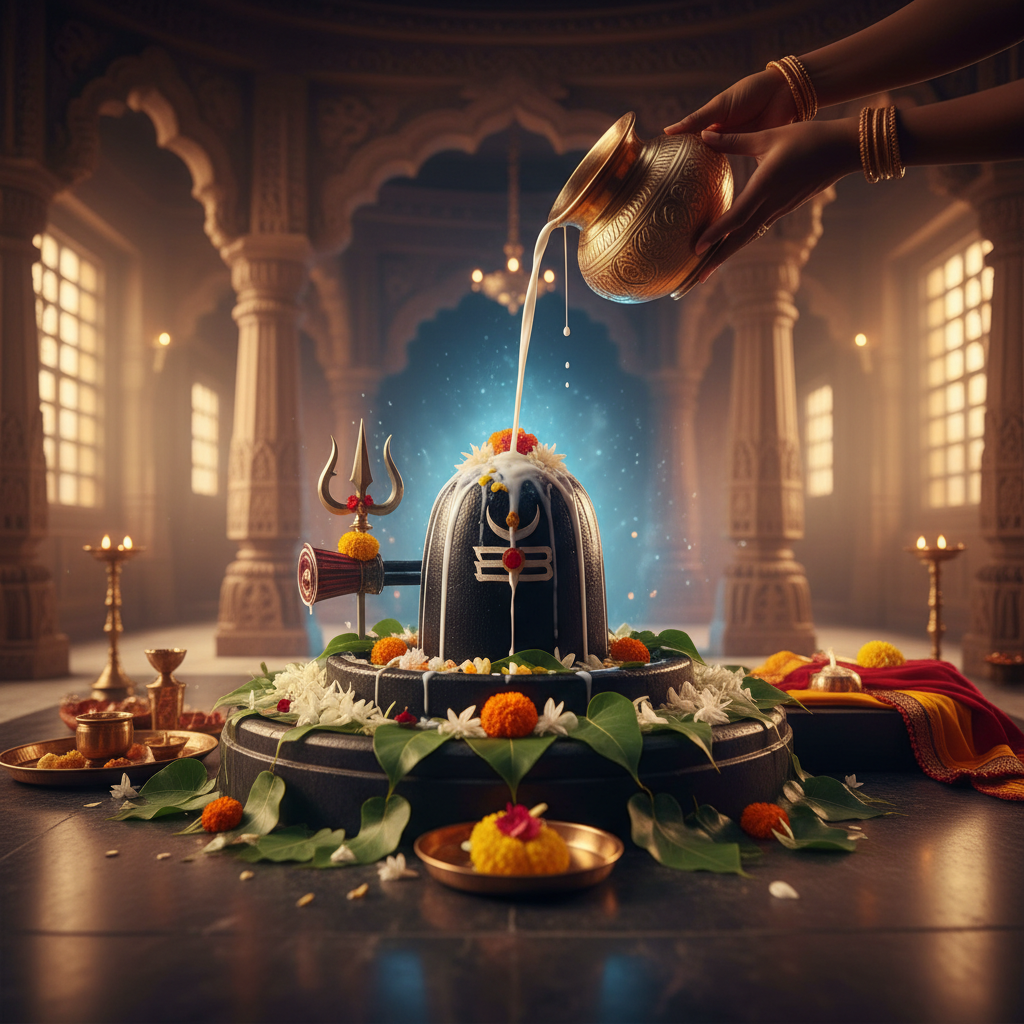
Panchamrit literally means "five nectars" - pancha for five, amrit for the nectar of immortality. It is a mixture of five specific ingredients, prepared fresh and used in two closely related ways during Hindu worship: poured over a murti or Shivling as part of abhishek, the ritual bathing of a deity, and distributed afterward to devotees as prasad, sacred food blessed by that contact with the divine.
The mixture appears across an enormous range of Hindu observances rather than being tied to one specific deity or festival. It plays a central role in Janmashtami celebrations of Krishna's birth, in Maha Shivratri abhishek, in the Satyanarayan Katha performed in homes for general wellbeing, and in countless smaller, everyday pujas where a devotee wants to offer something more elaborate than plain water.
What makes panchamrit distinct from an ordinary offering is that it is never treated as a single ingredient standing in for devotion. Each of the five components is added deliberately, in a customary order, and the combination is understood to be meaningful as a whole, not just a convenient recipe. Devotees preparing panchamrit at home are, in effect, assembling a small symbolic statement about what a well-lived, generous life looks like, one ingredient at a time, before ever pouring it over the deity.
The sections that follow look at each ingredient individually, since the tradition itself treats them that way rather than as interchangeable sweeteners in a jar. Even the vessel used matters to many families, who prefer preparing and offering panchamrit in a copper, silver or brass container rather than plastic or steel, extending the same intentionality to how the mixture is held as to what goes into it.
Milk (Doodh): Purity and Nourishment
Milk is usually the first ingredient added, and it sets the tone for everything that follows. In Hindu tradition, milk represents purity in its most basic form, an offering with no impurity or selfish intent mixed into it, and it is closely tied to the idea of motherly nourishment. The cow, from which this milk traditionally comes, holds a revered place in Hindu life precisely because of this quality of selfless giving, sustaining human life without asking anything in return.
Beyond purity, milk symbolizes the sustaining, life-giving quality of devotion itself. Just as milk nourishes a growing child before it can eat anything else, offering milk first in panchamrit represents the devotee's most basic, unconditional gesture of care toward the divine, the starting point before anything more elaborate is added.
Milk also carries a cooling, soothing quality in Ayurvedic thought, and its use in abhishek is partly understood through this lens as well: bathing a deity in milk is a gesture of soothing and honoring, not unlike how milk is offered to a guest or an infant as the gentlest thing one can give. This combination of purity, nourishment and gentleness is why milk anchors the entire panchamrit mixture rather than simply being one ingredient among five interchangeable ones.
Milk's central place in panchamrit also connects to its broader status in Hindu life. It is the first food most infants receive, it is offered to guests as a gesture of welcome, and it forms the base from which curd and ghee, the next two ingredients, are themselves derived. In that sense, milk is not just one of five equal parts but the source material from which much of the rest of the mixture grows, a small reflection of how devotion itself is meant to begin with something simple and pure before it becomes more elaborate.
Curd (Dahi): Growth, Prosperity and Multiplication
Curd is made from milk, but it is never treated as simply "aged milk" in this context. What matters symbolically is the transformation: a small amount of culture turns an entire pot of milk into curd, and that curd can, in turn, help make more curd. This process of one thing multiplying into more is precisely why curd represents growth and multiplication in the panchamrit tradition, most often connected to prosperity, offspring and the expansion of good fortune within a household.
Curd is also considered auspicious in its own right well beyond panchamrit. Many Hindu households keep a small amount of curd for tilak or for a bite before someone leaves on an important journey or attempts something significant, precisely because of this association with successful, multiplying outcomes rather than static ones.
There is a practical dimension too. Curd was, in a pre-refrigeration world, one of the more reliable ways to preserve the nutritional value of milk, meaning its inclusion in an ancient ritual mixture reflects genuine household wisdom about using dairy fully rather than wastefully. Nothing in panchamrit is filler; each ingredient earns its place through both symbolism and practical household relevance, and curd is a clear example of both working together.
- Curd represents transformation and multiplication, not simply preserved milk
- It is separately considered auspicious before journeys and important undertakings
- Its inclusion also reflects practical, resourceful use of dairy in traditional households
- The culture-and-multiply process is often used in teaching stories to explain how small, consistent effort compounds over time
Ghee: Strength, Victory and the Sacred Fire

Ghee, clarified butter, is the ingredient most directly connected to fire ritual. In a havan or yajna, ghee is the primary substance offered into the sacred fire, since it burns cleanly and is believed to carry offerings most effectively up to the deities being invoked. Its presence in panchamrit draws on this same association, linking the mixture to the broader tradition of fire offerings even though no flame is involved in abhishek itself.
Because of its role in yajna, ghee has become closely tied to strength, energy and victory in Hindu symbolism. Wrestlers and athletes in traditional akhadas consumed ghee as part of building physical power, and the substance is often described in texts as sustaining and fortifying, not merely a cooking fat. Including it in panchamrit is a way of offering strength and vigor to the deity, or by extension, asking for that same strength to be reflected back into the devotee's own life.
Ghee is also considered one of the purer dairy products in Ayurvedic thought, since the clarification process removes milk solids and water, leaving something concentrated and long-lasting, unlike raw milk or curd, which spoil quickly. This durability has made ghee, symbolically, an offering that represents something enduring rather than fleeting, a fitting middle ingredient bridging the softer qualities of milk and curd with the sharper, more energetic qualities of honey and sugar that follow.
Ghee used in panchamrit and abhishek is traditionally homemade, churned from curd rather than bought as a shortcut, in households that maintain the older methods, since the process of making it, however small in scale, is itself considered an act of devotion performed before the puja even begins.
Honey (Shahad): Sweetness of Speech and Unity
Honey brings a different kind of symbolism into panchamrit, one rooted in how it is made rather than only in how it tastes. Bees gather nectar from countless different flowers, often across a wide area and many species, and combine all of it into a single, unified substance. This process is frequently cited in Hindu teaching as a natural metaphor for unity within diversity, the idea that many different sources, efforts or even beliefs can combine into one harmonious whole without losing their essential sweetness.
Honey is also closely tied to speech. A common blessing and piece of everyday guidance in Hindu households is to speak "madhur vaani", sweet words, and honey in panchamrit is understood partly as a request and an offering related to this same sweetness, both what one speaks and what one receives from others. Offering honey to a deity carries an implicit prayer that one's own words remain gentle, honest and free of bitterness.
Unlike milk or curd, honey does not spoil in the way ordinary organic substances do, and this has given it an additional association with preservation and lasting sweetness, a blessing that is meant to endure rather than fade quickly. Combined with its connection to the industrious, cooperative nature of how it is produced, honey rounds out panchamrit with a quality none of the other four ingredients quite capture: sweetness earned through patient, collective effort rather than given freely and instantly. Some households also point out that only a small quantity of honey is ever used in the mixture, a reminder that its lesson is about concentrated sweetness rather than excess.
Sugar (Mishri): Joy, and What the Five Together Mean
The fifth ingredient, sugar or, in many households, mishri (rock candy), represents simple, uncomplicated joy and happiness. Where honey's sweetness is earned through collective effort, sugar's sweetness is direct and immediate, dissolving completely and leaving nothing bitter behind. This quality of dissolving without residue is often read symbolically too: a devotee's happiness, tradition suggests, should be offered without holding anything back or expecting something in return.
Some regional traditions substitute jaggery for refined sugar, which shifts the symbolism slightly toward natural, less processed sweetness, though the core meaning of uncomplicated joy remains the same across variations. Either way, sugar is generally added last, closing the mixture on a note of pure delight after the more complex meanings carried by milk, curd, ghee and honey.
Taken together, the five ingredients build a complete picture: purity and nourishment from milk, growth and prosperity from curd, strength and endurance from ghee, unity and sweet speech from honey, and joy from sugar. Some traditions also connect this five-part structure loosely to the idea of offering something whole and well-rounded back to the divine, not unlike how the pancha tattva, the five elements of earth, water, fire, air and space, are understood to make up a complete existence. Whether or not a devotee thinks in these deeper terms while stirring the mixture in their kitchen, the practice itself has quietly carried this five-part logic for centuries, which is part of why panchamrit still feels different from an ordinary sweet offering.
📿 The Vandnaa app's puja guides walk you through preparing panchamrit and other samagri correctly for your next abhishek.
Common Questions From Devotees
Can panchamrit be eaten as prasad after abhishek?+
Yes, this is in fact one of its primary purposes. After being offered to the deity during abhishek, panchamrit is distributed to devotees as prasad, considered blessed by that contact and safe and auspicious to consume.
What if one of the five ingredients isn't available at home?+
Most priests and family traditions allow preparing panchamrit with whatever ingredients are available, since sincerity of offering matters more than absolute completeness. A close substitute, like jaggery for sugar, is commonly and acceptably used.
Is there a fixed order for mixing the five ingredients?+
Many households follow milk, then curd, then ghee, then honey, then sugar, roughly the order of their symbolic meaning, though minor regional and family variations exist. Consistency within one's own family tradition matters more than a single universal rule.
Why exactly five ingredients, not four or six?+
The number five recurs across Hindu symbolism, echoing ideas like the pancha tattva, the five elements believed to compose existence. Panchamrit's five ingredients are traditionally understood as building a similarly complete, well-rounded offering.
Is panchamrit prepared the same way in every region of India?+
The core five ingredients are consistent, but proportions, the choice between sugar and jaggery, and whether items like tulsi leaves or Ganga jal are added at the end vary meaningfully by region and family custom.
Does panchamrit have any significance in Ayurveda?+
Several of its ingredients, particularly milk, ghee and honey, are individually valued in Ayurvedic thought for their nourishing and balancing qualities, though panchamrit itself is primarily a devotional preparation rather than a medicinal one.
About the author
Pandit Mahesh Trivedi · Festival Traditions & Panchang
Pandit Mahesh leads the festival-date and Panchang content on Vandnaa. He cross-references multiple regional panchangs (Drik, Vaishnava, Bengali, Marathi) for every festival date published on the site.
Meet the Vandnaa editorial team →