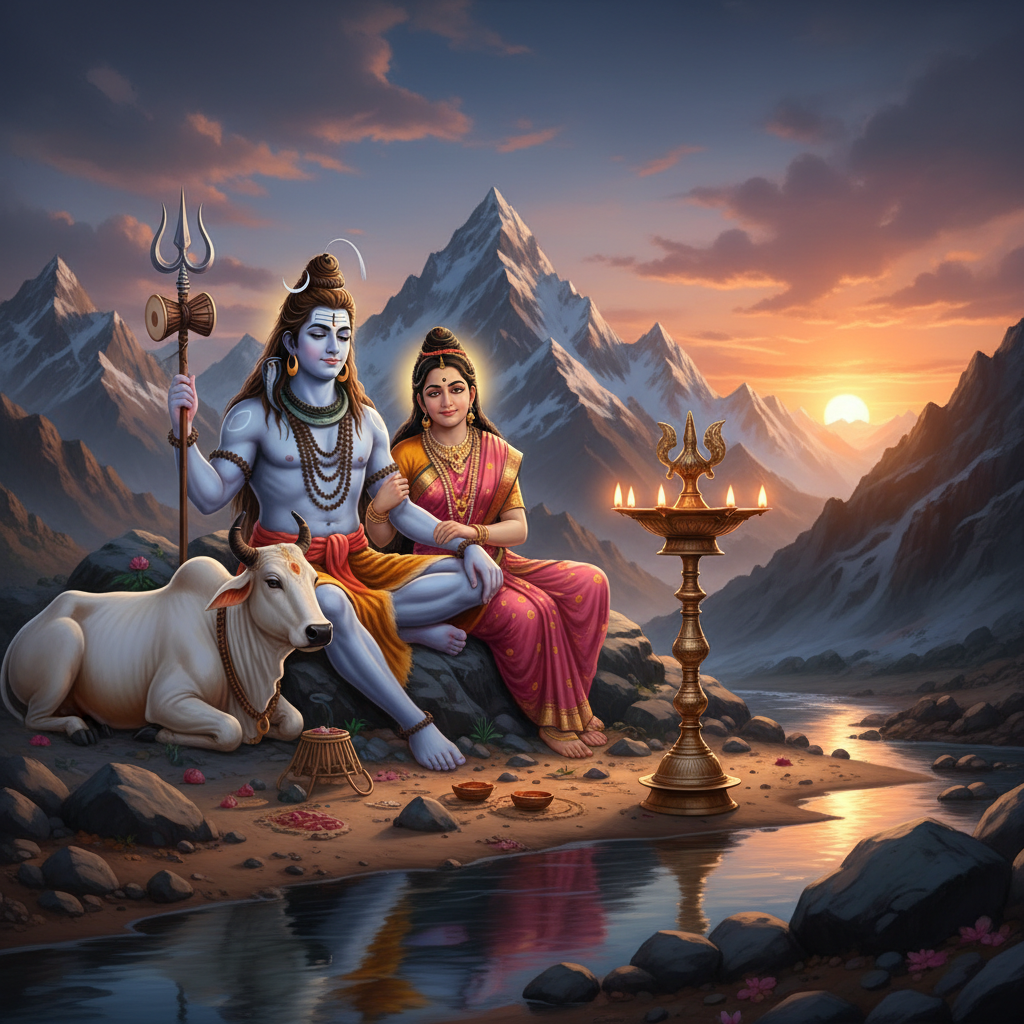
Two Fasts, One Deity, Two Different Days
Devotees of Shiva who follow the lunar calendar closely will notice that two distinct monthly observances appear in quick succession near the end of every fortnight: Pradosh Vrat and Masik Shivratri. Both are dedicated entirely to Lord Shiva, both recur every month rather than once a year, and both fall within a day or two of each other, which is precisely why they get mixed up so often, especially by newer observers building a personal vrat routine.
They are not the same observance under two names. Pradosh Vrat falls on the Trayodashi, the thirteenth tithi, and is anchored to the twilight hours just before and after sunset. Masik Shivratri falls on the Chaturdashi, the fourteenth tithi, the very next day in the Krishna Paksha, and is anchored instead to the depth of night. The two, in effect, form a natural back-to-back pairing in many months, twilight devotion followed by midnight devotion, though each has its own independent rules, katha and puja structure.
Both vrats are considered monthly rehearsals, in a sense, for the year's two largest Shiva festivals: Pradosh Vrat scales up annually into Maha Pradosh observances, while Masik Shivratri scales up once a year into Maha Shivratri, the single most significant night in the Shaiva calendar. Understanding how the monthly versions differ makes it much easier to appreciate what makes their annual counterparts special.
This guide compares the two directly, tithi by tithi and ritual by ritual, so you can tell at a glance which one a given date on your calendar refers to.
The Tithi Each One Falls On
The most fundamental difference between the two is the specific lunar day each occupies.
Pradosh Vrat falls on Trayodashi, the thirteenth day of both the waxing and waning lunar fortnights, meaning it occurs twice a month, once in Shukla Paksha and once in Krishna Paksha, giving twenty-four Pradosh Vrats across the year. Depending on which day of the week a given Trayodashi falls on, the vrat takes a special name: Som Pradosh on a Monday, considered especially auspicious, Bhauma or Mangal Pradosh on a Tuesday, associated with relief from debt, and Shani Pradosh on a Saturday, associated with relief from obstacles linked to Shani (Saturn).
Masik Shivratri, by contrast, falls only once a month, specifically on Krishna Paksha Chaturdashi, the fourteenth day of the waning fortnight, the day immediately before the new moon (Amavasya). This gives twelve Masik Shivratris across the year, one of which, falling in the month of Phalguna or Magha depending on the regional calendar, is elevated to Maha Shivratri, the grandest of them all.
- Pradosh Vrat: Trayodashi, both fortnights, roughly 24 times a year
- Masik Shivratri: Chaturdashi, Krishna Paksha only, 12 times a year
- Pradosh Vrat's name changes based on the weekday it falls on
- Masik Shivratri always falls the night before Amavasya
Because Trayodashi precedes Chaturdashi by definition, Pradosh Vrat in the Krishna Paksha of a given month typically falls just one day before that month's Masik Shivratri, which is the main source of the confusion between the two. Devotees new to either observance often find it useful to mark both dates on a calendar at the start of the month, since the exact gap between them is easy to misjudge from memory alone.
Twilight Worship vs the Depth of Night
The two vrats are also anchored to entirely different windows within the day, which shapes how each is actually observed.
Pradosh Vrat centres on Pradosh Kaal, the roughly ninety-minute window that spans from about forty-five minutes before sunset to forty-five minutes after it. This twilight period is considered the time when Lord Shiva is in a particularly graceful, dancing form, engaged in the cosmic Tandava, and is believed to be most receptive to devotees during precisely this window. The puja is therefore timed tightly around local sunset, and devotees typically observe a partial day fast, taking only a single sattvic meal, and complete their main worship before nightfall.
Masik Shivratri centres on Nishita Kaal, the middle of the night, generally the hour surrounding midnight. The vrat is nirjala or near-nirjala for many observers, extending from the previous sunrise through the following morning, and it is traditionally punctuated by worship at four separate intervals through the night, known as the Chaturdashi's char pahar puja, mirroring in miniature the structure followed on Maha Shivratri itself. Many devotees stay awake through some or all of the night in Shiva's honour.
- Pradosh Vrat: puja timed to roughly 90 minutes around sunset
- Masik Shivratri: puja centred on midnight, often extended across four night-time intervals
- Pradosh Vrat is typically a same-evening observance
- Masik Shivratri can extend into an overnight vigil for committed observers
This difference in timing is the clearest practical marker: if the ritual you are preparing for happens around sunset, it is Pradosh; if it stretches into the night, it is Masik Shivratri.
How the Puja Itself Differs

Beyond timing, the structure of worship carries its own distinctions worth knowing before you begin either vrat.
For Pradosh Vrat, the devotee typically bathes in the late afternoon, dresses in clean attire, and sits facing north or east as Pradosh Kaal approaches. The core ritual involves offering water, milk, bel leaves and white flowers to a Shiva Lingam, reciting the Pradosh Vrat katha, which recounts stories such as that of a poor Brahmin widow whose son's life was saved through devotion on this tithi, and performing a standing prayer (some traditions specify remaining standing through part of the puja) before the deity as dusk falls.
For Masik Shivratri, the ritual is more elaborate and sustained. Devotees perform an abhishek, a ritual bathing of the Shiva Lingam using milk, curd, honey, ghee and sugar in sequence (the panchamrit), followed by chandan and bel patra offerings, and chanting of the Maha Mrityunjaya Mantra or continuous Om Namah Shivaya japa. Where the four-pahar structure is followed, this entire sequence of abhishek and prayer is repeated four times through the night, at roughly three-hour intervals, with a fresh substance and a fresh verse of prayer at each stage.
- Pradosh Vrat: single evening puja, standing prayer, focus on Pradosh Kaal katha
- Masik Shivratri: night-long ritual, panchamrit abhishek, may repeat across four pahars
- Bel patra and water offerings are common to both
- Masik Shivratri's ritual is a compressed rehearsal of the annual Maha Shivratri sequence
🕉️ Vandnaa's app carries the Pradosh Vrat katha, the Masik Shivratri puja sequence and both sets of mantras, so devotees preparing for either evening always know exactly which ritual applies.
Can the Two Be Observed Together When They Fall Close By?
Because Trayodashi and Chaturdashi are consecutive tithis, Pradosh Vrat and that month's Masik Shivratri very often fall on back-to-back days, and occasionally, depending on the exact timing of tithi transitions, both can appear to overlap around a single sunset-to-midnight stretch. Devotees frequently ask whether observing one automatically covers the other, or whether both need to be kept separately.
Most tradition and most family priests treat them as two distinct vrats with two distinct purposes, even when adjacent. A devotee who wishes to honour both fully would observe the Pradosh puja at twilight on the Trayodashi, break that partial fast appropriately, and then begin the Masik Shivratri observance afresh as Chaturdashi begins, carrying it through to the following morning. It is entirely acceptable, and common, for a devotee to observe only one of the two if health, time or family custom does not allow for both; there is no tradition suggesting that skipping one diminishes merit earned from the other.
- Treat Pradosh Vrat and Masik Shivratri as two separate observances, even when adjacent
- It is acceptable to observe only one if circumstances do not allow for both
- Always confirm exact tithi timings for the specific month, since tithi start and end times shift and can occasionally cause a Trayodashi and Chaturdashi to fall on the same civil day
- Priests at a local Shiva temple are a reliable source for that month's precise Pradosh Kaal and Nishita Kaal timings
For devotees building a sustainable monthly practice, many choose to prioritise Som Pradosh (falling on a Monday) and Masik Shivratri consistently, treating the other Pradosh dates as optional, rather than attempting all twenty-four Pradosh Vrats plus twelve Shivratris every single year.
Benefits and Popularity: Who Tends to Observe Which
Both vrats are believed to bring the devotee closer to Shiva's grace, but tradition attaches slightly different emphases to each, which shapes who tends to gravitate toward one or the other.
Pradosh Vrat is widely associated with relief from specific difficulties tied to the weekday it falls on, financial stress relieved through Bhauma Pradosh, obstacles cleared through Shani Pradosh, and overall well-being through Som Pradosh, making it a popular choice for devotees seeking Shiva's help with a defined, practical concern. Its shorter, single-evening format also makes it more accessible to working professionals and those newer to a personal vrat practice.
Masik Shivratri carries a heavier association with spiritual discipline, inner transformation and the pursuit of moksha, themes drawn directly from Maha Shivratri, the night tradition holds Shiva performed his cosmic dance and the night many households treat as the most important of the entire Shaiva year. It tends to attract more committed, long-term sadhakas (spiritual practitioners) who are comfortable with an overnight vigil and a stricter fast.
- Pradosh Vrat: shorter, weekday-linked benefits, more accessible for beginners
- Masik Shivratri: longer, spiritually intensive, popular with committed practitioners
- Both, observed sincerely over time, are said to strengthen marital harmony, remove obstacles and deepen devotion to Shiva
- Neither vrat requires elaborate temple access; both can be observed fully at a home altar
Whichever of the two you choose to prioritise in your own monthly rhythm, knowing precisely which tithi, which hour and which ritual belongs to which name is the first step toward observing either with genuine confidence.
Common Questions From Devotees
What is the main difference between Pradosh Vrat and Masik Shivratri?+
Pradosh Vrat falls on Trayodashi and is observed around sunset, twice a month. Masik Shivratri falls on Krishna Paksha Chaturdashi and is observed around midnight, once a month, with a more intensive night-long ritual.
Can I observe both Pradosh Vrat and Masik Shivratri in the same month?+
Yes. Since they fall on consecutive tithis, many devotees observe the Pradosh puja at twilight and then begin the Masik Shivratri vrat as the next tithi begins, treating them as two separate observances rather than one continuous fast.
Is Masik Shivratri the same as Maha Shivratri?+
No. Masik Shivratri occurs every month on Krishna Paksha Chaturdashi. Maha Shivratri is the single, most significant one of these twelve, falling once a year, typically in the month of Phalguna or Magha, and is observed on a much larger scale.
Why does Pradosh Vrat's name change depending on the day of the week?+
Tradition attaches a specific added benefit to Pradosh Vrat depending on which weekday the Trayodashi falls on, so it is named accordingly: Som Pradosh on Monday, Bhauma or Mangal Pradosh on Tuesday, and Shani Pradosh on Saturday, each carrying its own particular significance.
What should I eat, if anything, during Pradosh Vrat and Masik Shivratri?+
Pradosh Vrat is usually observed with a single sattvic meal before the evening puja. Masik Shivratri is more often kept nirjala or fruit-only through the night, breaking the following morning after the final round of puja, though the exact practice varies by family and health considerations.
About the author
Pandit Mahesh Trivedi · Festival Traditions & Panchang
Pandit Mahesh leads the festival-date and Panchang content on Vandnaa. He cross-references multiple regional panchangs (Drik, Vaishnava, Bengali, Marathi) for every festival date published on the site.
Meet the Vandnaa editorial team →Explore on Vandnaa
Related Articles
Pradosh Vrat: Meaning, Significance, Benefits & Vidhi
8 min read
Masik Shivratri 2026 - Monthly Calendar, Vidhi, Mantras & Significance
10 min read
All 24 Ekadashis of the Year: Names and What Each Commemorates
7 min read

Dincharya: Structuring a Hindu Daily Spiritual Routine From Sunrise to Sleep
7 min read