What Is the Prashna Upanishad
The Prashna Upanishad belongs to the Atharva Veda and takes its name from prashna, meaning 'question'. It is structured as six chapters, each built around one seeker's question to the sage Pippalada.
Six students, all seeking knowledge of Brahman, approach Pippalada and live with him in disciplined study for a year before he agrees to answer. This format makes the Upanishad feel like a structured course of learning, moving from the nature of creation to the deepest teaching on the Self.
The Six Questions Asked to Pippalada
The first seeker asks where all creatures originate, and Pippalada answers through Prajapati, describing rayi (matter) and prana (life force) as the two root principles of creation. The second asks how many powers sustain a being, exploring prana's central role among the senses.
The third question examines prana itself: where it comes from and how it moves through the body. The fourth explores what remains awake within a person even during deep sleep and dream. The fifth turns to meditation on Om and where it leads after death, and the sixth asks about the Purusha with sixteen parts, bringing the dialogue to a close on the nature of the individual self.
The Meaning of Prana and Rayi
Central to the Prashna Upanishad is the idea that creation rests on two principles working together: prana, the active life force, and rayi, the substance it animates - compared to the sun and the moon, or fire and its fuel. Neither functions without the other.
Prana is also described as taking five forms within the body (prana, apana, vyana, udana, samana), each governing a different function such as breathing, digestion and speech. This detailed map of the life force was meant to help the seeker understand the body itself as a fit vehicle for the pursuit of Brahman.
How Devotees Approach This Teaching
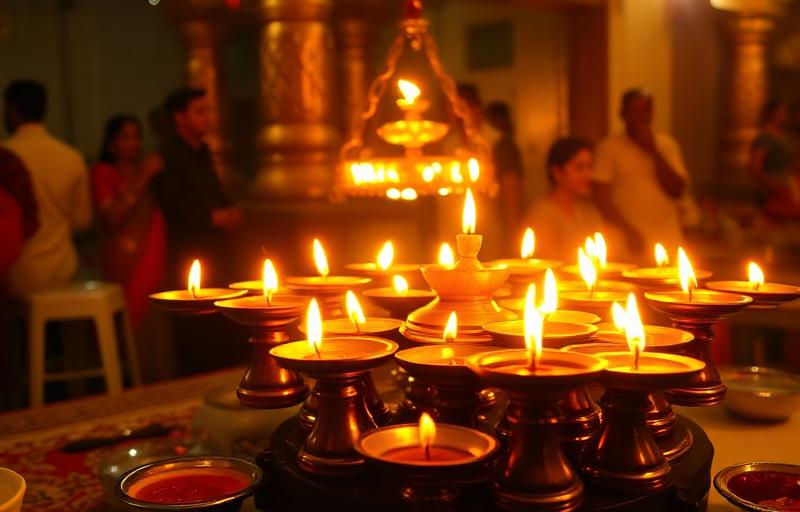
The Prashna Upanishad's format - a full year of disciplined living before receiving an answer - is often cited as a lesson in itself: understanding is earned through patience and preparation, not demanded instantly.
Its fifth question, on meditating upon Om, is widely practised even today; many devotees chant Om slowly and deliberately as a bridge between waking awareness and quieter states of mind, treating the syllable, as described in the Upanishad, as a support that carries the meditator toward higher understanding.
Benefits as Understood in Tradition
- Devotees believe understanding prana and rayi deepens respect for the body as a vehicle for spiritual life, not something to neglect
- The teaching on the states of sleep and dream is said to bring insight into the mind's own workings
- Meditation on Om, as taught here, is believed to steady and calm the mind over time
- As per tradition, the disciplined patience shown by the six seekers is considered a model for approaching any true learning
A Simple Takeaway for Daily Life
The Prashna Upanishad reminds us that real answers often take time and preparation, whether in spiritual life or ordinary decisions. It also gently points to the breath, prana, as something worth noticing - a few quiet, conscious breaths each day can be a small echo of its teaching.
Studying scripture like this, patiently and without rushing to a conclusion, is an act of faith and love, not a transaction.
Common Questions From Devotees
What is the Prashna Upanishad about?+
It records six deep questions that six seekers put to the sage Pippalada, covering the origin of creation, the nature of prana (life force), sleep and dream, meditation on Om, and the sixteen-part Purusha.
Who is Pippalada in the Prashna Upanishad?+
Pippalada is the sage who answers the six questions after the seekers live with him in disciplined study for a year, making him the central teaching voice of this Upanishad.
Which Veda does the Prashna Upanishad belong to?+
The Prashna Upanishad belongs to the Atharva Veda and is one of the principal Upanishads associated with this Veda, alongside the Mundaka and Mandukya Upanishads.
About the author
Anjali Mehta · Editor, M.A. Religious Studies
Anjali is the managing editor for Vandnaa and oversees the festival and vrat coverage. She holds an M.A. in Religious Studies and reviews every published article for accuracy, accessibility, and tradition-fidelity.
Meet the Vandnaa editorial team →