23 May 1867
Ramalinga Swamigal, called Vallalar, the great giver, 1823 to 1874, is the last major figure of the Tamil Shaiva line and the one who broke with most of it.
And the best place to start is not with his doctrine.
The Dharma Salai
On 23 May 1867, at Vadalur in South Arcot, he lit a fire in a kitchen.
And the instruction was that it should never be allowed to go out.
The Sathya Dharma Salai, the hall of true charity, is a free food house. Anybody who comes is fed, without question, without registration, without any test of who they are or what they believe or what caste they belong to.
And it is still running.
The fire has been kept burning since 1867, which is over a century and a half, and the kitchen has fed people through famines, through the end of company rule and the whole of the British administration, through independence, and through everything since.
Why he put this first
Because of a specific claim that runs through everything he wrote.
The greatest suffering is hunger.
And he means it literally and as a doctrine, not as a sentiment.
His argument:
- A hungry person cannot do anything else. Not think, not worship, not attend to any of the things religion asks people to attend to
- Therefore feeding them is not preliminary to the spiritual work. It is the work
- And a person who has food and does not share it while somebody in front of them is hungry has failed at the only test that was actually being administered
Jeeva karunyam
Compassion toward living beings, and it is the name of his central principle and the title of his prose treatise on it.
And his position is stronger than the usual one: he holds that jeeva karunyam is itself the direct means, not an ethical prerequisite for practice, and that the divine is reached through the relief of suffering and not through anything else.
Which reorders the whole apparatus. Worship, ritual, texts, mantras and philosophy are all downstream of whether you fed the person at the door.
And it follows for him that killing animals for food is out, because the same principle cannot be applied to human hunger and suspended for other creatures. He was strictly vegetarian and argued for it at length.
This app's note on that: that is his position, stated as his. Vandnaa does not require vegetarianism of its readers, dietary practice varies enormously across Hindu communities and regions, and this entry reports what Vallalar held rather than prescribing it.
Where he came from
Born 5 October 1823 at Marudur, near Chidambaram.
His father died when he was young and the family moved to Madras, where he was raised largely by his elder brother Sabhapati Pillai, who gave public discourses for a living.
And he refused to be schooled.
The accounts describe him declining formal instruction, being regarded as a problem, and being kept fed and defended by his brother's wife, Papammal, who is one of those women who appear in one line of a biography and hold the whole thing up.
And then he began to compose.
The famous episode has his brother, unable to attend, sending him to give a discourse in his place, and the young man delivering one that made his reputation.
And after that he moved south, to Chidambaram, then Karunguzhi, and finally Vadalur, and did not return to city life.
The Hall of Seven Veils
On 25 January 1872 he opened the Sathya Gnana Sabai at Vadalur.
The hall of true knowledge, and it is unlike any other building in Indian religion.
What is in it
A lamp.
And nothing else.
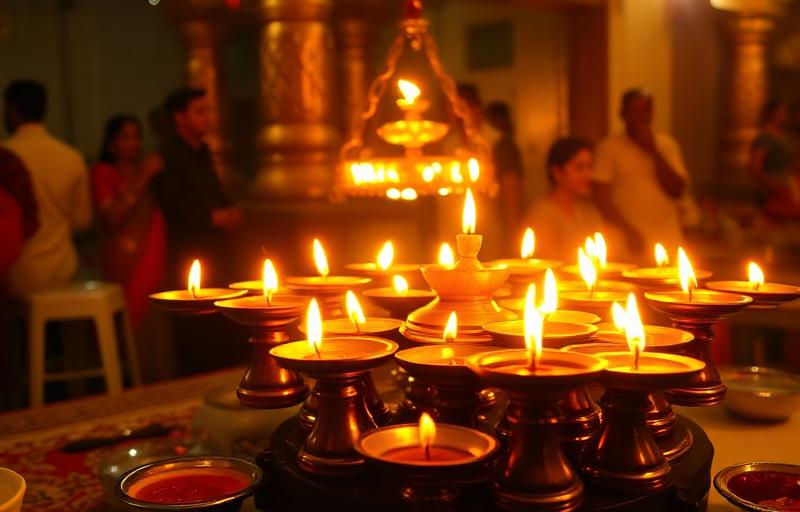
There is no image, no murti, no lingam, no figure of any kind. The object of attention is a flame, and it is placed behind seven screens, of seven colours, which are drawn aside on specified days.
What the seven screens mean
The coverings.
In his account they correspond to the layers that stand between a person and the light: the impurities, the veils of ignorance, the elements of the apparatus that obscures. The Shaiva Siddhanta material in this batch is behind this, especially anava, the primal covering that makes the soul small, and the fourth of Shiva's five acts, tirobhava, concealment.
And the drawing of the screens is the ritual. On the days when they are opened, one after another, and the flame becomes visible, that is the entire ceremony.
Which is a very strange thing to build in nineteenth century Tamil Nadu
Because of what he was breaking with.
He came out of the Shaiva Siddhanta world: he grew up on the Tirumurai, the Tevaram and the Tiruvachakam, his early poetry is full of the temples at Chidambaram, Thiruvottiyur, Thiruvannamalai and Thillai, and his verses on Nataraja are among the best in the later Tamil corpus.
And then he stopped.
In his later phase he rejected:
- Image worship
- Caste, entirely and explicitly, and this is one of the strongest anti caste positions in nineteenth century Tamil religion
- Religious division, including the division between religions
- Ritual as such, where it is not accompanied by the relief of somebody's suffering
- Animal sacrifice and the eating of meat
- The literal reading of puranic narrative
And what he put in its place is the Samarasa Suddha Sanmarga Sathya Sangam: the society of the true path of pure harmony.
And the word samarasa comes from Thayumanavar, whose entry precedes this one in this batch, a hundred and thirty years earlier, and it travels intact.
Where this app stands on the image question
Openly, since it comes up.
Vandnaa is a saguna devotional app. It has images, aartis, temples, festivals, murtis and deities throughout, and it is built for people whose practice runs through those.
Vallalar rejected them in his later years.
And both positions are inside the Hindu traditions, and they have argued for a very long time, and this app has recorded the same disagreement with the Dadu Panth, with Kabir, and with the whole nirguna line.
Reporting what somebody held is not adopting it, and a reader who lights a lamp in front of a picture is not being corrected by this entry.
The Arutperunjothi Agaval
His major work, one thousand five hundred and ninety six lines in the agaval metre.
Arut perum jothi: the vast light of grace, and the phrase is his signature. It appears as a refrain, it is what is on the flag at Vadalur, and it is the name of what the lamp behind the seven screens stands for.
The Thiruvarutpa
His collected songs, in six volumes.
And the title caused the fight.
The Arumuga Navalar controversy
In 1869 a serious public dispute broke out.
Arumuga Navalar of Jaffna was one of the most important Tamil figures of the nineteenth century: a Shaiva reformer, the man who effectively created modern Tamil prose, a formidable editor who produced reliable editions of the Shaiva canon, and an educationist.
And he attacked the Thiruvarutpa, in print, arguing that the title was illegitimate: that arutpa, song of grace, was a term belonging to the Tirumurai canon, and that calling a contemporary work by it was a usurpation. His pamphlet is titled with a pun, contrasting arutpa with marutpa, deluded song.
How to hold that
As a real disagreement between two serious reformers, and not as a story with a villain.
Navalar's position is a position about canon: a scriptural corpus closed centuries ago should not be extended by a living person, and the discipline of not doing so is what keeps a tradition from dissolving.
Vallalar's position is that grace did not stop.
And both men spent their lives on Tamil Shaivism, both were reformers, both attacked practices they thought were corrupt, and they disagreed sharply about where the line was.
Which is what a living tradition looks like from the inside.
The Body of Light, and the Warning That Goes With It
The part of his teaching that needs the most care, and this app is going to be direct about it.
What he taught
That the physical body can be transformed and death avoided.
His account has three stages:
- Suddha deham, the pure body, in which the physical body is purified
- Pranava deham, the body of sound or of light
- Gnana deham, the body of wisdom
And he said the process was under way in his own body. The accounts describe him saying his body was changing, becoming golden, and eventually casting no shadow.
The disappearance
On 30 January 1874, at Mettukuppam, he went into a room and told his followers to lock the door and not open it.
He told them he would not be found, and that he would be dispersed into everything, and that they should not look for him.
The door was locked.
And afterwards the British administration had it opened, the district authorities being unwilling to leave the matter as it stood.
And the room was empty.
How this app treats that
Reporting what the record contains, and not more.
What is on the record: that he went in, that the door was secured, that the authorities opened it, and that nothing was found. This was reported at the time and it is part of the documentary history, not only of the tradition's own memory.
What cannot be established: what actually happened. Naturalistic explanations have been offered and none of them can be confirmed either, and there is no way from here to settle it.
And this app is not going to assert a miracle or deny one. It is going to say what the record says.
Now the warning, and it is serious
The deathless body teaching is actively dangerous in the wrong hands, and it is currently in the wrong hands.
What is being sold, right now, in India and abroad:
- Immortality programmes and light body courses, for money
- Breatharianism and inedia: the claim that a sufficiently advanced practitioner does not need food, and can live on light, air or prana
- Instructions to stop eating, in stages, as a spiritual practice
- Instructions to stop medical treatment, because medicine interferes with the transformation
And people have died.
Not metaphorically. There are documented deaths from attempted breatharian fasting, in India and elsewhere, and there are deaths from people with treatable conditions stopping their medication on a teacher's instruction.
So, plainly
Do not stop eating. Nobody has ever demonstrated survival without food under any controlled condition, and the people making the claim have consistently been found eating.
Do not stop your medication. Not for any teaching, any teacher, any transformation, any programme. If you have diabetes, epilepsy, hypertension, tuberculosis, a heart condition or a mental illness, the medicine is what is keeping you alive.
Do not pay anybody for immortality. It is the oldest fraud there is.
And if somebody is pressuring you or a family member to fast beyond safety or to abandon treatment, that is a matter for the family and if necessary for the police. Police 112. Tele MANAS 14416.
And on Vallalar himself
Two things, held together.
His teaching on the transformed body is his teaching, it is in the texts, and this entry is not going to pretend otherwise.
And it is not what he built.
What he built is a kitchen that has fed people continuously since 1867, a hall with a lamp and no image, and a body of poetry, and a principle that the relief of hunger is the highest worship.
Nobody has ever been harmed by the kitchen.
And a person who wants to follow Vallalar has an unusually clear instruction available: he told them exactly what to do, and it is to feed people, and it does not require anything else.
The Short Version
Who: Ramalinga Swamigal, called Vallalar, the great giver, 1823 to 1874, the last major figure of the Tamil Shaiva line and the one who broke with most of it. Born 5 October 1823 at Marudur near Chidambaram, raised in Madras largely by his elder brother Sabhapati Pillai after their father died, defended and fed by his brother's wife Papammal when he refused formal schooling. He moved south to Chidambaram, then Karunguzhi, then Vadalur.
The kitchen: on 23 May 1867 he lit a fire in a kitchen at Vadalur, the Sathya Dharma Salai, with the instruction that it never be allowed to go out. Anybody who comes is fed, without question, registration or any test of who they are or what they believe. It is still running and the fire has been kept burning for over a century and a half, through famines, the whole of the British administration, independence and everything since.
Jeeva karunyam: compassion toward living beings, his central principle. His claim is that the greatest suffering is hunger, meant literally and as doctrine: a hungry person cannot do anything else, so feeding them is not preliminary to the spiritual work but is the work, and a person who has food and does not share it has failed the only test being administered. He held that jeeva karunyam is itself the direct means rather than a prerequisite. It follows for him that killing animals for food is out, and he was strictly vegetarian, though this app reports that as his position rather than requiring it of readers.
The Sathya Gnana Sabai: opened 25 January 1872 at Vadalur. It contains a lamp and nothing else, with no image of any kind, placed behind seven screens of seven colours which are drawn aside on specified days, corresponding to the coverings that stand between a person and the light. In his later phase he rejected image worship, caste entirely and explicitly, religious division, ritual unaccompanied by the relief of suffering, animal sacrifice and meat, and the literal reading of puranic narrative, and put in their place the Samarasa Suddha Sanmarga Sathya Sangam. The word samarasa comes from Thayumanavar, a hundred and thirty years earlier.
The controversy: in 1869 Arumuga Navalar of Jaffna, a Shaiva reformer who effectively created modern Tamil prose, attacked the Thiruvarutpa in print, arguing that arutpa, song of grace, belonged to the Tirumurai canon and that a contemporary work using it was a usurpation. It was a real disagreement between two serious reformers about where the line of canon sits, not a story with a villain.
The disappearance: on 30 January 1874 at Mettukuppam he went into a room, told his followers to lock it and not look for him, and said he would be dispersed into everything. The British administration later had it opened and it was empty. That is what the record contains. What actually happened cannot be established.
The warning: his teaching that the body can be transformed into suddha, pranava and gnana deham and death avoided is currently being used to sell immortality programmes, breatharianism and instructions to stop eating and stop medication. People have died. Do not stop eating, do not stop your medication for any teaching or teacher, and do not pay anybody for immortality. What Vallalar actually built is a kitchen, and nobody has ever been harmed by it.
Quick Answers
Who was Vallalar?+
Ramalinga Swamigal, 1823 to 1874, called Vallalar, the great giver, the last major figure of the Tamil Shaiva line and the one who broke with most of it. He was born at Marudur near Chidambaram, raised in Madras largely by his elder brother Sabhapati Pillai after their father died, and defended and fed by his brother's wife Papammal when he refused formal schooling. He founded the Sathya Dharma Salai, a free food house at Vadalur, in 1867, and the Sathya Gnana Sabai, a hall containing a lamp and no image, in 1872, and taught the Samarasa Suddha Sanmarga, the true path of pure harmony, whose central principle is jeeva karunyam, compassion toward living beings.
What is the Vadalur Dharma Salai?+
The free food house Vallalar founded at Vadalur in South Arcot, whose kitchen fire he lit on 23 May 1867 with the instruction that it never be allowed to go out. Anybody who comes is fed, without question, without registration, and without any test of who they are, what they believe or what caste they belong to. It is still running, and the fire has been kept burning for over a century and a half, through famines, the whole of the British administration, independence and everything since. It is the concrete legacy of his teaching that the greatest suffering is hunger and that relieving it is the highest worship.
What is jeeva karunyam?+
Compassion toward living beings, Vallalar's central principle and the title of his prose treatise on it. His claim is that the greatest suffering is hunger, meant literally and as doctrine rather than as sentiment. His argument is that a hungry person cannot do anything else, cannot think or worship or attend to any of the things religion asks people to attend to, so feeding them is not preliminary to the spiritual work but is the work; and that a person who has food and does not share it while somebody in front of them is hungry has failed at the only test that was actually being administered. His position is stronger than the usual one, since he holds that jeeva karunyam is itself the direct means rather than an ethical prerequisite for practice, which reorders the whole apparatus: worship, ritual, texts, mantras and philosophy are all downstream of whether you fed the person at the door.
What is inside the Sathya Gnana Sabai at Vadalur?+
A lamp, and nothing else. There is no image, no murti, no lingam and no figure of any kind. The object of attention is a flame, placed behind seven screens of seven colours which are drawn aside on specified days, and in Vallalar's account the screens correspond to the layers standing between a person and the light, the impurities and veils of ignorance, which connects to the Shaiva Siddhanta concept of anava, the primal covering that makes the soul small, and to tirobhava, the concealing act among Shiva's five. The drawing of the screens is the entire ceremony. The hall was opened on 25 January 1872.
What happened to Vallalar in 1874?+
On 30 January 1874, at Mettukuppam, he went into a room and told his followers to lock the door and not open it, saying he would not be found, that he would be dispersed into everything, and that they should not look for him. The door was locked, and afterwards the British administration had it opened, the district authorities being unwilling to leave the matter as it stood, and the room was empty. That is what the record contains, and it was reported at the time rather than existing only in the tradition's memory. What actually happened cannot be established: naturalistic explanations have been offered and none of them can be confirmed either. This app reports what the record says and neither asserts a miracle nor denies one.
Can the body really be made deathless?+
Nobody has ever demonstrated it, and this teaching is currently being used to sell dangerous things. Vallalar taught a transformation of the physical body through suddha deham, pranava deham and gnana deham, and said the process was under way in his own body, and that is in the texts. What is being sold now on the strength of it includes immortality programmes and light body courses for money, breatharianism and inedia, the claim that an advanced practitioner can live on light or air, instructions to stop eating in stages, and instructions to stop medical treatment because medicine interferes with the transformation. People have died, not metaphorically: there are documented deaths from attempted breatharian fasting and from people with treatable conditions stopping medication on a teacher's instruction. Do not stop eating, since survival without food has never been demonstrated under controlled conditions. Do not stop your medication for any teaching or teacher. Do not pay anybody for immortality. If somebody is pressuring you or a family member, that is a matter for the family and if necessary the police: 112, and Tele MANAS 14416.
About the author
Pandit Ravindra Sharma · Vedic Rituals & Bhakti, 22+ years
Pandit Ravindra is the Vandnaa editorial team's resident specialist on aarti, chalisa, and daily devotion. He has performed home and temple pujas across Varanasi and Delhi for over two decades and contributes the bhakti-focused articles on this site.
Meet the Vandnaa editorial team →