What the Word Itself Says
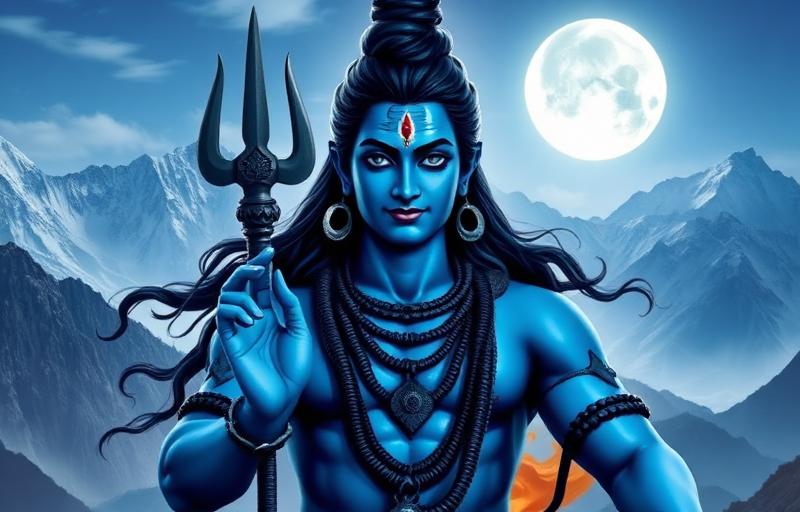
Rudraksha is a compound of two Sanskrit words: Rudra, one of Shiva's oldest names, associated in the Vedas with a fierce, storm-linked aspect of divinity that later becomes fully identified with Shiva himself, and aksha, meaning eye or, in this particular compound, tear. Taken together, the word means, quite directly, the tears of Rudra.
The fullest account of how those tears became a physical tree is found in the Rudraksha chapters of the Shiva Purana and the Padma Purana, and the two main tellings differ on why Shiva was crying, though both keep the same basic mechanism: real tears, falling from Shiva's eyes to the earth, taking root and growing into the Rudraksha tree, whose hard, ridged seeds are what devotees wear today.
One version places the moment after an extended period of deep meditation: Shiva, opening his eyes after a very long tapasya, is overcome, on seeing the suffering of ordinary beings in the world he has been withdrawn from, and weeps out of compassion for what he sees. In this telling, the tree is born directly from an act of grief for other people's pain, which is why Rudraksha is so often described in devotional literature as carrying Shiva's own compassion within it.
A second, more martial version places the tears after a great battle, sometimes specified as the war against Tripurasura, connecting the tree to the same episode where Shiva destroys the three flying cities - here the tears are read less as sorrow for the world in general and more as the release that follows a period of extreme, sustained concentration and effort.
From Tears to a Botanical Fact
The tree the tradition names, Elaeocarpus ganitrus, is a real, identifiable species, growing primarily in the Himalayan foothills of Nepal and northern India, along with parts of Southeast Asia, and the seed inside its fruit, dried and cleaned of its outer husk, is what becomes the bead strung into a rudraksha mala.
The seed's surface is naturally divided into vertical grooves called mukhi, faces, and the number of these divisions on a given seed, ranging from one to as many as twenty-one in rare specimens, is treated in the tradition as significant, with different mukhi counts associated with different deities or purposes: a five-faced (panch mukhi) rudraksha, by far the most common, is associated with Shiva's five faces and is the standard bead used in general japa; rarer counts, particularly the one-faced ek mukhi, are treated as considerably more significant and correspondingly rarer to find genuinely.
The practice of stringing 108 rudraksha beads into a mala for japa, the repeated recitation of a mantra, is one of the most widespread devotional objects in Hindu practice generally, not confined to Shaiva worship specifically, though its origin story remains tied to Shiva.
A rudraksha mala's specific association with Rudra's own tears is part of why it is treated in classical texts as carrying protective and purifying qualities beyond its use as a simple counting tool - wearing or using the actual physical remnant of Shiva's grief or compassion is understood as maintaining a direct, tangible connection to him, distinct from an image or a symbol that merely represents him.
What This Origin Story Still Shapes
Because the story attaches the tree's origin to a moment of Shiva's own compassion or emotional release, rudraksha is treated in devotional practice as unusually democratic among sacred objects: unlike temple access, priesthood or certain forms of Sanskrit ritual knowledge, which have historically carried restrictions by caste or gender in various parts of the tradition, wearing rudraksha has generally been treated as open to any devotee, of any background, without special qualification, which many traditional teachers connect directly back to a tear having no caste and no gender in the first place.
Maha Shivratri, the major annual festival dedicated to Shiva, is the occasion on which new rudraksha malas are most commonly purchased, consecrated and worn for the first time, and the beads are frequently gifted at this time specifically because of their association with Shiva's own emotional presence rather than only his iconographic attributes like the trishul or the crescent moon.
The five-faced rudraksha's specific link to Shiva's five faces (Sadyojata, Vamadeva, Aghora, Tatpurusha and Ishana, the Panchamukha Shiva known from other Puranic and Tantric contexts) is one of the clearer places in Hindu material culture where a widely worn devotional object, a botanical seed, and a specific theological framework about the nature of Shiva's own form are all directly and explicitly linked in one continuous chain.
For a reader new to the tradition, the story is worth knowing less as a piece of trivia about a popular bead and more as a specific claim the tradition makes about where devotion actually comes from: not manufactured, in this telling, by any craftsman or committee, but grown, quite literally, from an emotion Shiva himself once had.
What People Ask Most
Was Shiva crying from sadness or from joy when the Rudraksha tree was born?+
Different Puranic tellings give different reasons - one places the tears as compassion for the suffering of ordinary beings after a long meditation, another places them after a great battle as a release following intense effort - but both keep the same tree-from-tears mechanism.
What does the number of faces (mukhi) on a rudraksha bead mean?+
It refers to the natural vertical grooves on the seed's surface, and different mukhi counts are associated with different deities or purposes in the tradition - the five-faced (panch mukhi) rudraksha, linked to Shiva's five faces, is by far the most common and is used as the standard bead for general japa.
Which tree actually produces rudraksha seeds?+
Elaeocarpus ganitrus, a real botanical species growing primarily in the Himalayan foothills of Nepal and northern India and parts of Southeast Asia - the seed is taken from inside its fruit, after the outer husk is removed.
Is there a restriction on who can wear rudraksha?+
Unlike some other forms of ritual access in the tradition's history, wearing rudraksha has generally been treated as open to any devotee regardless of background, which many teachers connect to its origin as an ordinary human emotion, a tear, that carries no such distinction.
About the author
Pandit Mahesh Trivedi · Festival Traditions & Panchang
Pandit Mahesh leads the festival-date and Panchang content on Vandnaa. He cross-references multiple regional panchangs (Drik, Vaishnava, Bengali, Marathi) for every festival date published on the site.
Meet the Vandnaa editorial team →