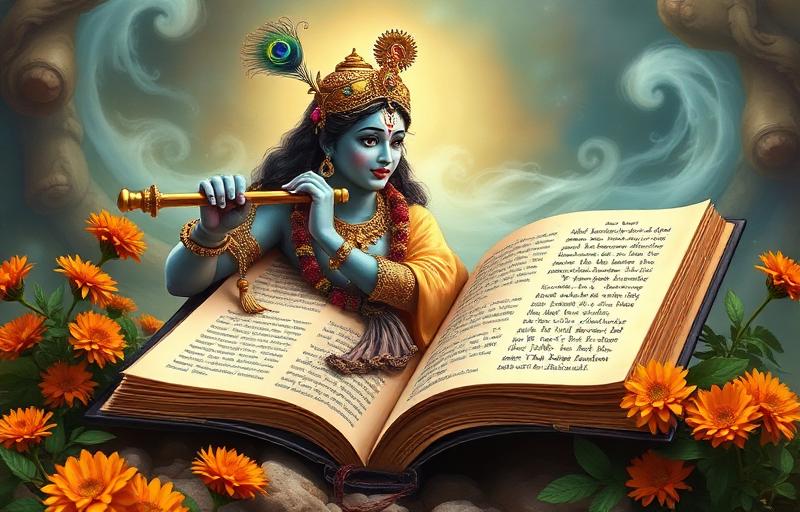
A Flower That Started With Narada
The episode begins with the sage Narada, who, having brought a single celestial Parijata flower down from heaven, presented it not to Krishna's chief queen Rukmini but specifically to Satyabhama, deliberately, in most tellings, to test or stir some reaction between Krishna's wives. Satyabhama, delighted with the flower's extraordinary fragrance and beauty, asked Krishna directly for the tree itself, not merely more flowers from it, wanting the entire Parijata transplanted to her own garden.
The tree's origin
The Parijata was, according to the Puranas, one of the treasures produced during the Samudra Manthan, the churning of the cosmic ocean, and had come to be planted specifically in Indra's garden in heaven, Nandanavan, under his personal care and protection rather than growing freely available anywhere else.
Krishna's response
Rather than refuse the request as impossible or excessive, Krishna agreed to bring the tree to earth for Satyabhama, and travelled to heaven, mounted on Garuda, specifically to retrieve it - setting up a direct confrontation with the very god under whose personal care the tree had been kept.
The Fight With Indra Over One Tree
Indra, unwilling to simply hand over one of heaven's own treasures on request, resisted, and a battle broke out between Krishna and the assembled forces of heaven, with Indra himself eventually engaging Krishna directly. The confrontation, as told across the Puranas, ends with Krishna prevailing, not through the tree's value being conceded but through the underlying point being made plain: that Krishna, an avatar of Vishnu himself, held a claim heaven's own king was ultimately not in a position to contest by force.
Indra, defeated and having recognised who he was actually contending with, relented and allowed the tree to be taken, and Krishna carried the Parijata back to earth and had it planted in Satyabhama's own garden at Dwarka, fulfilling the request precisely as she had made it.
The condition attached to the tree
What makes the story more than a simple wish granted is a specific detail several tellings include: the Parijata, though planted in Satyabhama's garden, is described as bearing flowers that fall on Rukmini's side of the shared grounds, or, in other versions, the tree's blossoms and fragrance are arranged to benefit the household more broadly rather than remaining Satyabhama's exclusive possession, a detail read as a gentle correction built into the story itself, undercutting any reading of the episode as rewarding possessive jealousy between the queens outright.
How This Fits the Wider Satyabhama Story
This episode sits within the wider Bhagavata narrative of Satyabhama's character, which repeatedly presents her as intensely devoted to Krishna and unusually assertive and self-possessed among his queens compared to the more measured Rukmini, a contrast the tradition draws deliberately across several connected stories rather than treating either queen's temperament as simply better than the other's.
Satyabhama's most famous appearance elsewhere is fighting alongside Krishna against Narakasura (a story told fully in its own episode elsewhere in the tradition), where she takes an active combat role unusual for a queen consort in this literature, killing Narakasura herself in some versions rather than merely accompanying Krishna. Read alongside the Parijata episode, the two stories together build a consistent picture of a queen whose desires and assertions Krishna takes seriously and acts on directly, rather than deflecting.
What the story is generally read to illustrate
Beyond its role in Satyabhama's characterisation specifically, the Parijata episode is often cited in devotional commentary as an illustration of Krishna's willingness to go to genuinely extraordinary lengths, confronting heaven's own king directly, for what might otherwise seem a small, personal request from someone he loves, treating the sincerity and warmth of the request as sufficient reason regardless of its apparent scale.
What People Ask Most
Why did Satyabhama ask for the whole Parijata tree instead of just more flowers?+
After Narada presented her with a single celestial flower, Satyabhama was so taken with its extraordinary fragrance and beauty that she wanted the entire tree transplanted permanently to her own garden rather than relying on further gifts of individual flowers, and asked Krishna directly for it.
Why did Krishna have to fight Indra to get the Parijata tree?+
The Parijata, one of the treasures produced during the Samudra Manthan, had been planted in Indra's own heavenly garden, Nandanavan, under his personal care. Indra was unwilling to simply hand over one of heaven's treasures on request, leading to a battle that ended with Krishna prevailing once the confrontation made clear who he actually was.
Did Satyabhama keep the Parijata tree entirely for herself?+
Several tellings include a detail that softens exclusive ownership: the tree, though planted in Satyabhama's garden, is described as dropping its flowers onto Rukmini's side of the shared grounds, or otherwise benefiting the wider household, which is generally read as a gentle correction against the episode being understood simply as rewarding possessiveness.
About the author
Anjali Mehta · Editor, M.A. Religious Studies
Anjali is the managing editor for Vandnaa and oversees the festival and vrat coverage. She holds an M.A. in Religious Studies and reviews every published article for accuracy, accessibility, and tradition-fidelity.
Meet the Vandnaa editorial team →