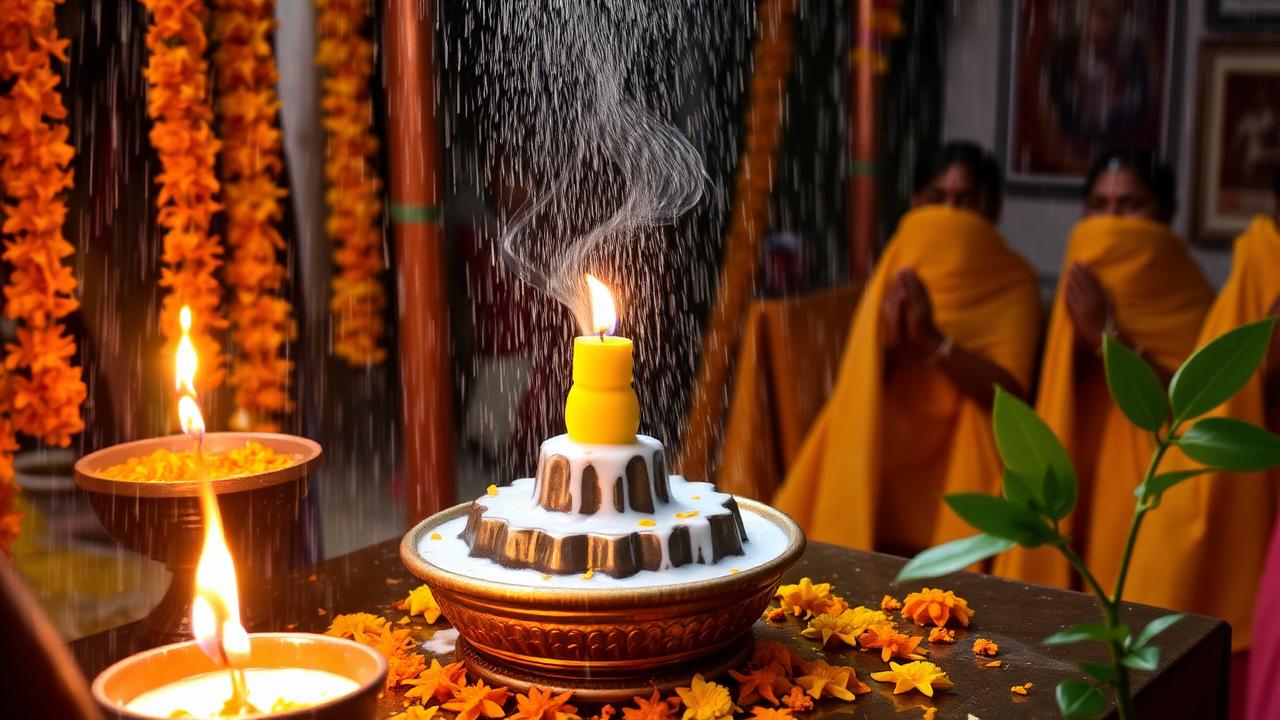
What Is Jalabhishek and Why It Matters in Sawan
Jalabhishek - from jal (water) and abhishek (ritual bathing) - is the single most fundamental act of Shiva worship, and the one every other form of abhishek (milk, honey, panchamrit) is built on top of. In its simplest form, it is nothing more than pouring water over a Shivling with devotion. In Sawan, it becomes something closer to the month's central ritual act.
The practice traces directly to the Samudra Manthan story: after Shiva swallowed the Halahala poison to save creation and held it in his throat, becoming Neelkanth, the devas poured water over him continuously to ease the burning sensation the poison caused. Every jalabhishek performed today, in a home or a grand temple, is understood as a small re-enactment of that same act of cooling and caring for Shiva - which is why water offered with sincerity is considered to please him even more than expensive offerings given without attention.
What makes jalabhishek distinct from just 'giving water' is the intention and correctness with which it is offered - the type of water, the vessel, the manner of pouring, and the mantras that accompany it all shape it into a ritual act rather than a mechanical one. Priests often note that a devotee who does not know elaborate Sanskrit but pours water with genuine feeling, focus and the basic sequence correct, is understood to receive the same blessing as an elaborate temple ceremony.
This guide walks through exactly how to do it correctly at home - the vessel, the water, the flow, your own posture, and the mantras - so that Sawan's simplest ritual is also performed properly.
Choosing the Right Vessel and Water
The materials used for jalabhishek are not arbitrary - tradition specifies preferences for both the vessel and the water itself, though it also allows for reasonable substitution when the ideal option is not available.
The vessel (lota or abhishek patra):
- Copper is the most widely preferred material, since copper is believed to purify water it touches and is closely associated with Shiva worship specifically.
- Brass and silver are also considered acceptable and are commonly used, especially in temples.
- A small hole or spout at the base is ideal, since it allows a slow, continuous, controlled stream rather than a sudden pour - a purpose-built abhishek patra (sometimes called a dhara patra, hung above the Shivling to drip continuously) achieves this automatically.
- Avoid steel or plastic vessels for the ritual itself if possible, though these are not strictly forbidden - copper and brass are simply the preferred tradition.
The water:
- Gangajal (water from the Ganga), even a small bottled quantity mixed into a larger vessel of regular water, is considered the most auspicious option and is what most households keep specifically for festivals like Sawan.
- Plain, clean water is entirely acceptable on its own when Gangajal is not available - purity of source matters less than purity of intention, and tradition is clear that devotion, not the water's origin, is what Shiva values most.
- Water should be at room temperature, not ice-cold, out of basic respect for the ritual, and should be fresh, not water that has been sitting out uncovered for days.
- Some households add a few tulsi leaves or a pinch of raw rice (akshat) to the water as an additional gesture, though this is optional and regional rather than universal.
Step-by-Step Jalabhishek Method
With the vessel and water ready, the actual ritual follows a specific, learnable sequence:
1. Preparation: Clean the Shivling (or the area around your home altar) with plain water first if it has been a few days since the last puja. Light a diya and incense before beginning.
2. Face the right direction: Devotees traditionally face east or north while performing abhishek, with the Shivling positioned so that its jal-hari (the water outlet channel at its base) points north - if using a home Shivling, check that it is placed this way.
3. Sankalp: Sit or stand calmly for a moment, close your eyes, and silently or aloud state your intention for the puja - even a simple 'I offer this water to Lord Shiva with devotion' is a complete sankalp.
4. Begin pouring: Lift the vessel with both hands (a gesture of respect and full attention) and begin a slow, steady, unbroken stream of water directly onto the top of the Shivling, letting it flow down naturally over the sides and out through the jal-hari.
5. Chant continuously: As you pour, chant Om Namah Shivaya or another Shiva mantra (see below) on repeat - the chanting should roughly match the duration of the pour, so a longer abhishek naturally invites more repetitions.
6. Complete the stream without interruption: Traditionally, once started, the pour should not be abruptly stopped and restarted multiple times within a single round - a smooth, unhurried single stream is preferred over several short bursts.
7. Close with pranam: Once the water vessel is empty, offer a final pranam, then proceed to bel patra and other offerings if your puja includes them.
🔱 The Vandnaa App's step-by-step Sawan puja guide walks you through this exact sequence with on-screen prompts, useful the first few times until the order becomes second nature.
Flow Rate and Correct Body Position

Two details devotees frequently overlook - how fast the water flows and how they physically position themselves - are actually specified fairly clearly in traditional practice, even though they are rarely explained in most quick guides.
Flow rate: The ideal jalabhishek is a thin, continuous, unbroken stream, not a rapid dump of water. A commonly cited guideline compares the correct flow to a thin thread (sutra dhara) - visible, steady, unhurried. Pouring too fast wastes water without adding devotion, while a stream that is too thin or keeps breaking can feel more like distraction than ritual. Practically, tilt the vessel gradually rather than all at once, and adjust so the stream neither splashes loudly nor trickles so slowly that it takes excessive time.
Duration: There is no single fixed duration - home abhishek is often 2-5 minutes per offering (water, then each additional substance if doing a fuller abhishek), while temple rudrabhishek can run considerably longer as multiple priests take turns. What matters more than total time is that the stream remains steady throughout whatever duration you choose.
Body position: Devotees may sit or stand; both are acceptable, and the choice mostly comes down to the height of your Shivling setup and personal comfort or mobility. What tradition is more specific about is not turning your back to the Shivling once the puja has begun, and maintaining a straight, attentive posture rather than a slouched or distracted one, since abhishek is considered an act requiring your full presence, not something done half-attentively while multitasking.
A practical note for home setups: placing a plate, small basin, or the drainage-channel Shivling stand underneath catches the water for reuse in the garden or for tulsi, keeping the practice both respectful and water-conscious.
Mantras to Chant During Jalabhishek
Any of the following can accompany the water offering, chosen based on your familiarity, available time, and specific intention - there is no requirement to use all of them in a single sitting.
For a simple, everyday abhishek: 'Om Namah Shivaya' - repeated continuously through the pour. This five-syllable Panchakshari mantra is considered complete on its own and needs no elaboration; it is the single most-used mantra for jalabhishek across India.
For a more elaborate or health-focused abhishek: Mahamrityunjaya Mantra - 'Om Tryambakam Yajamahe Sugandhim Pushtivardhanam, Urvarukamiva Bandhanan Mrityor Mukshiya Maamritat.' Particularly favoured when the abhishek is offered with an intention for health, protection or overcoming a difficulty, and traditionally chanted 11 or 108 times.
For a Vedic, more formal abhishek: Rudrashtakam or Shri Rudram verses - typically chanted by a priest or a devotee familiar with Vedic recitation, common in temple settings and grander home ceremonies. If you do not know these by heart, playing a recording while you pour is considered entirely acceptable.
A short alternative for beginners: 'Om Sadyojataya Namah, Om Vamadevaya Namah, Om Aghorayaya Namah, Om Tatpurushaya Namah, Om Ishanaya Namah' - the five-fold invocation of Shiva's principal aspects, used by some households as a slightly more elaborate but still accessible option.
A practical note on pace: the chant should feel unhurried and matched to your breathing rather than rushed to fit a specific count - if you lose track of repetitions, simply continue chanting until the water offering itself is complete, since the water and the mantra are meant to conclude together, not the mantra racing ahead or trailing behind.
Home vs Temple Jalabhishek: A Practical Guide
Both settings are entirely valid, and the choice usually comes down to practicality, time, and personal preference rather than one being spiritually superior to the other.
Home jalabhishek - advantages:
- Complete control over timing, so it fits around a work or family schedule, especially valuable on a weekday Sawan Somwar.
- No crowds or queues, which allows a slower, more unhurried, meditative pace.
- Ability to personalise the mantras and duration to your comfort level, especially useful for beginners still learning the sequence.
- Requires only a small Shivling (widely available in brass or stone, even a few inches tall) and basic samagri, making it accessible to any household.
Temple jalabhishek - advantages:
- The energy of a temple, and often a priest guiding correct pronunciation and sequence, which some devotees find deepens their experience.
- Access to a Jyotirlinga or a historically significant Shivling during Sawan carries additional significance for many devotees, particularly on Shivratri or the first and last Somwar.
- Community aspect - performing abhishek alongside other devotees, especially during the long queues and collective energy of Sawan Mondays at major temples like Kashi Vishwanath or Mahakaleshwar.
A realistic approach for Sawan 2026: many devotees do both across the month - a quiet daily or weekly practice at home, combined with at least one temple visit, often timed to the first Somwar (3 August) or Shivratri (11 August) when temple energy and crowds are at their peak. Neither setting is required to make the other invalid; what matters, in both cases, is that the water is offered with genuine attention rather than as a mechanical gesture rushed through to get to the next task.
Common Questions From Devotees
What is jalabhishek and why is it important in Sawan?+
Jalabhishek is the ritual pouring of water over a Shivling, symbolically re-enacting how the devas cooled Shiva after he drank the Halahala poison. It is the most fundamental Shiva ritual, especially central during Sawan.
What vessel should be used for jalabhishek?+
Copper is the most preferred vessel material, followed by brass and silver, ideally with a small hole or spout for a slow, continuous stream. Plain vessels can be used if these are unavailable.
How fast should the water flow during jalabhishek?+
The ideal flow is a thin, steady, unbroken stream, sometimes compared to a fine thread, rather than a fast pour. This should continue smoothly for the duration of the abhishek without frequent stopping.
Which mantra should I chant during jalabhishek?+
Om Namah Shivaya is the most common choice for everyday abhishek. The Mahamrityunjaya mantra is often used when the intention is health or protection, while Rudrashtakam suits a more elaborate ceremony.
Can jalabhishek be done at home without a priest?+
Yes. A sincerely performed home jalabhishek with the correct sequence, a steady water stream, and genuine attention is considered to carry the same spiritual value as an elaborate temple ceremony.
What is the difference between jalabhishek and rudrabhishek?+
Jalabhishek uses only water, while rudrabhishek is a fuller ceremony that includes water plus other substances like milk, honey, curd and ghee offered in sequence, usually accompanied by more extensive Vedic chanting.
About the author
Acharya Vinaya Kapoor · M.A. Sanskrit, Mantra & Stotra Studies
Acharya Vinaya holds an M.A. in Sanskrit from Banaras Hindu University and writes the mantra and stotra commentary on Vandnaa. Her focus is on accurate pronunciation, traditional context, and helping modern readers connect with classical texts.
Meet the Vandnaa editorial team →