What Is Seemantonnayan and When It Is Performed
Seemantonnayan is one of the sixteen traditional samskaras, or life-cycle sacraments, observed in Hindu tradition, performed during pregnancy to bless the wellbeing of the mother and the unborn child. Today it is more widely and popularly known as Godh Bharai, and celebrated as a joyful gathering of the women of the family.
The timing of the ceremony is guided by family and regional custom, and varies considerably, with different communities observing it in different months of the later part of pregnancy. Rather than following one universal rule, most families simply follow their own family tradition, choosing a time when the mother-to-be feels comfortable.
At its heart, the occasion is a collective prayer for a safe and healthy delivery, and an expression of the family's joy and anticipation for the child soon to arrive.
Samagri and Items Used in Seemantonnayan
- New clothes, a saree, or bangles for the mother-to-be
- Kumkum, haldi, chandan and akshat
- Fresh flowers
- A coconut
- Betel leaves and betel nuts
- A photo or small idol of the family deity for blessing
- Seasonal fruits and a variety of snacks to share, according to family and regional custom
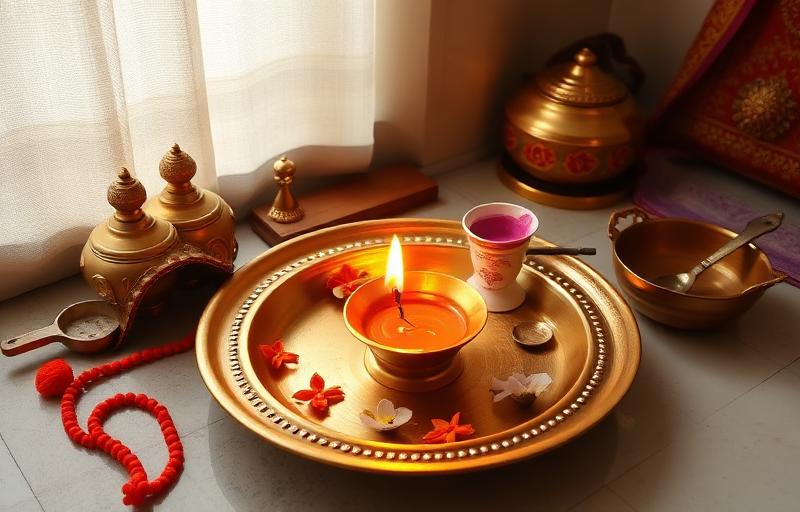
- A decorated plate for aarti and a ghee diya
- Sindoor
- A decorated seat or swing for the mother-to-be, in many regional traditions
How the Seemantonnayan Ceremony Is Conducted
1. The mother-to-be is seated comfortably, often on a decorated seat, sometimes a swing, depending on family tradition.
2. The elder women of the family perform a short puja, invoking the family deity's blessing for a safe and healthy delivery.
3. Aarti is performed around the mother-to-be.
4. Haldi-kumkum and akshat are applied to her forehead one by one by the elder women present, as a mark of blessing.
5. New clothes, bangles or jewellery may be gifted to her as part of the celebration.
6. She is offered her favourite foods and seasonal fruits, often fed affectionately by the women present.
7. The ceremony closes with collective prayers and the distribution of prasad and sweets to everyone gathered.
Timing of Seemantonnayan: A Note on Regional Variation

Unlike ceremonies tied to a fixed astrological calculation, the timing of Seemantonnayan is primarily guided by family custom and regional tradition, and it genuinely varies from community to community. Some families observe it in the fifth month of pregnancy, others in the seventh, eighth, or ninth, and there is no single month that applies universally.
Whatever the family tradition, the mother's comfort, health and her doctor's advice should always take priority over any ceremonial timing. Families are encouraged to keep the occasion relaxed and adaptable to the mother-to-be's wellbeing, rather than rigidly tied to a specific date.
Practical Tips for a Comfortable Seemantonnayan
- Making the event too long, crowded or tiring for the mother-to-be, when the occasion is meant to be joyful and reassuring rather than exhausting.
- Overlooking her food preferences or any medical dietary restrictions in favour of traditional ritual food, when her health should always come first.
- Turning the ceremony into a purely performative display rather than a warm, personal gathering of close family.
- Assuming there is one single correct way to perform the ceremony; customs genuinely differ across regions and families, and none of them is more valid than another.
- Forgetting that the mother-to-be's comfort and consent about every part of the ceremony, from seating to the food offered, matters more than following every traditional detail exactly.
The Devotional Meaning Behind Seemantonnayan
Seemantonnayan, or Godh Bharai, is ultimately a celebration of new life and the collective hope of an entire family for the wellbeing of both mother and child. It is a gentle reminder that devotion often expresses itself not through elaborate ritual alone, but through care, blessings and shared joy among the women of a family.
The true spirit of the occasion lies in the warmth surrounding the mother-to-be as she is showered with love before welcoming her child into the world.
Frequently Asked Questions
Is Seemantonnayan the same in every region of India?+
No, the customs, timing and specific rituals vary considerably across regions and communities. What remains common across most traditions is the underlying intention of blessing mother and child.
Who typically organises the Godh Bharai ceremony?+
It is usually organised by the women of the family, often the mother-to-be's mother, mother-in-law, sisters or close relatives, who plan the gathering and lead the rituals.
Should medical advice take priority over the traditional timing of the ceremony?+
Yes, always. The mother's health and her doctor's guidance should take precedence over any ceremonial date, and most families are happy to adjust the timing accordingly.
About the author
Pandit Mahesh Trivedi · Festival Traditions & Panchang
Pandit Mahesh leads the festival-date and Panchang content on Vandnaa. He cross-references multiple regional panchangs (Drik, Vaishnava, Bengali, Marathi) for every festival date published on the site.
Meet the Vandnaa editorial team →