What Surya Namaskar Actually Is + The 12 Names of Sun
Surya Namaskar (literally 'salutation to the Sun') is a complete sadhana that integrates:
- 12 asanas done in sequence as a flowing round.
- 12 Surya mantras (Bija + Beej + Naam), one for each posture.
- Synchronised breathing - each pose corresponds to inhale, exhale, or breath retention.
- Devotional dedication to Surya (the Sun God).
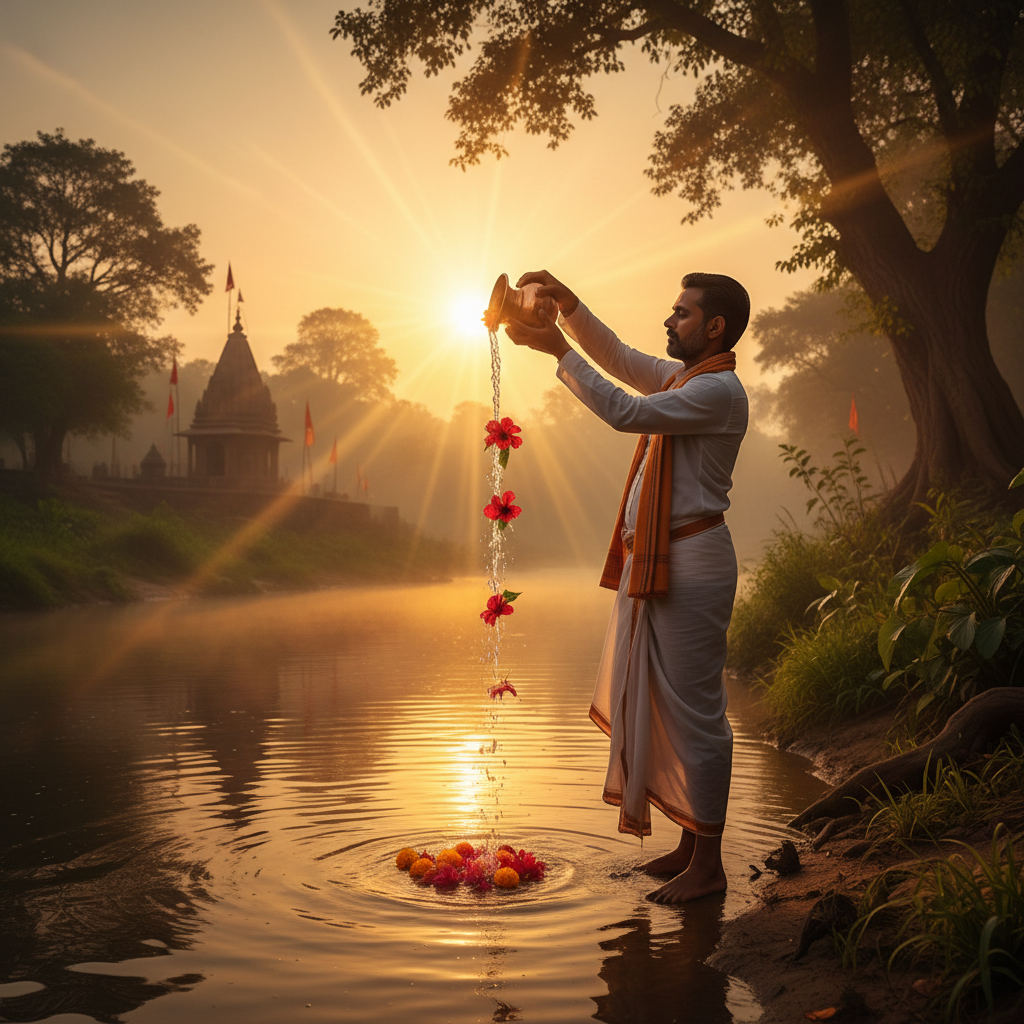
- East-facing orientation at sunrise for maximum effect.
This combination - which appears in no other yogic practice - is why Surya Namaskar is considered the king of asanas. A single 12-step round done with mantra and breath takes about 60-90 seconds. Daily practitioners build up to 12 rounds (one for each name of Surya) which takes 12-15 minutes.
The 12 names of the Sun (used as mantras during Surya Namaskar):
1. Om Mitraya Namah (one who is friendly to all) 2. Om Ravaye Namah (one who is praised by all) 3. Om Suryaya Namah (one who is the dispeller of darkness) 4. Om Bhanave Namah (one who illuminates) 5. Om Khagaya Namah (one who moves through the sky) 6. Om Pushne Namah (giver of strength) 7. Om Hiranyagarbhaya Namah (the golden cosmic self) 8. Om Marichaye Namah (lord of dawn) 9. Om Adityaya Namah (son of Aditi - infinity) 10. Om Savitre Namah (the impeller of all) 11. Om Arkaya Namah (worthy of worship) 12. Om Bhaskaraya Namah (one who brings illumination)
Each name corresponds to one solar quality. Saying the name as you flow through the matching pose creates a 12-fold devotional engagement with the Sun in a single round.
In 12 rounds (the full set), you've recited every name of the Sun, performed every pose, breathed deeply through 12 cycles, and faced the sun directly for the entire duration. This is the most efficient sadhana ever designed - more spiritual content per minute than any other practice.
The 12 Poses Step-by-Step (With Breath + Mantra)
Complete one round = 12 poses in sequence. Start and end in Pranamasana facing east.
Pose 1 - Pranamasana (Prayer Pose) - inhale + 'Om Mitraya Namah'
- Stand straight with feet together, palms folded in namaste at chest.
- Spine straight, eyes closed momentarily for one breath.
Pose 2 - Hasta Uttanasana (Raised Arms Pose) - inhale + 'Om Ravaye Namah'
- Raise both arms overhead, palms facing up.
- Arch back slightly, looking up at hands.
Pose 3 - Hasta Padasana (Hand to Foot Pose) - exhale + 'Om Suryaya Namah'
- Fold forward at hips, hands touching feet (or knees for beginners).
- Head tucked toward knees.
Pose 4 - Ashwa Sanchalanasana (Equestrian Pose) - inhale + 'Om Bhanave Namah'
- Step right leg back into a lunge, left knee bent at 90 degrees.
- Arch back, look up.
Pose 5 - Dandasana (Stick/Plank Pose) - hold breath + 'Om Khagaya Namah'
- Step left leg back to meet right, body in straight plank position.
- Hold for one breath cycle.
Pose 6 - Ashtanga Namaskara (Eight Limbs Salutation) - exhale + 'Om Pushne Namah'
- Drop knees, then chest, then chin to floor (eight body parts touching: two feet, two knees, chest, chin, two palms).
- Hips slightly raised.
Pose 7 - Bhujangasana (Cobra Pose) - inhale + 'Om Hiranyagarbhaya Namah'
- Slide forward, push chest up with hands.
- Arch back, look up.
- Legs and lower body on floor.
Pose 8 - Adho Mukha Svanasana (Downward Dog) - exhale + 'Om Marichaye Namah'
- Push back, lifting hips up.
- Body forms an inverted V.
- Head between arms, looking back at feet.
Pose 9 - Ashwa Sanchalanasana (other leg) (Equestrian Pose) - inhale + 'Om Adityaya Namah'
- Step right leg forward into a lunge (now right is forward, left back).
- Same arch and upward gaze as Pose 4.
Pose 10 - Hasta Padasana (Hand to Foot Pose) - exhale + 'Om Savitre Namah'
- Bring left leg forward to meet right, fold over legs.
- Same as Pose 3.
Pose 11 - Hasta Uttanasana (Raised Arms Pose) - inhale + 'Om Arkaya Namah'
- Rise up, raise arms overhead, arch back.
- Same as Pose 2.
Pose 12 - Pranamasana (Prayer Pose) - exhale + 'Om Bhaskaraya Namah'
- Return to standing with palms folded at chest.
- Same as Pose 1.
This is one round. To complete a 'set' of two rounds for symmetric muscle work, repeat starting with the LEFT leg back in Pose 4 (and right forward in Pose 9). This ensures both legs get the same workout. Most practitioners count one round = the right-leg-back sequence; the left-leg version makes round two. So 12 rounds total = 6 right-leg + 6 left-leg.
Timing:
- Beginner: 1 round = 90-120 seconds. Total practice = 3-4 rounds = 5-7 minutes.
- Intermediate: 1 round = 60-75 seconds. Total = 6-8 rounds = 8-10 minutes.
- Advanced: 1 round = 45-50 seconds. Total = 12 rounds = 10-12 minutes.
- Athletic: Some advanced practitioners do 108 rounds at 30 seconds each = full hour of intense practice (this is a major sadhana, not daily).
When to Do Surya Namaskar + Pre-Practice Checklist
Best time: Brahma Muhurta (4-6 AM) or just after sunrise. The first 30-60 minutes after sunrise are spiritually and physiologically optimal:
- Sun's UV intensity is gentle (won't burn).
- Air quality is at its daily best.
- Stomach is empty (mandatory for SN).
- Body's cortisol naturally peaks around 6-8 AM, providing energy.
- Vitamin D synthesis from morning sun is at its safest (15-30 min exposure).
Acceptable times if you can't do sunrise:
- Within 2 hours after sunrise (still good).
- 4-6 PM (golden hour) - second-best window. Can face WEST at this time for sunset salutation.
- Never midday (sun is too harsh, you risk heat stress).
- Never after sundown (the practice loses its solar connection).
Pre-practice checklist:
1. Empty stomach. No food 3-4 hours before. Water is OK; coffee/tea not recommended within 30 minutes before. 2. Empty bladder + bowels. Use the bathroom first. 3. Loose comfortable clothing. Cotton, no constriction at waist or chest. 4. Bare feet on yoga mat or cotton cloth. Don't practice on bare floor (slippery) or carpet (catches feet). 5. Face east (or west for evening). Set up your mat accordingly. 6. Outdoor or window-facing spot if possible. Direct sunlight on your skin maximises the practice. Even doing SN inside facing an east window with morning sun streaming in is significantly better than a dark room. 7. Warm up (1-2 minutes). Gentle neck rolls, shoulder rotations, ankle rotations, wrist circles. Don't jump straight into SN with cold joints. 8. Hydrate after, not during. Water 30 minutes after, not during practice.
Who should NOT do Surya Namaskar:
- Women during menstruation (first 3 days of period).
- Pregnant women in 2nd and 3rd trimester (modifications needed in 1st).
- Anyone with hernia (the abdominal compression aggravates).
- Anyone with severe back injury or recent spinal surgery.
- Anyone with hypertension reading over 160/100 (the rapid breathing can spike BP).
- Anyone with severe heart conditions without doctor clearance.
- During acute fever or illness.
Modifications for limitations:
- Knee issues: Skip the Ashtanga Namaskara (pose 6), instead lower to a gentle plank.
- Wrist pain: Place fists or forearms instead of palms in Bhujangasana and Adho Mukha Svanasana.
- Back issues: Don't do the deep backward arch in Hasta Uttanasana - just raise arms straight up.
- Beginner without flexibility: Do half-rounds (skip Ashtanga and Bhujangasana - go straight from plank to downward dog).
- Office worker / desk job: Start with just 2-3 rounds at a slow pace; build to 6 rounds over 2 months.
Recommended progression:
- Week 1-2: 3 rounds, no mantras (focus on poses + breath).
- Week 3-4: 4 rounds, add the 12 names of Surya silently.
- Week 5-6: 6 rounds, chant mantras aloud.
- Month 2-3: Build to 8 rounds.
- Month 4-6: Build to 12 rounds (full set).
- Year 1+: 12-24 rounds daily.
- Year 2+: Try 108 rounds on a Sunday or special occasion (this is a major sadhana).
Documented Health + Spiritual Benefits
Physical benefits (documented in multiple studies):
1. Full-body workout in minutes. 12 rounds of Surya Namaskar = approximately 288 individual asana movements in 15 minutes. Engages every major muscle group: arms, shoulders, chest, abs, back, glutes, thighs, calves. No other 15-minute practice provides equivalent full-body engagement. 2. Cardiovascular fitness. Heart rate rises to 110-130 BPM during practice - mild aerobic zone. Daily SN over 6 months has been shown to improve VO2 max comparable to brisk walking 30 min/day. 3. Spine flexibility + strength. The 12 poses include forward folds, backward arches, inversions, planks - working the spine through its full range of motion. Daily practitioners have measurably better spinal mobility in old age. 4. Weight management. 12 rounds burn 80-100 calories. Daily practice + clean eating creates a sustainable weight-loss + maintenance protocol without gym equipment. 5. Digestive improvement. The abdominal compression in Hasta Padasana and Ashtanga Namaskara massages internal organs, improves peristalsis. Daily SN often resolves chronic constipation within 2-3 weeks. 6. Better sleep. Morning SN regulates the circadian rhythm - bright sunlight + intense breath work + body temperature changes signal the body's master clock. Practitioners sleep deeper and wake more refreshed. 7. Bone density. Weight-bearing in plank and downward dog increases hand, wrist, and arm bone density. Particularly valuable for women approaching menopause. 8. Skin glow. Improved circulation + sweating + sun exposure (vitamin D) collectively give the famous 'morning yoga glow'. 9. Hormonal balance. Multiple studies (notably from S-VYASA, Bangalore) have shown improvements in thyroid function, insulin sensitivity, and reproductive hormones with 6+ months of daily SN. 10. Reduced PCOS symptoms. A 2018 study at SDM College demonstrated significant PCOS symptom reduction in women doing 6 rounds of SN daily for 3 months. The combination of weight loss + hormonal regulation + stress reduction addresses PCOS multi-causally.
Mental + spiritual benefits:
1. Discipline anchor. The practice requires daily commitment at the same morning time - creates a foundational discipline that radiates into other life areas. Many successful entrepreneurs and athletes cite SN as their 'daily non-negotiable'. 2. Mindfulness training. Coordinating asana + breath + mantra requires complete present-moment attention. Distractions cannot enter. This is meditation-in-motion. 3. Stress relief. Cortisol decreases after sustained practice. Anxiety symptoms improve over 4-6 weeks. 4. Sun-energy charging. Beyond science: the practice is a direct devotional engagement with Surya. Practitioners report feeling 'energised' for hours after, in ways beyond the physical exercise effect. 5. Mantra resonance. The 12 mantras create their own subtle effect. Saying 'Om Mitraya Namah' aloud at sunrise has been done by millions of Hindus for thousands of years - the practice is supported by accumulated devotional energy of the tradition. 6. Surya devotion. The Sun is the most universally accessible deity. You can SEE him; he gives you light, warmth, and life directly. Surya Namaskar is one of the few practices where the deity is literally visible and present during worship.
Long-term spiritual progression: Practitioners who do 12 rounds daily for years often report deeper meditation experiences in seated practice afterwards. The body is prepared, energy is moving, the mind is quiet. SN before pranayama before seated meditation creates the classic 3-stage morning sadhana that has been the Hindu yoga template for millennia.
The 108-round special practice: On Sundays, on solar eclipses, on Makar Sankranti (Sun's northward movement), and on Rath Saptami (Surya's birthday), advanced practitioners do 108 rounds. This is a 90-minute intense practice that combines all 12 names spoken 9 times = 108 mantras total. It is considered a major sadhana that ideally is done annually at minimum.
Common Questions From Devotees
Can I do Surya Namaskar without saying the mantras?+
Yes - the asanas alone give 70% of the physical benefit. But the full spiritual practice requires the mantras. Compromise: do the poses with breath synchronisation always, add mantras silently (mental japa) when you can't say them aloud (in a gym, office), and chant aloud at home in morning practice. Even silent mental mantras during the poses retain most of the devotional benefit.
Can I do Surya Namaskar indoors if I can't go outside in the morning?+
Yes, but try to face an east-facing window with curtains open so morning light reaches you. The practice retains all its physical benefits indoors. The full spiritual effect is best with direct sun exposure but morning sun through a window is still better than complete indoor darkness. If you live in a flat with no east window, face east as best you can and visualise the sun before you while practicing. The intention and orientation matter more than literal sun visibility.
Is Surya Namaskar a religious practice that non-Hindus can't do?+
It is a Hindu devotional practice in origin but practiced today by millions worldwide regardless of religion. The asanas alone are universally accessible (any yoga studio teaches them). The mantras can be skipped or replaced with general sun-appreciation. Some Muslim, Christian, and atheist practitioners do the poses without the mantras and report all the physical benefits. The choice to engage with the devotional aspect is personal. Hindu tradition has always welcomed sincere practitioners of any background.
How long until I see results from daily Surya Namaskar?+
Typical progression: Week 1-2 = sore muscles + better sleep. Week 3-4 = noticeable energy increase in the day, mood improvement. Month 2 = visible spine flexibility, better posture, 1-2 kg weight loss. Month 3 = significant cardiovascular improvement, digestion regular, skin glow. Month 6 = body composition changes, hormonal markers improve in labs. Year 1 = transformative - the body recomposes, the mind is sharper, sadhana deepens. The benefits are cumulative - the daily-ness matters more than intensity of any single session.
About the author
Acharya Vinaya Kapoor · M.A. Sanskrit, Mantra & Stotra Studies
Acharya Vinaya holds an M.A. in Sanskrit from Banaras Hindu University and writes the mantra and stotra commentary on Vandnaa. Her focus is on accurate pronunciation, traditional context, and helping modern readers connect with classical texts.
Meet the Vandnaa editorial team →