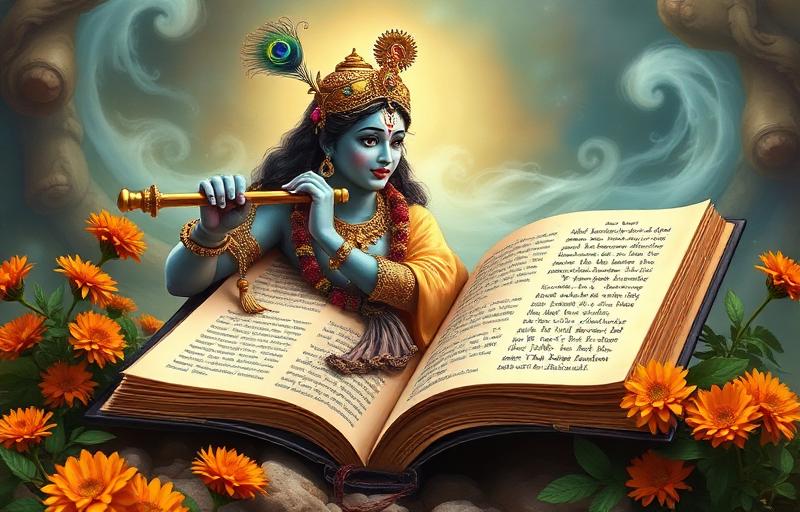
A Disciple Who Waited for the Deity Directly
On Sharabhanga's direction, an episode covered elsewhere in this series, Rama, Sita and Lakshmana travelled to the ashram of the sage Sutikshna, a disciple of the great sage Agastya, whose own particular devotion had, according to the story he tells Rama, been unusual: rather than seeking Vishnu through conventional meditation or ritual, Sutikshna had prayed specifically to see the deity in embodied human form, and had, in effect, been waiting years for exactly the kind of direct encounter Rama's arrival now provided.
Sutikshna welcomed Rama with open recognition of who he understood him to be, offered him hospitality and pressed him to remain at his ashram permanently rather than continuing deeper into the forest, an invitation Rama declined gently, explaining his need to continue toward more remote regions given the length of his exile and Sita's need for a settled, defensible dwelling eventually.
Agastya's Gift of Weapons
Continuing on Sutikshna's direction, Rama and his companions arrived at the ashram of Agastya himself, the same sage covered elsewhere in this series for drinking the ocean and stopping the Vindhya mountain's growth, whose reputation and spiritual authority in the southern forests was considerable.
Agastya received Rama with full honour and, in a gesture with real narrative consequence, gave him a set of celestial weapons: the bow of Vishnu, said originally to belong to the deity himself, along with a quiver of inexhaustible arrows, a sword, and other implements that Agastya explained had been kept in trust, waiting for exactly this purpose, to arm Rama for the battles ahead in the forest and eventually at Lanka.
Agastya also advised Rama on where to settle, recommending the region of Panchavati on the banks of the Godavari as a suitable location, close enough to other hermitages for some safety, remote enough to serve as a defensible base, a recommendation Rama followed, an episode connected elsewhere in this series to why Rama chose that specific site.
Two Kinds of Hospitality, Both Necessary
Sutikshna and Agastya's episodes, told back to back, offer two different registers of what the forest sages provide Rama during his exile: Sutikshna gives emotional and devotional welcome, the recognition of a devotee whose years of prayer are answered, while Agastya provides the practical, material means, weapons and a strategic settlement location, by which Rama will actually survive and eventually prevail in the conflicts to come.
Together these two encounters mark the transition point in the Aranya Kanda between the exile's earlier, more contemplative episodes and its coming action, since it is from Panchavati, the settlement Agastya recommends, that the Ramayana's central abduction plot, beginning with Surpanakha and continuing through Maricha's golden deer, will unfold, both events covered elsewhere in this series.
Common Questions From Devotees
Are the weapons Agastya gave Rama the same ones used against Ravana?+
The Vishnu bow and the inexhaustible quiver given by Agastya are described as central to Rama's arsenal through the rest of the epic, though the final decisive weapon against Ravana in most tellings is a specific arrow blessed by sages at the war's climax.
Why didn't Rama simply stay at Sutikshna's ashram permanently?+
Rama explains he needed a more remote, defensible location suited to a longer stay with Sita, and the text presents his onward journey as a practical necessity rather than a rejection of Sutikshna's devotion.
Is this the same Agastya connected to the Vindhya mountain story?+
Yes, it is the same sage, whose broader reputation for both cosmological feats, drinking the ocean and halting the Vindhyas, and for guiding southern-forest hospitality to Rama, is treated as continuous across the tradition.
About the author
Anjali Mehta · Editor, M.A. Religious Studies
Anjali is the managing editor for Vandnaa and oversees the festival and vrat coverage. She holds an M.A. in Religious Studies and reviews every published article for accuracy, accessibility, and tradition-fidelity.
Meet the Vandnaa editorial team →