Nidhivan
Swami Haridas, sixteenth century, is the founder of the Haridasi tradition, one of the foundational figures of Hindustani classical music, and the man who installed the deity of Banke Bihari at Vrindavan.
His dates: disputed, with the widest traditional reckoning giving 1478 to 1573, which would make him ninety five, and other accounts placing him around 1512 to 1573.
Where: Rajpur, near Vrindavan, or Haridaspur in Aligarh district, depending on the account, and he settled at Nidhivan, in Vrindavan.
What he did: he sang, in a grove, and did not do anything else.
No temple to run, in his lifetime. No court appointment. No writing to speak of beyond a hundred and twenty eight verses. No travelling, no preaching tours, and no attempt to build anything.
He stayed in one grove and sang, and people came.
His standing as a musician
This is not a devotional claim. It is a fact of musical history.
Hindustani classical music in its modern form descends substantially from the dhrupad tradition of this period, and Swami Haridas is one of its two or three central figures.
His students, by tradition:
- Tansen, of Akbar's court, the most celebrated musician in Indian history
- Baiju Bawra, the other great name of the period
The Tansen connection is disputed by some historians and is held firmly by the musical tradition itself. What is not disputed is that Haridas was a dhrupad master of the first rank and that the Haridasi musical lineage is continuous.
Dhrupad
Worth a note, because it explains him.
Dhrupad is the oldest surviving form of Hindustani classical music, and it is austere.
- Extremely slow alap, unmetred, developing the raga note by note before anything else happens
- No ornamentation for effect
- Text in Braj bhasha or Sanskrit, usually devotional
- Accompanied by the pakhawaj and the tanpura, and nothing else
- Sung, historically, in temples rather than in courts, though it was also a court form
It takes a long time and it does not entertain. A dhrupad alap can run forty minutes before a word is sung.
Which is exactly the temperament of the man in this entry.
His refusal
He did not sing on request.
Not for patrons, not for visitors, not for rulers, and not on any schedule. He sang when he sang, in the grove, and anybody who happened to be there heard it.
And that is the setting for the story he is known for.
Akbar in the Grove
The story, and it is one of the best in Indian cultural history.
The situation
Akbar had Tansen, who was the greatest singer of the age and one of the navaratna, the nine jewels of his court.
And Akbar heard, from Tansen, that Tansen's own teacher was better.
Which he did not believe, and wanted to test.
The problem
Haridas would not come.
He did not accept invitations, he did not go to courts, he did not sing on request, and there was nothing the emperor could offer him that he wanted.
And this is worth pausing on. Akbar could summon anybody in India. The one category of person over whom an emperor has no leverage is one who wants nothing from him, and Haridas lived in a grove and did not want anything.
The plan
Tansen's, and it was a good one.
He took Akbar to Nidhivan, and the emperor came in disguise, dressed as Tansen's servant, carrying his instrument or attending on him depending on the account.
They sat in the grove.
And then Tansen sang, badly, on purpose.
What he did: performed a composition, in the presence of his own teacher, with a deliberate error in it.
And Haridas could not bear it.
He corrected him. Which meant singing the thing properly himself, and once he had begun he continued.
And Akbar, sitting on the ground dressed as a servant, heard him.
What Akbar said afterwards
And this is the point of the story.
The account records him saying, on the way back, something to the effect that he would never hear such singing again, and that the difference between the two was this:
Tansen sings for an emperor. Haridas sings for nobody.
In other versions: Tansen sings for a man, and Haridas sings for the one who made the man.
Why the observation is exactly right
Because it is not about talent.
Tansen was, by every account including this one, an extraordinary musician. The difference Akbar identified is not one of ability.
It is that one of them was performing.
A performance is addressed to somebody, is shaped by what they will respond to, and adjusts itself to the room. That is not a criticism; it is what performance is, and Tansen was the best there has ever been at it.
What Haridas was doing was not that, because there was nobody it was addressed to, and therefore nothing to adjust to, and therefore no reason for it to be anything other than what it was.
And Akbar, who had spent his life being performed for, recognised the difference immediately.
How to hold the story
The historicity is disputed. Tansen's discipleship under Haridas is held by the musical tradition and questioned by some historians; the Nidhivan visit is a traditional account.
And it does not matter much, because the observation the story exists to make is a good one regardless of whether the meeting happened.
The general form, which is usable
Anything you make is shaped by who you think is going to see it.
That is not avoidable and is not a fault. But it is worth knowing that it is happening, and worth occasionally doing something that nobody is going to see, to find out what it turns into.
Banke Bihari
What the tradition says
Haridas sang, in Nidhivan, and what he sang about was the eternal nikunja lila: Shyama and Shyam, which is to say Radha and Krishna, together in the grove.
And the tradition says they appeared.
And that the appearance was too much, and that at the request of the assembled devotees the two forms merged into one, so that it could be borne, and remained.
That combined form is the deity of Banke Bihari.
Banke means bent in three places, the tribhanga posture. Bihari is one who enjoys, who plays.
The temple
The deity was later moved from Nidhivan to the present Banke Bihari temple in Vrindavan, built in the nineteenth century, and it is among the most visited temples in India.
Its distinctive practices, which are unlike almost anywhere else:
One. The curtain.
Darshan is not continuous. A curtain is drawn across the deity every few minutes, and then opened again.
The reason the tradition gives: that the gaze is not something a person should be exposed to continuously, and that a devotee looking at it without interruption would not be able to leave.
Whatever you make of the reason, the effect is real and everybody who has been notices it: you get the darshan in fragments, and each time the curtain opens it is new.
Two. No bell, no conch.
The temple does not use them.
The reason given: the deity is a child, and is sleeping, and should not be startled.
Three. No regular mangala arti.
The dawn arti, which is standard at every major temple, is not performed at Banke Bihari, on the same reasoning: the deity is not woken early.
It is held once a year, on Janmashtami.
Four. The seva.
The worship is conducted as service to a child: dressing, feeding, playing, resting, and the schedule follows a child's day rather than a ritual calendar.
Why this matters
Because it is a coherent whole and it comes from the founder's temperament.
A man who would not sing on request, who lived in a grove and did nothing else, whose tradition holds that the divine is a play going on continuously and not an event to be summoned, ends up with a temple that does not ring bells, does not wake the deity, and closes the curtain every few minutes.
Nidhivan
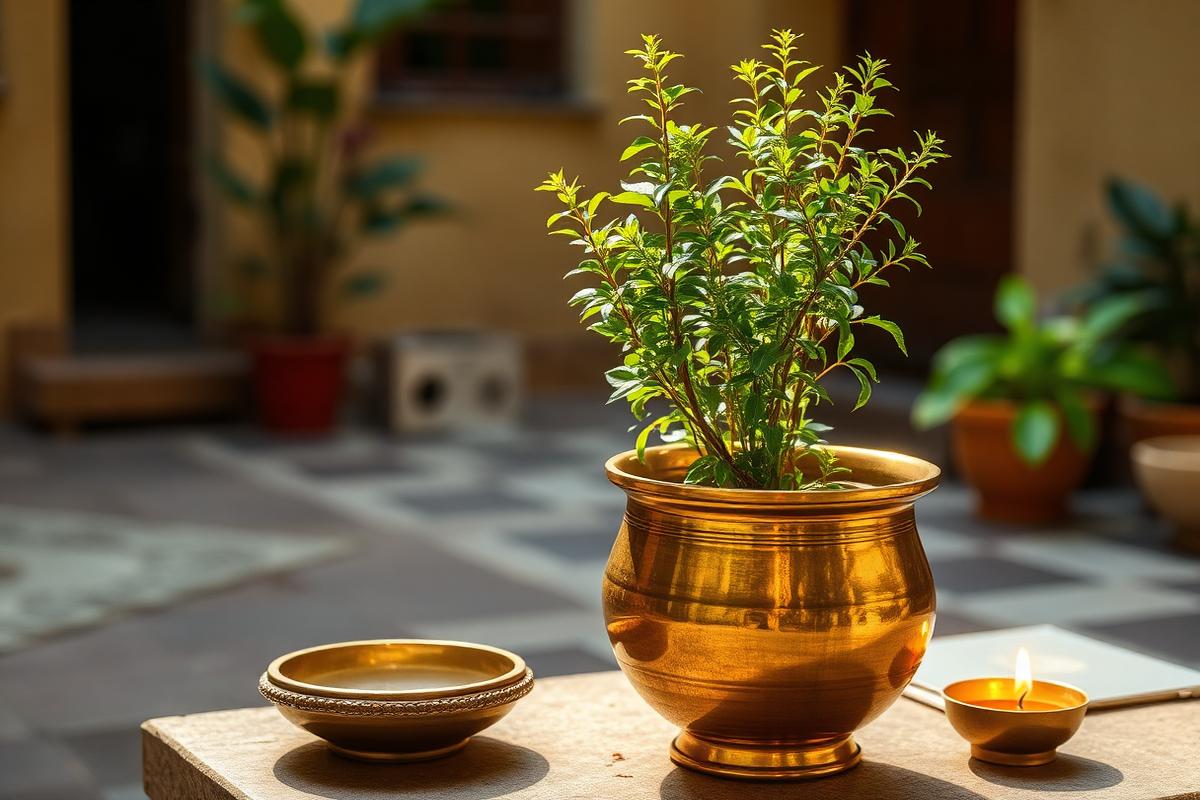
The grove itself is still there, in Vrindavan, and it is a small dense wood of tulsi trees with intertwined trunks.
The local tradition: that Radha and Krishna come there every night for the rasa, that the trees are the gopis, and that nobody may remain in the grove after dark.
How this app states it: that is a strongly held local tradition, it is what people in Vrindavan will tell you, and it is reported here as tradition rather than asserted as fact. The grove is closed after the evening arti and visitors leave.
Haridas's own samadhi is at Nidhivan, and it is a working shrine.
The Kelimal, and the Tradition
His writings
One hundred and twenty eight verses. That is the entire surviving output.
The Kelimal, in Braj bhasha, divided into two parts:
- One hundred and ten kelimal padas, on the play, the lila
- Eighteen siddhanta ke pada, doctrinal verses, which set out the tradition's position
Compare the scale. Annamacharya wrote thirty two thousand songs. Tyagaraja wrote hundreds. Abhinavagupta wrote forty books.
Haridas wrote a hundred and twenty eight verses and stopped, and his standing is not reduced by it.
What the eighteen doctrinal verses say
They are the distinctive part of his tradition and they are worth setting out.
One. Rasa upasana.
The worship is of the rasa, the aesthetic and emotional state itself, and the whole tradition is organised around it rather than around ritual or doctrine.
Two. Nitya vihara.
The central distinction from other Vaishnava traditions.
Most Krishna traditions are centred on the lila as narrative: Krishna's birth, childhood, the events at Vraj, the departure, the Mahabharata. The events happened and are remembered and re enacted.
The Haridasi position: the nikunja lila, the play in the grove, is eternal and continuous. It is not something that happened. It is happening, now, and has never stopped.
Which is why the tradition does not emphasise the biographical Krishna at all: not the birth, not Kamsa, not Mathura, not Dwarka, not Kurukshetra. Only the grove.
Three. Shyama first.
Radha is primary. In the Haridasi formulation, the pair is Shyama Shyam, in that order, and Radha is not an accessory to Krishna.
Four. Sakhi bhava.
The practitioner's stance is that of a sakhi, a female companion of Radha, whose role is to attend on the two of them and whose satisfaction is in their being together.
Not the lover. Not the beloved. The friend who arranges things and watches.
Haridas himself is regarded in the tradition as an incarnation of Lalita, one of the eight principal sakhis.
Five. No renunciation required, and no ritual apparatus.
The tradition has two branches: the Vairagi or Tatiya Sthan line, who are renunciates, and the Goswami line, who are householders and who serve at the temple.
Both are legitimate and neither ranks above the other.
Where the tradition is now
- The Banke Bihari temple, Vrindavan, one of the most visited in India
- The Tatiya Sthan at Vrindavan, the seat of the renunciate branch, which is deliberately austere and where music is central
- Nidhivan, with his samadhi
- The Haridasi musical lineage, which is continuous and in which dhrupad is still taught and performed
- Swami Haridas Jayanti, on Radhashtami, generally August or September
- The Swami Haridas Sangeet Sammelan and similar music festivals held in his name
Where to hear the music
Dhrupad is having a revival and is more accessible now than it has been for a century.
- The Dagar family, the Gundecha brothers, Uday Bhawalkar, Nirmalya Dey and others have recorded extensively
- The samaj gayan tradition at Vrindavan, which is the Haridasi and allied temple singing, is performed daily and is quite unlike concert dhrupad
- Recordings of Haridasi padas exist and the tradition is documented
A listening note: dhrupad is slow and does not do anything for a long time. That is the form working correctly, and it takes a few listenings before the alap stops sounding like an introduction and starts sounding like the piece.
What to Take From Him
One. He would not sing on request.
Not for patrons, not for rulers, not on any schedule, and there was nothing an emperor could offer him that he wanted.
Which is the only position from which an emperor has no leverage over you, and it is available to almost nobody, and he had it because he lived in a grove and wanted nothing.
Two. Akbar's observation.
Tansen sings for an emperor; Haridas sings for nobody. Not a comment on ability, and Tansen was the greatest performer there has been.
A performance is addressed to somebody and adjusts itself to the room, which is what performance is and is not a fault. What Haridas was doing had nobody to adjust to.
The transferable version: anything you make is shaped by who you expect to see it. Occasionally make something nobody will, and find out what it turns into.
Three. A hundred and twenty eight verses.
He is one of the foundational figures of Hindustani classical music and the founder of a tradition with one of the most visited temples in India, and his entire surviving written output is a hundred and twenty eight verses.
Output is not the measure, and this series keeps finding that: Syama Sastri with seventy compositions, Savata Mali with thirty seven, Devara Dasimayya with a hundred and fifty.
Four. It is happening now.
The Haridasi position is that the play in the grove is not an event that occurred and is remembered. It is continuous and has never stopped, and the practice is attention to something already going on rather than commemoration of something that is over.
Which is a real difference in the shape of a practice, and it removes the element of nostalgia that a great deal of religion runs on.
Five. The curtain.
Darshan at Banke Bihari is deliberately interrupted every few minutes, on the reasoning that continuous exposure is not what a person should have, and that a devotee looking without interruption would not be able to leave.
As a principle: the interruption is what makes each opening new, and the same is true of almost anything you value. Continuous access to a thing removes your ability to see it.
Six. Sakhi bhava.
The practitioner's stance is neither the lover nor the beloved but the friend who attends on the two of them and whose satisfaction is in their being together.
Which is an unusual and rather generous place to stand, and it is worth knowing that a tradition organised itself around it.
A daily practice from this entry:
- Radhe Radhe, which is what Vrindavan says instead of hello
- A dhrupad alap, listened to once, all the way through, without doing anything else
- At Banke Bihari, if you go: notice the curtain, and notice what the interruption does
- And once, the Haridas test: make or do something with nobody in mind at all, and see what comes out
A closing thought
The greatest singer of the Mughal age told the emperor that his own teacher was better, and the emperor did not believe him and wanted to hear for himself, and found there was nothing he could do about it, because the man lived in a grove outside Vrindavan and did not want anything.
So the singer took the emperor there dressed as his servant, sat him on the ground, and then sang badly on purpose until the old man could not stand it and sang it properly himself.
And on the way home the emperor said he would never hear anything like it again, and that the difference was that Tansen sang for an emperor and Haridas sang for nobody at all.
He left a hundred and twenty eight verses. The temple his singing produced does not ring bells, does not wake the deity in the morning, and closes the curtain every few minutes so that nobody has to look for too long.
The Short Version
Who: Swami Haridas, sixteenth century, dates disputed with the widest traditional reckoning giving 1478 to 1573. Founder of the Haridasi tradition, one of the foundational figures of Hindustani classical music, and the man who installed the deity of Banke Bihari. He lived at Nidhivan in Vrindavan, sang, and did nothing else: no temple to run, no court appointment, no travelling, and a hundred and twenty eight verses.
As a musician: a dhrupad master of the first rank, and by tradition the teacher of Tansen and Baiju Bawra. The Tansen discipleship is questioned by some historians and held firmly by the musical tradition. Dhrupad is the oldest surviving form of Hindustani classical music, with an extremely slow unmetred alap that can run forty minutes before a word is sung, no ornamentation for effect, and only the pakhawaj and tanpura.
The Akbar story: Akbar heard from Tansen that Tansen's own teacher was better and wanted to test it, but Haridas would not come, did not accept invitations and did not sing on request, and there was nothing the emperor could offer him. Tansen took Akbar to Nidhivan disguised as his servant, then sang a composition badly on purpose until Haridas could not bear it and corrected him by singing it properly. Akbar said afterwards that he would never hear such singing again, and that the difference was that Tansen sang for an emperor and Haridas sang for nobody.
Banke Bihari: the tradition holds that Shyama and Shyam appeared as he sang and merged into one form so that it could be borne. The temple has distinctive practices: a curtain drawn across the deity every few minutes, no bell and no conch because the deity is a sleeping child, no regular dawn arti except once a year on Janmashtami, and worship conducted as service to a child.
His writings: the Kelimal in Braj bhasha, a hundred and ten lila padas and eighteen doctrinal verses. The tradition's central position is nitya vihara: the play in the grove is eternal and continuous, not an event that happened and is remembered, which is why the tradition does not treat the biographical Krishna at all. Radha is primary, the practitioner's stance is sakhi bhava, and Haridas is regarded as an incarnation of Lalita.
Quick Answers
Who was Swami Haridas?+
A sixteenth century musician and saint of Vrindavan, founder of the Haridasi tradition and one of the foundational figures of Hindustani classical music. He lived at Nidhivan and by tradition was the teacher of Tansen and Baiju Bawra. He installed the deity of Banke Bihari, wrote a hundred and twenty eight verses called the Kelimal, ran no temple in his lifetime, held no court appointment, and did not travel. His dates are disputed, with the widest traditional reckoning giving 1478 to 1573.
What is the story of Akbar and Swami Haridas?+
Akbar heard from Tansen, the greatest singer of the age and one of his nine jewels, that Tansen's own teacher was better. He wanted to test it, but Haridas would not come to court, did not accept invitations, did not sing on request, and there was nothing an emperor could offer a man who lived in a grove and wanted nothing. So Tansen took Akbar to Nidhivan disguised as his servant, sat him on the ground, and then performed a composition with a deliberate error in it until Haridas could not bear it and corrected him by singing it properly himself. Akbar said on the way back that he would never hear such singing again, and that the difference was that Tansen sang for an emperor while Haridas sang for nobody.
Why does the Banke Bihari temple close the curtain every few minutes?+
The tradition's reason is that the gaze is not something a person should be exposed to continuously, and that a devotee looking at it without interruption would not be able to leave. Whatever one makes of the reason, the effect is real and everybody who has been notices it: the darshan comes in fragments, and each time the curtain opens it is new. The temple also uses no bell and no conch, on the reasoning that the deity is a sleeping child who should not be startled, and holds no regular dawn arti except once a year on Janmashtami, for the same reason.
What is the Haridasi position on the lila?+
That the nikunja lila, the play in the grove, is eternal and continuous. Most Krishna traditions treat the lila as narrative: the birth, the childhood, the events at Vraj, the departure, the Mahabharata, all of which happened and are remembered and re enacted. The Haridasi position is that the play in the grove is not something that happened; it is happening, now, and has never stopped. That is why the tradition does not treat the biographical Krishna at all, not the birth, Kamsa, Mathura, Dwarka or Kurukshetra, but only the grove. Radha is primary, the pair is named Shyama Shyam in that order, and the practitioner's stance is sakhi bhava, the friend who attends on the two of them.
What is dhrupad?+
The oldest surviving form of Hindustani classical music, and an austere one. It has an extremely slow unmetred alap developing the raga note by note before anything else happens, which can run forty minutes before a word is sung; no ornamentation for effect; text usually in Braj bhasha or Sanskrit and usually devotional; and accompaniment by the pakhawaj and tanpura and nothing else. Swami Haridas was a dhrupad master of the first rank. The form is having a revival and is more accessible now than it has been for a century, with extensive recordings by the Dagar family, the Gundecha brothers, Uday Bhawalkar and others.
What is Nidhivan?+
The grove at Vrindavan where Swami Haridas lived and sang, and where his samadhi is. It is a small dense wood of tulsi trees with intertwined trunks. The strongly held local tradition, which is what people in Vrindavan will tell you, is that Radha and Krishna come there every night for the rasa, that the trees are the gopis, and that nobody may remain in the grove after dark. It is reported here as tradition rather than asserted as fact. The grove closes after the evening arti and visitors leave.
About the author
Pandit Ravindra Sharma · Vedic Rituals & Bhakti, 22+ years
Pandit Ravindra is the Vandnaa editorial team's resident specialist on aarti, chalisa, and daily devotion. He has performed home and temple pujas across Varanasi and Delhi for over two decades and contributes the bhakti-focused articles on this site.
Meet the Vandnaa editorial team →