Temples Under Sand
Talakadu, also written Talakad, stands on a bend of the Kaveri in Mysuru district, Karnataka, about forty five kilometres from Mysuru.
What is there:
- A stretch of sand dunes beside the river, unlike anything else in the region
- Temples partly or wholly buried in that sand, some excavated and some still under it
- The Vaidyanatheshwara temple, the principal shrine in use
- The Pathaleshwara, Maruleshwara, Arkeshwara and Mallikarjuna shrines, which with Vaidyanatheshwara make the five of the Panchalinga
- The Kirtinarayana temple, a Hoysala period Vishnu temple, recovered by excavation
- The Kaveri itself, wide and shallow here
What happened. Talakadu was a substantial place. It was a capital of the Western Ganga dynasty, later held by the Cholas and the Hoysalas, and it carried a large number of temples across several centuries.
Then the sand came. Over a period, dunes advanced across the site and buried the town and its temples. Excavation has recovered some of them, and the work has continued in phases.
What a visitor sees today. A wide sandy area with temple towers rising out of it, some cleared to their bases in excavated pits, some still showing only their upper parts, and a working temple among them. It is one of the strangest sights in south India, and it looks exactly like what it is, which is a town that lost an argument with a river.
The Curse of Alamelamma
The story told to explain Talakadu is one of the best known in Karnataka, and it involves a queen, a set of jewels and three sentences.
The background:
- In 1610, Raja Wodeyar of Mysore took Srirangapatna from the Vijayanagara viceroy Tirumalaraja
- Tirumalaraja's wife, Alamelamma, held a collection of jewels which had been used to adorn the deity at Srirangapatna
- She had withdrawn to Malangi, on the Kaveri near Talakadu
- The Wodeyars sought the jewels, and accounts differ on how forcefully
What is said to have happened:
- Rather than surrender them, Alamelamma went to the Kaveri at Malangi and threw herself in, taking the jewels with her
- As she did so she pronounced a curse in three parts:
- Let Talakadu become sand
- Let Malangi become a whirlpool
- Let the Rajas of Mysore not have children
What happened afterwards, as it is generally recounted:
- Talakadu was buried under sand
- A whirlpool is pointed out in the Kaveri at Malangi
- The Wodeyar line was repeatedly troubled by succession, with rulers who died without direct heirs and adoptions required to continue the line
How the dynasty responded. This is the interesting part. The Wodeyars did not dismiss it. An image of Alamelamma was installed and honoured, and the royal house maintained observances connected with her.
A ruling family that formally propitiates the woman who cursed it, for three hundred years, is making a striking admission. Whatever anyone thought had actually happened at Malangi, the curse was treated as a live obligation rather than a folk tale.
Where the Sand Actually Came From
Geologists and geographers have looked at Talakadu, and the physical account is worth setting out alongside the curse.
What the explanations involve:
- The Kaveri bends sharply here, and the river's behaviour at a bend deposits sediment on one side
- Large quantities of river sand accumulated on the inside of the bend over a long period
- Once exposed and dry, that sand was moved by wind, forming dunes that advanced across the settlement
- Changes in the river's course, and human interventions upstream including anicuts and diversions, have been proposed as factors that altered how much sand was deposited and how it dried
- The process was gradual, over centuries, not a single event
How the two accounts relate. They are not in competition in the way people expect.
- The curse is dated to 1610. The burial of Talakadu was a process running over a much longer period, and the site's decline as a centre had begun well before
- A physical process explains how the sand arrived. It does not explain why anyone thought it needed explaining
- A curse explains why it happened to this place, which is the question people actually ask when a town disappears
What curses do in historical memory. This is worth understanding generally, because the pattern repeats across India.
A community that suffers a slow disaster with no obvious cause will look for an account that gives it meaning and a moral shape. A curse supplies both. It identifies a wrong, attaches consequences to it, and makes the disaster legible as something other than bad luck.
That the Wodeyars themselves adopted the story is the strongest evidence of how well it worked. The dynasty accepted a narrative in which its own founding act was a wrong that had to be paid for, which is not what a ruling house does with a story it finds convenient.
The Panchalinga Darshana
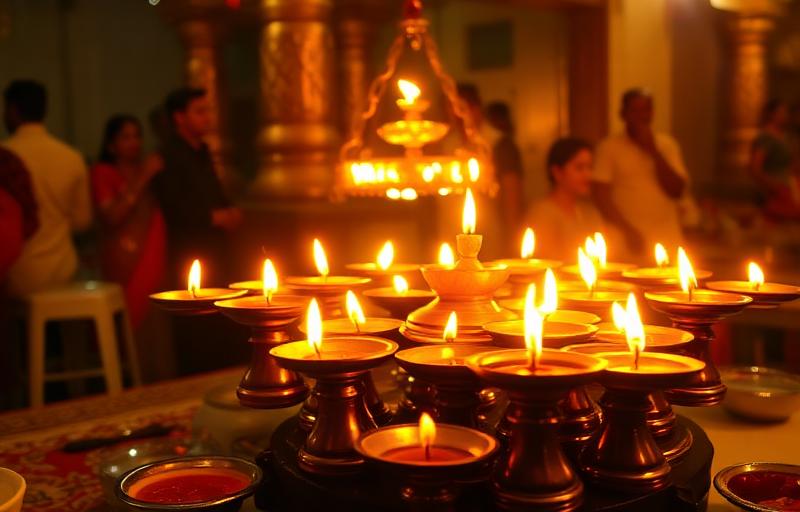
Talakadu's principal observance is the Panchalinga Darshana, and it is unusual in its frequency.
What it is:
- Darshan of five Shiva lingas at Talakadu in a single day, in a prescribed order
- The five are Pathaleshwara, Maruleshwara, Arkeshwara, Vaidyanatheshwara and Mallikarjuna
- The observance is held only when a particular calendrical conjunction occurs, and it has traditionally recurred at intervals of around twelve years
- When it is held, very large numbers of pilgrims come
On Pathaleshwara. This linga is said to change colour through the day, appearing red in the morning, black at midday and white in the evening.
Whether that is an effect of the stone, the light, the abhishek or something else is not something a visitor is going to settle, and the tradition presents it as a property of the deity. It is worth seeing if you are there.
Why five, and why once in twelve years:
- Groups of five Shiva shrines occur across India, including the Pancharama kshetras of Andhra Pradesh and the Panch Kedar of the Himalaya
- Grouping shrines into a set that must be visited in one day or one journey converts individual darshan into a pilgrimage
- Making it depend on a rare conjunction does something further. It creates an occasion that a person may see only two or three times in a lifetime, which concentrates attention on it enormously
A festival held every year becomes routine. A festival held when a particular alignment occurs, perhaps twice in a working life, does not.
Check before planning around it. The Panchalinga Darshana is not annual and the dates are announced when the conjunction falls. If it is the reason for your trip, confirm well in advance through Karnataka tourism or the temple authorities.
What Talakadu Was Before
It is easy to see Talakadu only as a ruin, and to miss that it was a significant place for a very long time.
The sequence:
- Talakadu was a capital of the Western Ganga dynasty, who ruled parts of southern Karnataka from around the fourth century onward
- It passed to the Cholas in the early eleventh century, under Rajaraja and his successors, and the Cholas held it for a period
- The Hoysalas under Vishnuvardhana took it in the twelfth century, and the Hoysala king took the title Talakadugonda, the conqueror of Talakadu, which indicates how much the conquest mattered
- The Kirtinarayana temple, recovered from the sand, belongs to this Hoysala period
- Later it came under Vijayanagara and then Mysore
Why a place on the Kaveri mattered:
- The river was the region's principal resource, and control of a crossing and a stretch of it was worth fighting for
- Talakadu sat on routes across southern Karnataka
- A capital needed water, defensible ground and agricultural land, and this had all three
What the excavations have found. Archaeological work has uncovered temples of several periods, and estimates of the number of structures buried at the site have run to around thirty.
Some have been cleared and are visible. Others remain under sand. Excavation at Talakadu is complicated by the fact that clearing sand does not keep it clear, since the dunes move, and maintaining an excavated temple in an active dune field is an ongoing problem rather than a completed task.
What you should take from that. The site is not a ruin that has settled into its final state. It is a slow process still running, in which people periodically dig temples out and the sand periodically comes back.
Visiting Talakadu
Getting there
- Talakadu, T Narasipura taluk, Mysuru district, Karnataka, on the Kaveri
- About 45 km from Mysuru and roughly 130 km from Bengaluru, by road
- Mysuru is the nearest railway station and airport
- Buses run from Mysuru and T Narasipura. A car is easier and lets you combine sites
When to go
- October to February for comfortable weather. It gets very hot on open sand from March
- Early morning or late afternoon. The sand is punishing at midday and there is no shade
- The Panchalinga Darshana, when it falls, which is not annual and must be confirmed in advance
- Mahashivratri and Kartika month bring local crowds
At the site
- The Vaidyanatheshwara temple, the main working shrine
- The excavated temples in their pits, including the Kirtinarayana
- Pathaleshwara, for the colour that is said to change
- The dunes and the river bank
- Allow two to three hours to walk the site properly
Practical notes
- Footwear matters. You will be walking on hot loose sand between temples. Sandals fill with sand and bare feet burn at midday
- Carry water and sun protection. There is almost no shade
- The excavated temples are protected. Do not climb on them or into the pits where they are fenced
- Photography of the site is generally fine. Ask about sanctums
The river
- The Kaveri here is wide and looks calm, and it is used for bathing
- Depth and current vary, the bed is uneven, and levels change with dam releases upstream, which can happen without warning
- Stay within your depth, do not swim across, keep children held, and take local advice about where it is safe
Combining the visit
- Somanathapura, the Hoysala temple with its extraordinary carving, is roughly 30 km away and should not be missed
- Shivanasamudra falls, downstream on the Kaveri, spectacular in and after the monsoon
- Srirangapatna and Mysuru on the way back
Done properly, Talakadu, Somanathapura and Srirangapatna make one of the best day trips from Mysuru, and cover a thousand years between them.
A closing thought. India has a great many ruined temples. It has very few where the ruin is still happening, where the thing that buried the place is still there and still moving, and where the local explanation involves a woman who is still worshipped by the family she cursed.
Quick Answers
Why are the temples at Talakadu buried in sand?+
The Kaveri bends sharply here and deposited large quantities of river sand on the inside of the bend over a long period. Once exposed and dry, that sand was moved by wind into dunes that advanced across the settlement. The process was gradual, over centuries, and changes in the river's course and upstream interventions have been proposed as factors.
What was the curse of Alamelamma?+
In 1610, after Raja Wodeyar took Srirangapatna, Tirumalaraja's wife Alamelamma is said to have thrown herself into the Kaveri at Malangi with the temple jewels rather than surrender them, pronouncing three curses: let Talakadu become sand, let Malangi become a whirlpool, and let the Rajas of Mysore not have children.
How did the Wodeyars respond to the curse?+
They did not dismiss it. An image of Alamelamma was installed and honoured, and the royal house maintained observances connected with her for centuries. A ruling family formally propitiating the woman who cursed it is a striking admission, and treated the curse as a live obligation rather than a folk tale.
What is the Panchalinga Darshana?+
Darshan of five Shiva lingas at Talakadu in a single day in a prescribed order: Pathaleshwara, Maruleshwara, Arkeshwara, Vaidyanatheshwara and Mallikarjuna. It is held only when a particular calendrical conjunction occurs and has traditionally recurred at intervals of around twelve years, so confirm the dates in advance if it is your reason for travelling.
What was Talakadu before it was buried?+
A capital of the Western Ganga dynasty, later held by the Cholas from the early eleventh century and taken by the Hoysalas under Vishnuvardhana in the twelfth, who took the title Talakadugonda, conqueror of Talakadu. Excavations have uncovered temples of several periods, with estimates of around thirty structures buried at the site.
What should I combine with a Talakadu visit?+
Somanathapura, the Hoysala temple with its extraordinary carving, roughly 30 km away, and Shivanasamudra falls downstream on the Kaveri, spectacular in and after the monsoon. With Srirangapatna on the way back, these make one of the best day trips from Mysuru and cover a thousand years between them.
About the author
Pandit Ravindra Sharma · Vedic Rituals & Bhakti, 22+ years
Pandit Ravindra is the Vandnaa editorial team's resident specialist on aarti, chalisa, and daily devotion. He has performed home and temple pujas across Varanasi and Delhi for over two decades and contributes the bhakti-focused articles on this site.
Meet the Vandnaa editorial team →