
Why Tulsi is the Most Sacred Plant in Hindu Tradition
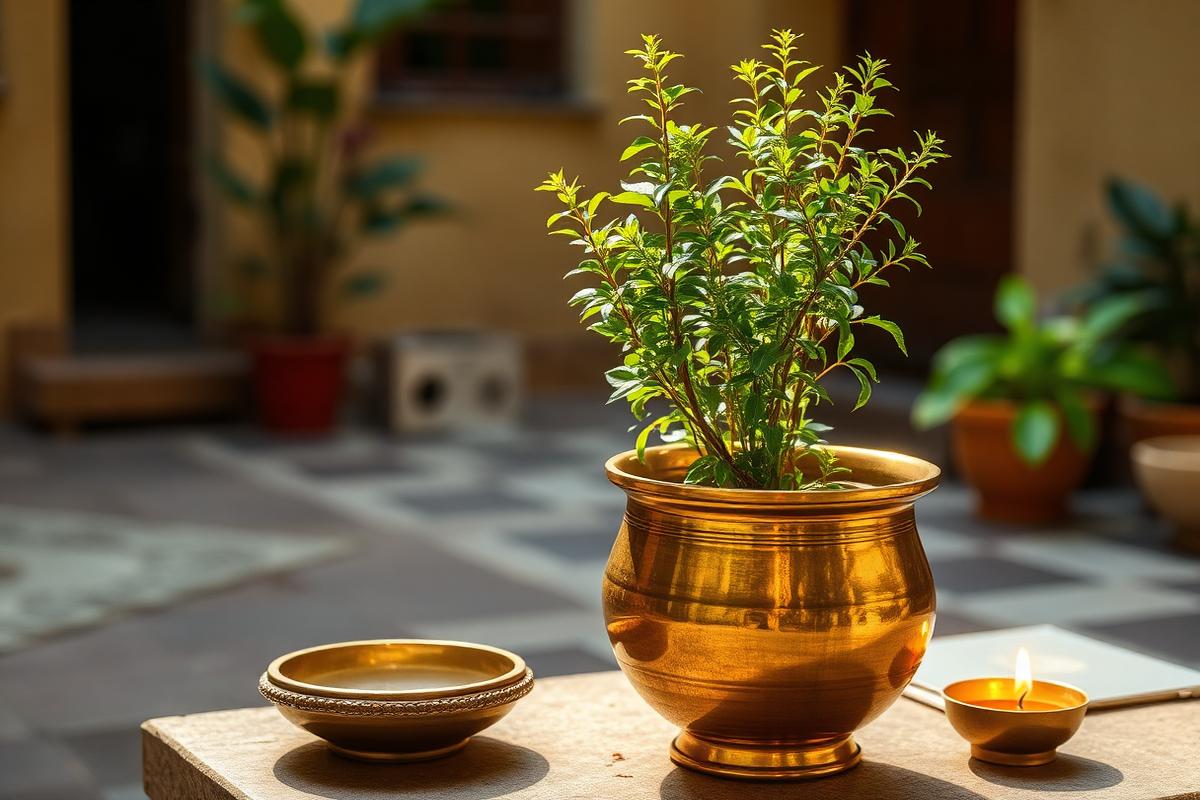
Tulsi (Ocimum sanctum / holy basil) is considered the earthly form of Goddess Lakshmi herself - specifically her incarnation as Vrinda. The Padma Purana, Skanda Purana, and Devi Bhagavatam all describe Tulsi as 'Vishnu Priya' (beloved of Vishnu). No Vishnu puja is complete without offering tulsi leaves - even a lavish 16-service ritual with gold and silk is considered incomplete if one tulsi leaf is missing. Scientific reasons Hindu sages prescribed tulsi: 1. Releases oxygen 20+ hours a day (most plants only during daytime photosynthesis). 2. Absorbs harmful gases including formaldehyde, benzene. 3. Mosquito-repellent and antimicrobial. 4. Anti-stress (adaptogen). 5. Boosts immunity (now backed by modern Ayurveda research). Two main varieties: Rama Tulsi (light green, mild) and Krishna Tulsi (purple-tinged, stronger). Both are equally sacred - Krishna Tulsi has slightly more medicinal use, Rama Tulsi is preferred for daily worship. Vana Tulsi (wild tulsi) is also acceptable but less common in homes. **The plant is so sacred that traditionally, women in the family bathe and worship Tulsi daily - circumambulating the plant 3 times, lighting a diya at its base, and offering a few drops of water. This 10-minute daily practice is considered equal to a major temple visit by many Vedic acharyas.
Exact Watering Rules - How Much, When & Days to Skip
Daily watering rule: Water in the EARLY MORNING (5-7 AM) before sunrise or just after. Quantity depends on pot size - typically 100-150 ml for a small pot (6-inch), 200-300 ml for medium, 500 ml for large outdoor planters. The finger test: Insert your index finger 1 inch into the soil. If dry → water. If moist → skip today. Tulsi prefers slightly damp, NOT soaking wet soil. Overwatering kills 70% of home tulsi plants. Days to NEVER water tulsi: 1. Sunday - Surya's day, watering disturbs solar energy in the plant. 2. Ekadashi (11th tithi of both pakshas) - Tulsi observes fast on Ekadashi like Vishnu devotees. Watering breaks her vrat. 3. Amavasya (new moon) - energetically still day; let plant rest. 4. After 6 PM any day - never water at night (leaves don't dry, fungal growth, snail attraction). Days to definitely water: Daily morning except above. On Thursday (Vishnu day) and Friday (Lakshmi day), the plant especially absorbs water - those are 'thirsty' days. Water quality matters: Use room-temperature filtered water. NEVER cold water from fridge (shocks roots). Add a pinch of compost-water once a week. Some traditions add 1 drop of cow's milk weekly - symbolic 'food' for tulsi (don't overdo - milk attracts ants). What happens if you accidentally water on forbidden days: Tulsi may dry up within 2 weeks. Remedy: chant 'Om Vishnave Namah' 21 times next morning while doing parikrama, and skip the next 3 days of watering as 'restoration'.
11 Critical Dos & Don'ts for Tulsi Plant
DOs (Essential): 1. Place in North or North-East direction of home or balcony. Center of courtyard is supreme. NEVER place in South or South-West. 2. Light a ghee diya at the base every evening (sunset to 7 PM). This is the daily worship. 3. Circumambulate 3 times in clockwise direction during morning watering, chanting 'Om Vishnave Namah'. 4. Use clay pot (terracotta breathes better than plastic). Clay is also more sattvic. 5. Pluck leaves only with right hand in morning, gently from below the inflorescence. Never with nails - use thumb-finger pinch. 6. Replant or shift pot before Tulsi Vivah (Kartik Shukla 11-12, November) - auspicious annual ritual. 7. Cover the base with marigold petals or fresh flowers during festivals (Diwali, Janmashtami especially). DON'Ts (Forbidden): 8. Don't pluck leaves on Sunday, Tuesday, Ekadashi, Sankashti Chaturthi - tulsi observes vrat these days. If you absolutely need a leaf, mentally apologize and chant 'Tulsi Maatre Namah' first. 9. Don't pluck leaves at night (after sunset) - tulsi 'sleeps' at night. 10. Don't let menstruating women touch the plant directly (traditional restriction - water from a distance). Modern practitioners debate this; follow what feels right. 11. Don't dispose of dried tulsi leaves in trash - they should be either added back to the plant's soil, given to flowing water (Ganga visarjan style), or buried under a Peepal tree.
Why Your Tulsi Keeps Dying - 5 Common Causes & Revival

If you've lost 2+ tulsi plants in a year, these are the likely reasons: Cause 1 - Overwatering (70% of deaths): Symptoms - yellow leaves, soggy soil, root rot smell. Fix: stop watering for 7 days, repot in dry soil with drainage holes, add small stones at bottom. Cause 2 - Wrong direction: Tulsi in West, South, or South-West dies faster. Fix: relocate to North/NE/East. Cause 3 - Insufficient sunlight: Tulsi needs 4-6 hours direct sun daily. Indoor-only tulsi dies. Fix: move to sunny window or outdoor balcony. Cause 4 - Wrong pot/soil: Plastic pots, water-retentive soil. Fix: clay pot + sandy loam mix (60% garden soil + 30% sand + 10% compost). Cause 5 - Negative energy in home: Spiritual cause - when home has unresolved disputes, alcohol abuse, or constant arguments, tulsi 'absorbs' the negativity and dies. Fix: clean spiritual energy first (camphor, chanting, donations), THEN plant new tulsi. Reviving a dying tulsi: 1. Trim all yellow/brown leaves and dead branches. 2. Repot in fresh soil. 3. Place in morning sun (avoid harsh noon sun). 4. Water ONLY when soil top inch is dry. 5. Daily light a ghee diya and chant 'Om Tulsi Namah' 11 times. 6. Don't pluck leaves for 21 days - let plant recover. 7. If tulsi shows new growth in 14 days, she has accepted your home. If not, the timing isn't right - wait 2 months before trying again. When tulsi naturally dies (late winter): Tulsi has a natural lifecycle - most plants die between Kartik (Nov) and Margashirsha (Dec) after flowering. Save the seeds from the dried inflorescence and plant fresh in Vasant (Feb-March). This is the natural cycle, not a 'death'.
Tulsi Vivah - The Annual Wedding Ceremony (Most Important Day)
Tulsi Vivah (Tulsi-Shaligram wedding) is the annual festival on Kartik Shukla Dwadashi (12th tithi after Diwali, November). On this day, Tulsi plant is ceremonially married to Lord Vishnu in his Shaligram form. Why this matters for plant care: Tulsi Vivah is when you re-energize your plant for the next year. What to do: 1. Bathe the Tulsi plant pot. 2. Decorate with saree-like cloth, jewelry, sindoor on the central leaf cluster. 3. Place a Shaligram (or Vishnu/Krishna idol) next to the plant. 4. Perform a simulated wedding - mangalashtak mantras, garland exchange, akshat sprinkling. 5. Friends and family gathered for the 'baraat'. Spiritual benefit: Performing Tulsi Vivah at home is equal in merit to giving a daughter in marriage (Kanyadaan). For families without daughters or who couldn't perform Kanyadaan, Tulsi Vivah is the substitute that fulfills that life karma. For unmarried girls: doing Tulsi Vivah for 5 consecutive years secures a virtuous husband. Plant care implication: After Tulsi Vivah, the plant is considered 'reborn' for the year. Refresh soil, prune dead parts, paint the pot, and treat the plant with renewed devotion. Most spiritual families see remarkable health in their tulsi plant for the year after a sincere Tulsi Vivah.
What People Ask Most
Can I keep Tulsi indoors if I don't have a balcony?+
Possible but challenging. Tulsi needs 4-6 hours of direct sunlight - most indoor positions don't get this. If you must keep indoor: place by a south or east facing window that gets morning sun, rotate the pot 90° every week so all sides get light, supplement with grow light in winter, and accept the plant will be smaller than outdoor tulsi. Better alternative: a small balcony railing planter even on a 2-feet balcony works perfectly.
Why does my tulsi plant flower? Should I let it?+
Flowering (mañjari) is natural after 6-8 months of plant life. Once flowering starts, the plant directs energy to seed production and gradually dies. Two options: (1) Let it flower for spiritual reasons - Tulsi flowers are sacred offerings. (2) Pinch off the inflorescence stem when small to keep the plant leafy longer. Most spiritual families do option 1 - allow natural lifecycle, collect seeds for next year's planting, and observe Tulsi Vivah when flowering peaks.
How many tulsi leaves to consume daily for health?+
Ayurveda recommends 2-5 leaves per day on empty stomach. Chew thoroughly - NEVER swallow whole. Best time: morning before tea/breakfast. Benefits: immunity, stress relief, blood sugar control, oral health. CAUTION: pregnant women should limit to 1-2 leaves, and those on blood thinners should consult doctor (tulsi has mild blood-thinning property). Don't chew with metal teeth fillings - tulsi reacts with mercury; if you have amalgam fillings, swallow with water without chewing.
Can I plant tulsi in any month or are there auspicious months?+
Best months: Kartik (Oct-Nov, after Tulsi Vivah), Vaishakh (April-May), Shravan (July-Aug). Avoid: Magh (Jan-Feb, too cold), peak summer (May-June without shade). Best day of week: Thursday (Vishnu day) or Friday (Lakshmi day). Best tithi: Ekadashi for sacred connection. Avoid: Amavasya, Sankashti, Solar/Lunar eclipse days. Take sankalpa before planting: 'I plant Tulsi Devi in my home for our family's welfare, spiritual progress, and prosperity'.
What to do with dried tulsi plant - is it disrespectful to throw away?+
Yes, throwing in trash is disrespectful. Three respectful options: (1) Visarjan in flowing water - river, lake, sea, or any natural water body. Wrap the dried plant in a small red cloth. (2) Bury under a Peepal tree or Banyan tree - both are sacred and accept tulsi's energy. (3) Cremate in your home havan (fire ceremony) with a brief mantra - 'Om Tulsi Mata, Vishnu Priye, Punaragamanaaya Cha' (Om Tulsi Mata, beloved of Vishnu, please return again). Save the seeds before disposal - they're the plant's 'soul', and planting them is the highest honor.
About the author
Dr. Suresh Iyer · Vastu Shastra & Jyotish, 18+ years
Dr. Suresh has practiced traditional Vastu and basic Vedic Jyotish for over 18 years across South India. He contributes the Vastu, direction, and home-puja layout guides on Vandnaa.
Meet the Vandnaa editorial team →Explore on Vandnaa
Related Articles
Tulsi Plant at Home: Right Direction, Vastu Rules & 9 Sacred Benefits Every Hindu Should Know
8 min read
Money Plant Vastu: Right Direction, 9 Rules, Care Tips & Why It Brings Prosperity
9 min read
Tulsi Vivah 2026: Date, Katha, Puja Vidhi & Why This Marriage Begins Wedding Season
9 min read

Ekadashi Vrat Rules 2026 - Complete Fasting Guide, Allowed Foods & All 24 Ekadashis
12 min read
Home Temple Setup: Vastu, Direction, Items & Complete Guide
9 min read