Why Vat Savitri Is the Most Powerful Vrat for a Married Woman
There is one story in all of Hindu scripture where a wife's devotion was so powerful that Yamraj - the god of death - had to give her husband's life back.
That story is Savitri and Satyavan. And the vrat born from it is the most sacred vow a married Hindu woman keeps every year.
Vat Savitri Vrat 2026 falls on Wednesday, 27 May 2026 - Jyestha Amavasya. Amavasya tithi begins at 2:22 PM on May 26 and ends at 4:16 PM on May 27. The puja must be completed between sunrise (5:25 AM) and 12:30 PM on May 27.
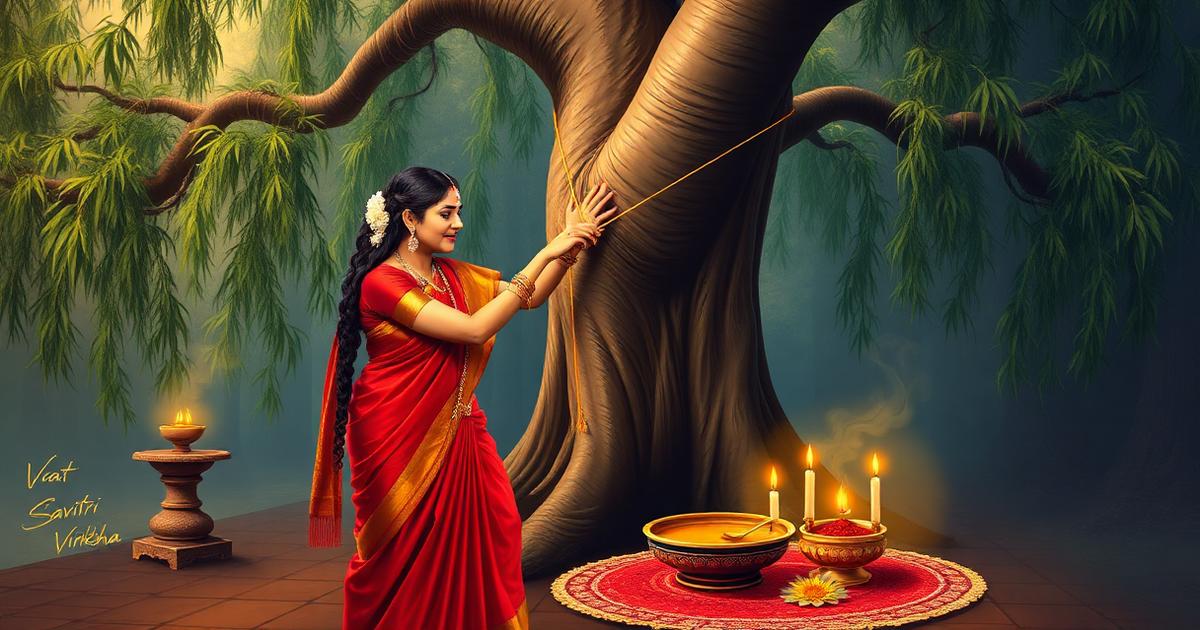
The fast is called Vat Savitri because the puja is performed under a Vat (banyan) tree - the tree under which Savitri sat when Yamraj carried away Satyavan's soul. The banyan is considered immortal (akshay vat) and is the only tree where Brahma, Vishnu and Shiva all reside together.
When a wife ties the sacred red thread around the banyan trunk while listening to Savitri's katha, she is invoking the same shakti that brought Satyavan back from death. Scriptures promise: this one vrat protects the husband for 7 lifetimes.
In this guide you'll learn the exact puja vidhi, the complete Savitri-Satyavan katha, the 7 strict rules that decide vrat strength, and the mantras to chant while tying the 108 parikrama threads.
🙏 Set a free Vat Savitri reminder in the Vandnaa App so you complete puja before the Amavasya tithi ends.
Vat Savitri Vrat 2026 - Exact Date, Tithi & Puja Muhurat
Note these timings - crossing Amavasya tithi breaks the vrat.
📅 Date: Wednesday, 27 May 2026 🕒 Amavasya Begins: 2:22 PM, 26 May 2026 🕒 Amavasya Ends: 4:16 PM, 27 May 2026
Sunrise Puja (Most Auspicious): 5:25 AM – 7:10 AM Main Puja Muhurat: 9:15 AM – 12:30 PM Abhijit Muhurat: 11:51 AM – 12:45 PM
Important: Many North Indian states (UP, Bihar, MP, Punjab) follow Jyestha Amavasya (27 May) - above dates apply. But Maharashtra, Gujarat and South India follow Jyestha Purnima, which in 2026 is 10 June - a separate date called Vat Savitri Purnima. Follow your family tradition.
Special yog in 2026: Amavasya falls on Wednesday (Budhvar) - Lord Ganesh's day. This creates Ganesh Yog which removes all vighna (obstacles) from the vrat. A very rare and powerful combination.
The Original Savitri-Satyavan Katha - The Story Every Suhagin Must Know
Princess Savitri was the daughter of King Ashwapati of Madra. When she came of age, no prince was worthy of her. She travelled the forests and chose Satyavan - a poor prince whose father had lost his kingdom and was living in exile.
The sage Narad warned Savitri: 'Satyavan is pure-hearted and brave - but he will die in exactly one year from today.'
Savitri did not change her choice. 'A Hindu girl chooses her husband once. My vow stands.'
She married him and lived in the forest for one year as a simple ascetic. Three days before his predicted death, she began a fast. On the fateful morning, she followed Satyavan into the forest when he went to collect wood.
While chopping, Satyavan felt his head spin. He lay down on Savitri's lap. Suddenly Yamraj himself appeared - riding a black buffalo, carrying a noose - and pulled Satyavan's soul out of his body.
Yamraj began walking south. Savitri followed.
Yamraj: 'Return. This path is not for the living.' Savitri: 'Where my husband goes, I go.'
For hours she walked behind Yamraj, speaking words of such wisdom about dharma, truth and the duty of a wife that Yamraj - impressed - offered her three boons (but not her husband's life).
Boon 1: Savitri asked - 'Return sight and kingdom to my blind father-in-law.' Granted. Boon 2: 'Give my father 100 sons.' Granted. Boon 3: 'Let me be the mother of 100 sons.'
Yamraj said 'Granted' - and then realised his mistake. How could Savitri bear 100 sons if her husband Satyavan was dead? A Hindu wife would never take another man.
Caught in his own word, Yamraj released Satyavan's soul. Satyavan awoke under the banyan tree as if from a deep sleep.
The banyan tree witnessed everything. From that day, every Jyestha Amavasya, Hindu women tie threads around a banyan and request the same boon - 'May my husband live a long, healthy life, and may I serve him in this and 7 lifetimes.'
This is the vrat that brings husbands back - even from death.
Step-by-Step Vat Savitri Puja Vidhi Under the Banyan Tree
If a real banyan tree is not accessible (common in cities), you may bring a banyan branch home and keep it in a pot of water during puja. The vrat remains valid.
Items needed (Samagri):
- Red cotton thread (100 hand + 8 strands = 108 for parikrama)
- Roli, chandan, akshat, kumkum, haldi, mehendi
- Red bangles, red cloth, red flowers (especially hibiscus)
- 16 shringaar items (bindi, sindoor, kangan, etc.)
- Fan made of leaves (palm or mango leaf)
- Dry fruits, kheer, chana, gud (jaggery)
- Ganga jal, unboiled milk
- Photo of Savitri-Satyavan (or printout)
- Vat (banyan) tree - or a branch if tree unavailable
Step 1 - Pre-Fast Preparation (evening of May 26): Eat only a single satvik meal. Do not eat after sunset. Apply mehendi on hands. Lay out 16 shringaar for next morning.
Step 2 - Snan & Shringaar (morning of May 27): Bathe before sunrise. Wear a red or yellow saree (married woman's colours). Complete all 16 shringaar - sindoor in mang, bindi, bangles, kajal, mehendi, etc. A suhagin's shringaar is her weapon for this vrat.
Step 3 - Sankalp: Sit before the banyan tree facing east. Take sankalp: 'I, [your name], wife of [husband's name], on this Jyestha Amavasya observe the Vat Savitri Vrat. I pray to Savitri Mata and the Vat tree for my husband's long life, good health and our togetherness in this and 7 lifetimes.'
Step 4 - Vat Tree Puja: Pour water mixed with milk at the roots of the banyan. Apply roli-chandan-haldi-kumkum on the trunk. Offer akshat and red flowers. Place the photo of Savitri-Satyavan at the base.
Step 5 - Katha Shravan: Read or listen to the Savitri-Satyavan katha (given in section above). Tell the story to your children if you have any - this keeps the tradition alive.
Step 6 - 108 Parikrama with Thread: Circle the banyan tree 108 times (7 minimum if 108 not possible). With each parikrama, wrap one turn of the red thread around the trunk while chanting: 'ॐ वट सावित्र्यै नमः' 'Om Vat Savitryai Namah' Pray for your husband's long life on each round.
Step 7 - Offering Bhog: Offer chana, gud, dry fruits and kheer to the tree. Fan the tree 7 times with the leaf fan - symbolic of the wind that revived Satyavan.
Step 8 - Aarti & Prasad: Light a ghee diya. Perform Savitri aarti. Touch the feet of the tree and an elder suhagin woman in your family - receive her blessings. Distribute prasad to other suhagins (never to men or unmarried girls as this prasad).
Step 9 - Break the Fast: After Amavasya tithi ends (4:16 PM), break the fast by eating the chana-gud prasad first, followed by a single satvik meal. No grains, onion or garlic today.
7 Rules Every Married Woman Must Follow on Vat Savitri Vrat
1. No argument with husband today - even if he is wrong. Speaking harshly to your husband on Vat Savitri breaks the entire vrat. If he is away, speak to him on phone with love.
2. Wear complete 16 shringaar - sindoor in mang is the most important. A vrat done without shringaar is like a prayer done without folded hands. This is the one day to fully honour your suhaag.
3. No food, no water till Amavasya ends (Nirjala vrat) - for women who cannot stay nirjal, fruits and milk once is allowed (Phalahar vrat). Never grain, salt, or processed food.
4. Do 7 parikramas minimum - 108 is ideal but if age/health doesn't permit, 7 is the minimum to complete the vrat. Less than 7 is considered incomplete.
5. Keep the thread for one year - tie a small piece of the parikrama thread on your wrist and keep till next Vat Savitri. It is your protective shield.
6. First bhog goes to cow, then Brahman, then suhagins - never eat before giving. Even a small piece of chana + gud must first go to a cow if possible.
7. Do not sleep during the day - Savitri did not sleep for three days before Satyavan's death. Following her, you too must stay awake during all sunlight hours. Rest only after Amavasya ends.
Absolute NOs on Vat Savitri day:
- Do not cut hair, nails or any thread
- Do not kill any insect (especially ants/spiders on the banyan)
- Do not wear black, white or dull colours
- Do not speak negative words - 'death', 'illness', 'failure'
- Do not give anyone else your sindoor or bindi to touch
The Complete Story of Savitri and Satyavan: Mythology Behind Vat Savitri Vrat
The story of Savitri and Satyavan, from the Mahabharata's Vana Parva, is one of the most intellectually brilliant narratives in Sanskrit literature - a debate with the god of death himself, won through logic, love, and unwavering presence of mind. Understanding the full story reveals why Vat Savitri is considered the ultimate festival of feminine power and intelligence.
The setting: Savitri was a princess of extraordinary beauty and intelligence - so exceptional that no man dared ask for her hand. Her father, King Ashwapati, reluctantly let her choose her own husband. Savitri wandered the forests and chose Satyavan - a prince living in the forest with his exiled, blind father Dyumatsena. She returned and announced her choice.
The terrible prophecy: The sage Narada, who was present, immediately told the court that Satyavan was fated to die within one year. Ashwapati begged his daughter to choose another. Savitri refused: "A princess chooses once. I have chosen. I will not choose again." The wedding proceeded.
The year of preparation: Savitri spent the entire year in perfect devotion - serving her in-laws, caring for Satyavan, while internally preparing for the day of his death. On the appointed day, she asked her father-in-law's permission to accompany Satyavan into the forest to collect wood and flowers.
The first encounter with Yama: In the forest, Satyavan fell ill under a tree, laid his head in Savitri's lap, and died. Yama (the god of death) appeared in his form of terrible majesty, carrying the noose, and took Satyavan's soul southward.
Savitri follows: Against all propriety (the living do not follow the dead), Savitri walked after Yama. Yama told her to turn back. She continued walking and began to speak - and her words were so wise, so philosophically profound, that Yama stopped to listen.
The three boons: Yama, moved by her determination and impressed by her wisdom, offered her three boons - anything except Satyavan's life.
- Boon 1: The restoration of her father-in-law's eyesight. Granted.
- Boon 2: The restoration of Dyumatsena's kingdom. Granted.
- Boon 3: A hundred sons born to her from Satyavan. Yama granted this - and then realized he had been outmaneuvered. A hundred sons from Satyavan required Satyavan to be alive. With these words: "Tathasthu" (let it be so), Yama released Satyavan's soul.
The teaching: Savitri did not beg, weep, or throw herself at death's feet. She engaged Yama philosophically - quoting dharmashastra, speaking of the nature of friendship, the obligations of the righteous, the nature of the good. Her third boon was not clever trickery - it was the natural consequence of knowing exactly what she wanted and being patient enough to wait for the right moment.
The story is the model for Vat Savitri Vrat: the woman who circles the banyan tree is tracing Savitri's patient encirclement of Satyavan's dying place, awaiting the moment when love's argument would prevail over death.
The Vandnaa app provides the complete Savitri-Satyavan katha in audio format, with the Sanskrit shloka where Savitri debates Yama - ideal for listening during the all-day fast.
Vat Savitri Vrat Mantras and Complete Puja Vidhi for Modern Women

The Vat Savitri puja is one of the most beautiful ceremonies in the Hindu calendar - combining elements of nature worship (the banyan tree), ancestral veneration, and matrimonial devotion into a single ritual. Here is the complete modern-adapted vidhi.
Preparation: The fast begins at sunrise. Wear bridal or festive attire - red or yellow is traditional. Prepare a puja thali with: raw cotton thread (sufficient for 7 circles), kumkum, turmeric, flowers (marigold and jasmine preferred), betel nuts (supari), betel leaves, a small lamp (diya) with ghee, incense, and uncooked rice.
Finding the banyan tree: The puja must be done at a banyan tree (vat vriksha). If no banyan tree is accessible, the tradition permits drawing a banyan tree on a clay pot or board, or using a banyan branch placed in soil. Urban adaptations: many temples have banyan trees in their compound specifically for this puja.
Sankalpa (intention-setting): Face east. Take water in your right hand and say: "Aum Kashipyasa Gotrasya Savitri Devi Prasadat Akhanda Saubhagya Praptiartham Vat Savitri Vrat Karishye" (with your own gotra/clan name). Pour the water.
Puja sequence: 1. Apply kumkum and turmeric to the base of the banyan tree. 2. Offer flowers at the roots. 3. Light the diya and incense. 4. Place betel nuts and leaves at the base. 5. Tie the first knot of the cotton thread around the trunk.
Circumambulation (parikrama): Holding one end of the thread, walk around the tree 7 times (clockwise). With each circumambulation, chant: "Savitrim Preeta Yasa Tvam, Satyavanam Saubhagya Prada, Tasyas Tava Priya Patnyas Savitrimeva Namostute"
As you walk, the thread wraps around the tree. The 7 circuits represent the 7 vows of Hindu marriage, the 7 promises renewed through this ritual.
The Satyavan-Savitri katha: After the parikrama, either recite or listen to the Savitri katha (the complete story). This can be done at home later in the day if time is limited at the tree.
Offerings: Offer food items to the tree: banana, seasonal fruits, and if possible, rice pudding (kheer) - milk-based offerings are particularly appropriate. These are then distributed as prasad to family members and neighbors.
The fast and its breaking: The nirjala (without water) fast is traditionally maintained until sunset, when the moon is seen and the stars appear. The fast is broken with prasad from the puja. If a full nirjala fast is medically not advisable, a partial fast (fruits and water only, no grain) is also considered valid.
For long-distance husbands: The puja is performed for the husband's wellbeing regardless of his physical location. Many women perform the puja with a photograph of their husband placed on the puja thali during the parikrama.
The Vandnaa app provides the complete Vat Savitri puja audio guide, the Savitri katha in full, and a reminder for the exact Jyeshtha Amavasya or Purnima date each year (the two dates observed by different regional traditions).
Quick Answers
Can unmarried girls or widows observe Vat Savitri Vrat?+
Unmarried girls can observe a modified version - praying for a good, long-lived husband in the future. They should wear yellow (not red), skip sindoor, and pray to Savitri for a Satyavan-like husband. Widows traditionally do not observe this vrat, but may visit the banyan tree to pray for the soul of their late husband - there is no prohibition in modern practice.
What if there is no banyan tree near my home?+
Go one day before and bring a small banyan branch with a few leaves. Place it in a pot filled with earth and water. Perform all puja around the pot-plant. Alternately, perform puja before a photograph of a banyan tree placed on a wooden chowki. The vrat is based on bhaav (devotion) - not location. Tie the 108-thread parikrama around the branch/photo.
Can I do Vat Savitri Vrat without the nirjala (waterless) fast?+
Yes - Phalahar vrat (fruits + milk once a day) is completely acceptable. Nirjala is traditional and gives maximum punya, but health comes first. Pregnant women, breastfeeding mothers, diabetics, or women above 60 should absolutely do only Phalahar. Your husband's long life does not depend on your dehydration - it depends on your devotion.
Is Vat Savitri same as Karva Chauth?+
Both are fasts for husband's long life, but different. Karva Chauth (October) involves a moon-sighting after sunset and the ritual of seeing husband's face through a sieve. Vat Savitri (May/June) is done around a banyan tree during daylight with 108 parikramas and the Savitri-Satyavan katha. Both are powerful - and many women observe both. Vat Savitri is older and mentioned in the Mahabharata; Karva Chauth became popular later.
About the author
Pandit Mahesh Trivedi · Festival Traditions & Panchang
Pandit Mahesh leads the festival-date and Panchang content on Vandnaa. He cross-references multiple regional panchangs (Drik, Vaishnava, Bengali, Marathi) for every festival date published on the site.
Meet the Vandnaa editorial team →