The Tree of the Three Gods - Trimurti Symbolism
Hindu tradition assigns specific cosmic roles to specific trees, but only one tree is considered the simultaneous dwelling of all three principal gods - Brahma, Vishnu and Shiva. That tree is the Vat (Ficus benghalensis, the banyan). Its three-part anatomy maps perfectly onto the Trimurti: the roots are Brahma (creation, hidden, the source), the trunk is Vishnu (the sustainer, holding everything up), and the aerial branches that descend back into earth to become new trunks are Shiva (transformation, the principle that destroys one form to create another).
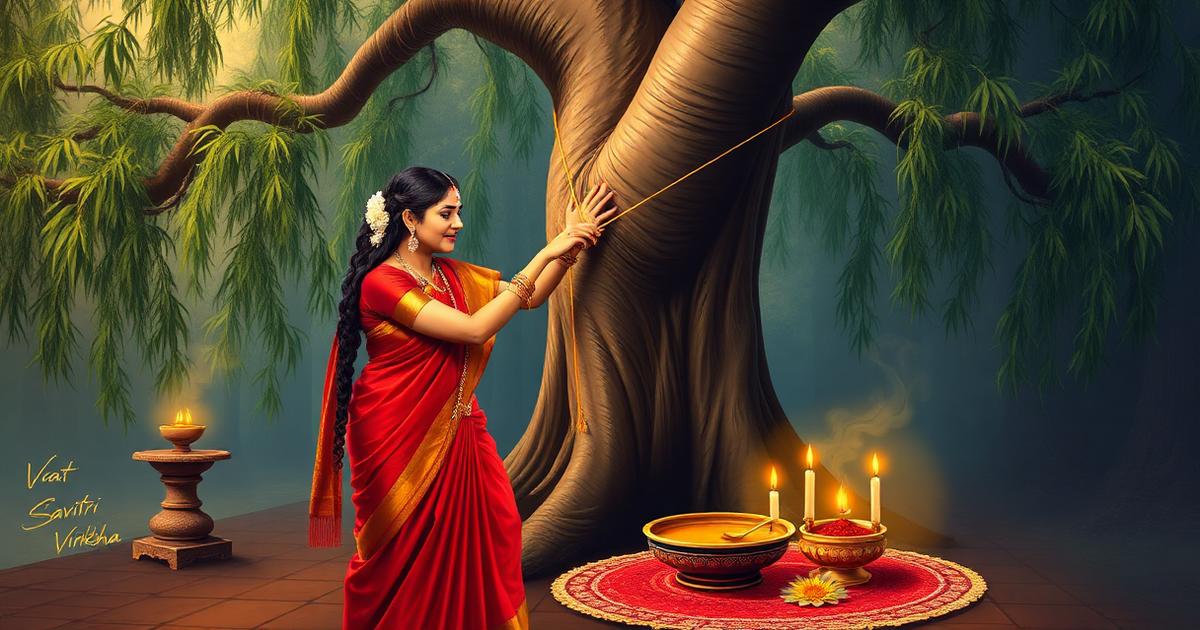
This triple symbolism is why women perform Vat Savitri vrat under a banyan tree and not under any other species. When she ties the red sacred thread around the trunk, she is symbolically binding her husband's life-span to the very fabric of the Trimurti. Vishnu (the sustainer) is begged to sustain her husband's life; Shiva (the destroyer of death) is begged to keep Yama away; Brahma (the creator) is begged to grant another full lifetime.
The banyan is also unique in that it never truly dies. When one trunk withers, the aerial roots that have already grown into independent trunks continue the tree's identity. The original 250-year-old Akshay Vat at Prayagraj (mentioned in Mahabharata) is, biologically speaking, the same individual tree - its central trunk dies and is replaced, but the genetic identity continues through aerial rooting. This is the literal meaning of 'akshay' (imperishable). It is the closest a tree comes to immortality.
The Bhagavad Gita's Chapter 15 begins with one of the most famous tree-metaphors in world spiritual literature: 'Urdhva-moolam-adhah-shaakham ashwattham praahuravyayam' - the eternal ashwattha tree with roots above and branches below. The 'ashwattha' is the peepal (sacred fig), Vat's cousin. Both belong to the Ficus genus and both are revered as cosmic trees in Hindu cosmology.
Savitri's Story - Why Women Bind the Banyan
The Mahabharata's Aranyaka Parva tells the story that became the foundation of every Indian married woman's most sacred vrat. Princess Savitri, daughter of King Ashvapati of Madra, chose her husband against all warnings. She had fallen in love with Satyavan, an exiled forest-dweller son of the blind king Dyumatsena. Sage Narada warned her: 'Choose anyone else. This Satyavan has only one year to live.' Savitri replied calmly: 'I have chosen. The good in him is real and rare. One year is enough for me.'
She lived with Satyavan in the forest for that year, sweeping the hut, gathering wood, serving her parents-in-law. Three days before the predicted death, she began a tridina-vrat (three-day fast), eating nothing. On the morning of the fated day, when Satyavan picked up his axe and went to the forest to cut wood, Savitri silently went with him. By afternoon, Satyavan complained of a terrible headache, lay down with his head in her lap, and stopped breathing.
She saw Yama Dharmaraj arrive in person, dark-skinned and dignified, with his noose. He drew Satyavan's small soul out of the body. Yama said: 'Such a noble soul that I came myself; usually I send my messengers. Now return; only my work continues.' Savitri quietly followed him.
Yama: 'Daughter, no living being follows me into death's road. Return.' Savitri: 'Wherever my husband goes, I follow. That is dharma.' Yama, impressed by her reasoning, granted a boon - anything except Satyavan's life. She asked for her father-in-law's sight to be restored. Granted. She kept following. Yama granted another boon. She asked for her father-in-law's lost kingdom. Granted. She kept following. Yama, increasingly moved, granted a third - 'anything except Satyavan'. She asked: 'May my father, who has no sons, have a hundred sons.' Granted. She kept following. Yama, finally exasperated: 'One last boon, child. Anything!' Savitri smiled: 'May I bear a hundred sons.' Yama said 'granted' before realising - he had just given her sons whose father could only be Satyavan. Bound by his own word, Yama returned Satyavan's soul.
Satyavan woke as if from sleep under the banyan tree. From that day, women have bound the banyan tree with red thread on Jyeshtha Purnima, asking the goddess Savitri (worshipped as the deity who defeated Yama) to grant their husbands the same long life. The banyan witnessed Yama's defeat once; women believe it will witness it again every year.
Why Banyan? The Environmental Wisdom Hidden in Worship
Modern environmentalists are rediscovering what Hindu sages knew 3000 years ago: the banyan is among the most ecologically valuable trees on earth. By giving it religious status, ancient Indians ensured it would never be cut down - a brilliant conservation strategy disguised as worship.
The banyan's ecological gifts:
- Oxygen production: A single mature banyan produces 100 kg of oxygen per year - enough for two human beings to breathe.
- Carbon sequestration: 6-12 tonnes of CO2 absorbed over its lifetime - among the highest of any tree species.
- Microclimate creation: Under a banyan, the temperature is 8-10°C cooler than outside in May-June. The thick canopy blocks direct sun while allowing diffused light.
- Water table maintenance: Deep tap roots and the network of aerial roots maintain groundwater levels for kilometres around. A village with a healthy banyan rarely faces water crisis.
- Bird and bat sanctuary: A single banyan can host 50+ bird species, hundreds of insects, fruit bats and squirrels. The Indian fig pollinator (Ficus wasp) has co-evolved with banyan over 30 million years.
- Soil binding: The roots stabilise soil and prevent erosion on slopes and along riversides.
Why the religious framing worked when modern conservation has not: When a forest department puts up a sign saying 'do not cut this tree', it gets ignored. When a banyan is declared the home of Brahma-Vishnu-Shiva, a married woman's husband-life-symbol, and the dwelling of the dead in 'Yama-vat' lore - cutting it becomes spiritually unthinkable. Religious veneration is the most effective conservation tool ever invented. Modern environmental movements are increasingly tapping into this - temple-tree initiatives, sacred grove protection (devra-van in Maharashtra, sarpa-kavu in Kerala) and sacred-tree-mapping projects.
The 'panchavati' principle: Ancient texts recommend planting five trees in this specific configuration around every village: peepal (north), bel (south), banyan (east), tulsi (centre, in a raised platform), neem (west). This panchavati creates ecological balance, religious sanctity, and is the original 'sacred grove' design. The banyan's east placement aligns it with sunrise; women doing morning puja under it receive the day's first sunlight filtered through the most sacred canopy.
Digging deeper, the Vat Savitri vrat ensures something subtle but important: at least one day a year, all women of a village gather under the same banyan tree and tie threads together. This creates community, transmits the Savitri-Satyavan story to younger generations, ensures the tree is cared for collectively, and forms a social bond that no government program could engineer.
How to Worship the Banyan: Complete Vidhi

If you have a Vat tree near your home or village temple, you can worship it any Saturday or on Jyeshtha Purnima for the Vat Savitri vrat. Here is the complete vidhi.
Items needed:
- Red sacred thread (kalava) - 27 strands or more
- Roli (red powder), akshat (rice mixed with turmeric)
- 5 to 11 different fruits, especially banana and mango
- Bhuna chana (roasted chickpeas)
- Gud (jaggery)
- A small bottle of water (preferably Ganga jal)
- Ghee diya and incense
- 5 betel leaves and supari
- A small mirror, comb and bindi (for Vat Savitri vrat specifically)
Step-by-step vidhi:
1. Reach the tree before 8 AM during shukla paksha; on Jyeshtha Purnima any time during day.
2. Sprinkle water around the tree in a circle of about 1 metre, purifying the ground.
3. Offer flowers and akshat at the roots, saying: 'O Vat Vriksha, dwelling of Brahma-Vishnu-Shiva, witness of Savitri's victory over Yama, I offer my pranaam.'
4. Tie the sacred thread around the trunk. Walk clockwise; tie one knot every revolution. For Vat Savitri vrat, the number of knots is 108 - but at minimum, tie 27 knots (one for each lunar mansion). With each knot, mentally chant: 'Om Vat-vriksha namah; aayushman bhava' (Salutations to the banyan; let [husband/family member] have long life).
5. Light the diya and incense at the eastern root. Place all fruits in a circle around the base.
6. Recite or read the Savitri-Satyavan story aloud to the tree. The story is the actual mantra - the tree 'remembers' Yama's defeat each time the story is told under its branches.
7. Pour water at the roots while saying: 'I water this tree as I water my husband's life. May both flourish.'
8. Distribute prasad (bhuna chana and gud) to all women present and to small children. Take a small portion home.
9. Circumambulate the tree 7 times (for general worship) or 108 times (for Vat Savitri). Each round, fold hands and silently say a wish for one family member.
10. Plant a young banyan sapling if possible somewhere on the same day - this completes the cycle. The most powerful Vat puja includes ensuring the next generation of trees.
For households without a nearby banyan:
- You can do a symbolic puja with a small banyan branch (collected respectfully, not broken violently) placed in a copper pot at home.
- Or worship a peepal tree as a substitute - peepal is the banyan's cousin and accepts most of the same vidhi.
- Or pledge to visit and worship a banyan once a year on Vat Savitri, traveling to a nearby village if needed.
- Or grow a banyan-bonsai at home - non-traditional but increasingly acceptable in urban India.
The single most important rule across all variations: never cut even a single leaf or branch from a Vat without genuine emergency need. A banyan considers itself disrespected by careless leaf-plucking and may withhold blessings.
Reader Questions Answered
Can a widow worship the Vat tree?+
Yes - the Vat tree is sacred for ALL women, not only for married women. Widows traditionally worship it for the souls of their departed husbands and for the wellbeing of their children. The vrat-form changes: instead of binding the tree for husband's life, the widow worships for ancestral blessings and her children's longevity. The Vat tree is also worshipped by widows on Pitru Paksha for the peace of departed family members. Some communities (like Maharashtrian Brahmins) explicitly include widows in the community Vat puja as 'mothers of the household'.
Is it true that one should not sleep under a banyan tree at night?+
Yes - this is supported by both spiritual lore and basic biology. Spiritually, the banyan is believed to attract pitru-energies (ancestral souls) at night, which is why Yama-vat lore associates it with the realm of the departed. Biologically, large trees release CO2 at night through respiration (the opposite of daytime photosynthesis); sleeping under heavy canopy increases CO2 exposure significantly. Both reasons point in the same direction: visit and worship banyan in daylight, do not camp or sleep under it overnight. Mid-day rest in its shade is excellent and traditionally encouraged.
What if there is no banyan tree available - can I use a peepal?+
Yes - peepal (ashwattha) is the second-best substitute and is accepted in most traditions. Peepal is the 'Krishna-vat' (the same family Ficus), it carries the same Trimurti symbolism, and worshipping peepal on Saturday is itself a powerful sadhana. The only specific situation where peepal is not a substitute: Vat Savitri vrat must traditionally be done at a banyan because Savitri's vow happened under a banyan. If even peepal is unavailable, the modern practice of bringing a Vat or peepal twig home in a copper pot for puja is accepted in cities and apartments.
Can I plant a banyan in my home garden?+
Only if you have a large open space (at least half an acre) and accept that the tree will eventually grow to enormous size. A full banyan can spread 100+ metres in canopy with roots that disturb building foundations. Vastu also advises against banyan in the immediate house compound - it should be at least 50 metres away. A safer option: plant a banyan-bonsai indoors (limits the size but allows daily worship), OR sponsor planting a banyan in a temple grove, schoolyard, or village commons - you get the spiritual merit without the practical challenge of having a giant tree on your land.
About the author
Anjali Mehta · Editor, M.A. Religious Studies
Anjali is the managing editor for Vandnaa and oversees the festival and vrat coverage. She holds an M.A. in Religious Studies and reviews every published article for accuracy, accessibility, and tradition-fidelity.
Meet the Vandnaa editorial team →