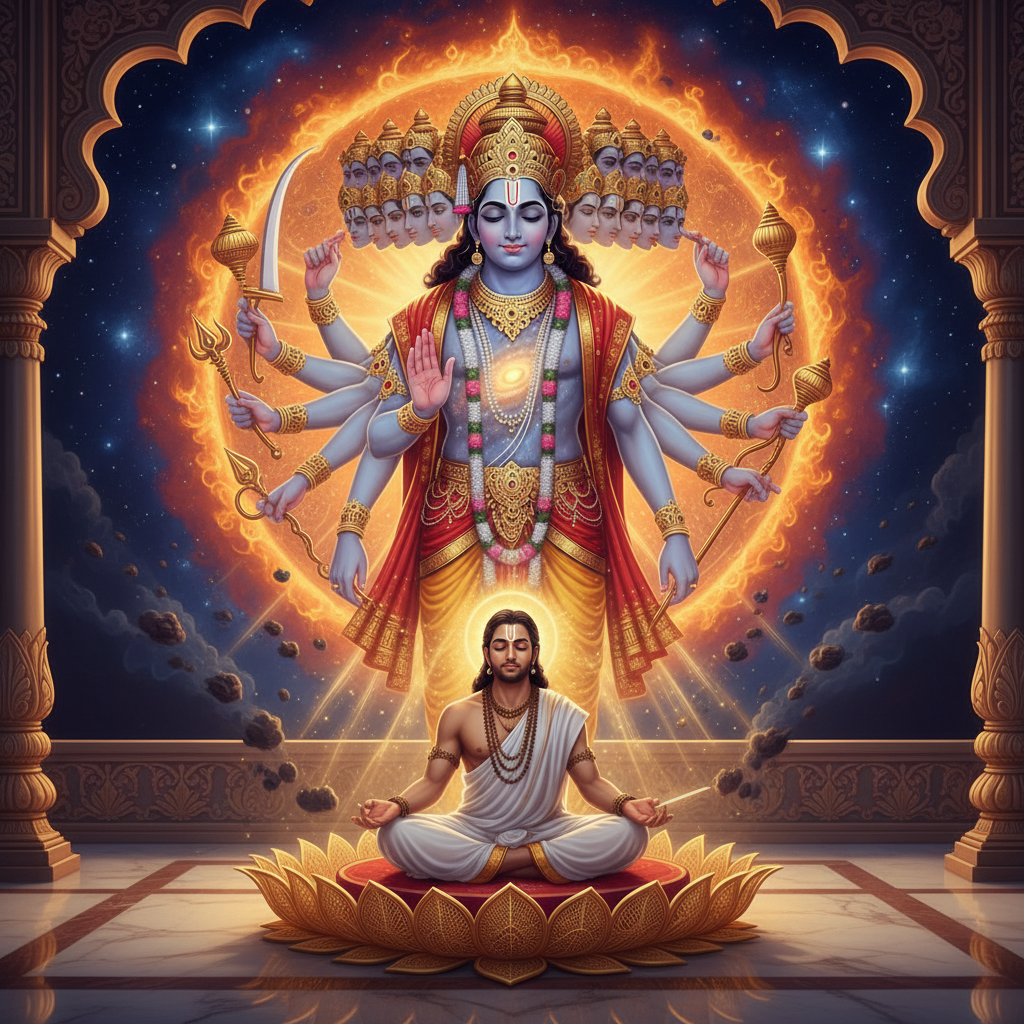
What Is the Vishnu Ashtottara Shatanamavali?
The Vishnu Ashtottara Shatanamavali is the litany of 108 names of Lord Vishnu, the preserver who sustains the entire universe. Each name is chanted as Om ... Namah, for example Om Narayanaya Namah.
Vishnu reclines on the cosmic serpent Shesha on the ocean of milk, descends as the ten avatars to protect dharma, and dwells in the heart of every devotee. The 1000 names of the Vishnu Sahasranama are most famous, but the 108-name Ashtottara is a beautiful, shorter daily litany. Each name praises a different aspect of his infinite, protecting nature.
A Selection of Key Names with Meaning
Below is a representative selection from the full 108; each is chanted as Om ... Namah.
- विष्णु (Vishnu) - the all-pervading one
- नारायण (Narayana) - the resting place of all beings
- हरि (Hari) - the remover of sins and sorrow
- केशव (Keshava) - of beautiful hair; the slayer of Keshi
- माधव (Madhava) - lord of Lakshmi (Ma), the goddess of fortune
- गोविन्द (Govinda) - protector of cows and the earth
- दामोदर (Damodara) - bound at the waist by a cord (the Krishna lila)
- पद्मनाभ (Padmanabha) - from whose navel the lotus of creation arose
- जनार्दन (Janardana) - refuge and giver to all people
- वासुदेव (Vasudeva) - dwelling in all and son of Vasudeva
- अच्युत (Achyuta) - the infallible, never-falling one
- अनन्त (Ananta) - the endless, infinite one
- गोपाल (Gopala) - protector and cowherd
- जगन्नाथ (Jagannatha) - lord of the universe
- पुरुषोत्तम (Purushottama) - the supreme being
- त्रिविक्रम (Trivikrama) - who measured the worlds in three strides (Vamana)
- उपेन्द्र (Upendra) - younger brother of Indra
- श्रीधर (Shridhara) - bearer of Shri (Lakshmi)
- हृषीकेश (Hrishikesha) - lord of the senses
- चक्रपाणि (Chakrapani) - holder of the Sudarshana chakra
- पीताम्बर (Pitambara) - clad in yellow garments
- जगन्नाथ (Lakshmipati) - लक्ष्मीपति, consort of Lakshmi
This is a selection from the traditional 108; reciting the complete Ashtottara Shatanamavali covers all the names.
Significance of the 108 Names
Vishnu is the sustaining power of existence, and his names describe how he protects and upholds creation. Narayana tells us he is the final resting place of all beings; Achyuta that he never fails his devotees; Padmanabha that the whole universe blossoms from him like a lotus.
Many of the names recall his avatars and lilas - Trivikrama the Vamana, Govinda and Damodara the Krishna, Gopala the cowherd. To chant the 108 names is to remember the one Lord behind all his forms and rescues, and to invite his steady protection into life. The number 108, sacred across tradition, makes the litany a complete round of remembrance.
Benefits & How to Chant

Benefits:
- Protection, peace and steadiness in life
- Removal of sins, fear and obstacles
- Prosperity and harmony, as Vishnu is consort of Lakshmi
- A calm, devoted mind and freedom from anxiety
- Spiritual progress toward liberation (moksha)
How to chant: 1. Best days: Thursday (Guruvar), Ekadashi and the Chaturmas period are especially dear to Vishnu. 2. Setup: Sit before an image of Vishnu (or Krishna/Rama), light a ghee lamp and offer tulsi leaves, yellow flowers and fruit. 3. Recite the full Ashtottara Shatanamavali, each name as Om ... Namah, ideally with a tulsi mala. 4. If short of time, chant 'Om Namo Bhagavate Vasudevaya' or 'Om Namo Narayanaya' 108 times and reflect on a few names. 5. Close with Vishnu aarti and offer the bhog (with tulsi) as prasad.
Tulsi is dear to Vishnu, so including a tulsi leaf in the offering makes the worship complete.
Reader Questions Answered
How many names are in the Vishnu Ashtottara Shatanamavali?+
There are 108 names. The Ashtottara Shatanamavali is the 108-name litany of Vishnu, each chanted as 'Om ... Namah' such as Om Narayanaya Namah. The longer Vishnu Sahasranama lists 1000 names.
What do names like Narayana and Padmanabha mean?+
Narayana means the one who is the resting place and refuge of all beings. Padmanabha means 'lotus-naveled', as the lotus from which creation arose grew from Vishnu's navel, with Brahma seated upon it.
When is the best day to chant Vishnu's 108 names?+
Thursday (Guruvar) and Ekadashi are most auspicious, along with the Chaturmas period. Reciting before a Vishnu image with a ghee lamp, tulsi leaves and a tulsi mala is the traditional way.
Why is tulsi offered when worshipping Vishnu?+
Tulsi (the holy basil) is considered most dear to Lord Vishnu, and no Vishnu worship is complete without it. Offering a tulsi leaf with the bhog and prayers is believed to please him greatly.
About the author
Acharya Vinaya Kapoor · M.A. Sanskrit, Mantra & Stotra Studies
Acharya Vinaya holds an M.A. in Sanskrit from Banaras Hindu University and writes the mantra and stotra commentary on Vandnaa. Her focus is on accurate pronunciation, traditional context, and helping modern readers connect with classical texts.
Meet the Vandnaa editorial team →