Origin & History: A 5000-Year-Old Plant Medicine
Mehndi comes from the henna plant (Lawsonia inermis), a small shrub native to North Africa, the Middle East and the Indian subcontinent. Its leaves, when crushed and made into a paste, release a natural pigment (lawsone) that binds to keratin in skin, hair and nails, leaving an orange-to-deep-brown stain. Henna's use is documented in ancient Egyptian mummies (Cleopatra is recorded using it), in Indus Valley artifacts from 3000 BCE, and in early Vedic texts that mention 'mendhi' as both medicine and beautification.
The word 'mehndi' itself comes from Sanskrit 'mendhika', which traveled into Hindi-Urdu as 'mehndi' and into Arabic as 'henna'. The same plant, the same practice, has united Indian, Middle Eastern and North African brides for 5000 years - making it perhaps the oldest continuously practiced female beauty ritual in human history.
In the Indian subcontinent, henna's earliest documented religious use is in Devi worship - particularly for Lakshmi and Parvati. Worshippers would apply henna to their palms as a form of bodily prayer, the dark color representing the goddess having 'touched' them. From there it migrated to wedding ritual: a goddess-touched body is auspicious for the new marriage. By medieval India, the bridal-mehndi tradition (mehndi raat or mehndi ki rasm) became the standard pre-wedding ritual it remains today.
Henna's medicinal properties were known long before its decorative uses became prominent: it is naturally antiseptic, antifungal, anti-inflammatory, cooling, and a natural sunscreen. Bedouin nomads applied henna to their feet to prevent fungal infections from sweat. Indian villagers applied it to children's hands during summer to draw out 'body heat'. The bride's mehndi served all these medical functions simultaneously, while also being a celebration. Beauty AND medicine - a perfect Ayurvedic principle.
Medicinal & Cooling Properties - Why Brides Need It
An Indian wedding is medically a stressful event for the bride. She undergoes days of fasting (Roka, Sangeet, Mehndi night, the wedding day itself), is under emotional pressure of transition, often slept poorly for weeks, has crowds of relatives constantly around, and has to perform several hour-long ceremonies in heavy clothing under heat. Her body needs significant cooling, stress reduction and skin protection. Mehndi provides all of these naturally - the elder grandmothers who designed this tradition understood this perfectly.
Cooling effect - measurable: Henna paste, applied to skin and left for 4-6 hours, drops the surface skin temperature by 2-3°C through evaporation and chemical interaction. This cooling spreads through the body's circulation. Brides who have full hand-and-foot mehndi report feeling 'breezy' and 'fresh' even when wearing heavy lehengas, despite the layered fabrics that would normally cause overheating. This is one of the practical reasons traditional brides have such elaborate, full-coverage mehndi rather than minimalist designs.
Stress reduction - verified: Henna contains alpha-pinene and other essential oils that have mild sedative properties when absorbed through skin. The 4-6 hour mehndi application is itself a deeply relaxing process: the bride sits still, women sing around her, she is being decorated, she has no responsibilities. By the end of mehndi night, even the most anxious bride is calm. The chemistry and the psychology both work.
Antiseptic protection: The wedding involves shaking hundreds of hands, touching every relative, walking barefoot in mandaps where dozens of people have stepped. The bride's hands and feet are continually exposed to bacteria, fungi and viruses. Mehndi on the palms and soles creates an antiseptic barrier - naturally killing pathogens on contact. Brides with traditional mehndi rarely develop skin infections during their wedding week; brides who skip mehndi for fashion-trends sometimes do.
Antifungal for sweat-prone areas: Indian summer weddings involve heavy sweating. Henna prevents fungal infections from forming under bangles, in the gap between fingers, in nail-beds. The dark color stays in the nail-beds for weeks after the wedding, continuing this protection through the high-stress honeymoon period.
Hair and scalp benefits (separate use): While bridal mehndi is on hands and feet, many Indian women apply henna to hair monthly. It conditions the scalp, prevents dandruff, naturally colors grey hair, and strengthens hair shafts. The combined effect over years: women who use henna regularly have noticeably healthier hair and palms-soles than those who do not.
In short, the bride is given a comprehensive Ayurvedic medical treatment disguised as art. This is the genius of Hindu wedding traditions - health, beauty, ritual and prayer all bundled into one practice that no one can refuse without giving up the celebration too.
The Color Belief & The Husband's Name Hidden in Design
Two of the most charming customs around mehndi are folk-beliefs that have been documented for centuries.
Belief 1: The darker the mehndi, the more the husband loves the wife
This is the most famous mehndi superstition. After the application, the paste is left on for 4-6 hours (some traditions overnight), then scraped off; the resulting stain develops over the next 24-48 hours, deepening from orange to dark brown. The depth of color is taken as a sign of the husband's love. A bride whose mehndi turns deep maroon is considered fortunate; a bride whose mehndi stays pale orange is sometimes teased that her husband is not as devoted.
Scientifically, the color depth depends on: skin pH (slightly acidic skin holds color better), body temperature during application (warmth deepens color), how long the paste is left on, quality of the henna (organic, freshly-ground, with lemon juice and a drop of clove oil gives the darkest color), and slight individual variation in keratin chemistry. None of these correlate with the husband's actual love.
But here is the soft truth: the belief itself functions as a self-fulfilling prophecy. A bride whose mehndi turns dark feels loved; she enters the marriage with positive expectations and tends to receive love in return. A bride whose mehndi stays pale starts the marriage doubting; she watches for proof of love and may interpret neutral events as evidence of insufficient affection. The belief, taken too literally, can shape the actual marriage. Wise families tell brides: 'no matter what color it turns, the love is real if both of you make it real.'
Belief 2: The husband's name is hidden in the bridal mehndi
This is the most romantic of all wedding rituals. The mehndi artist (often a senior female relative or a professional henna artist) secretly weaves the groom's name into the intricate patterns on the bride's hands. The name is broken into letters and disguised among flowers, peacocks, vines and geometric motifs - so well hidden that finding it requires careful searching.
On the wedding night, the groom must find his name on the bride's hands. He sits with her after all the ceremonies, takes her hands in his, and searches every petal and curve. Some brides have it hidden in 5 different places - making it a longer game. The first night is therefore not a stranger's first awkward encounter; it is a playful collaborative game between two new partners. The bride teaches the groom 'this part of my hand has your name' - a metaphor for 'I carry you everywhere on my body now.'
This tradition does several beautiful things at once: it forces the groom to study his wife's hands closely (which means studying her), it gives them something to talk about and laugh about (breaking awkwardness), and it makes the wife's hand into a love-letter that only the husband can fully read. Modern brides who skip this find that wedding nights feel oddly empty without the game. Many traditional families insist on it even when the bride wants minimalist mehndi.
A related custom: if the husband finds his name on the very first night, the marriage is considered to begin with 'good omen of attentiveness'. If he gives up, the bride playfully reveals the locations and teases him - 'see, you didn't even look properly'. Either way, the ritual sets up the dynamic of a husband who must always pay attention to the wife to find what is hidden in her - a metaphor that grows truer through the years.
Mehndi Beyond the Wedding: Karwa Chauth, Teej, Eid
Mehndi is not only a wedding ritual - it is the standard cosmetic-and-spiritual offering for nearly every Hindu festival celebrated by women. Here is the comprehensive calendar.
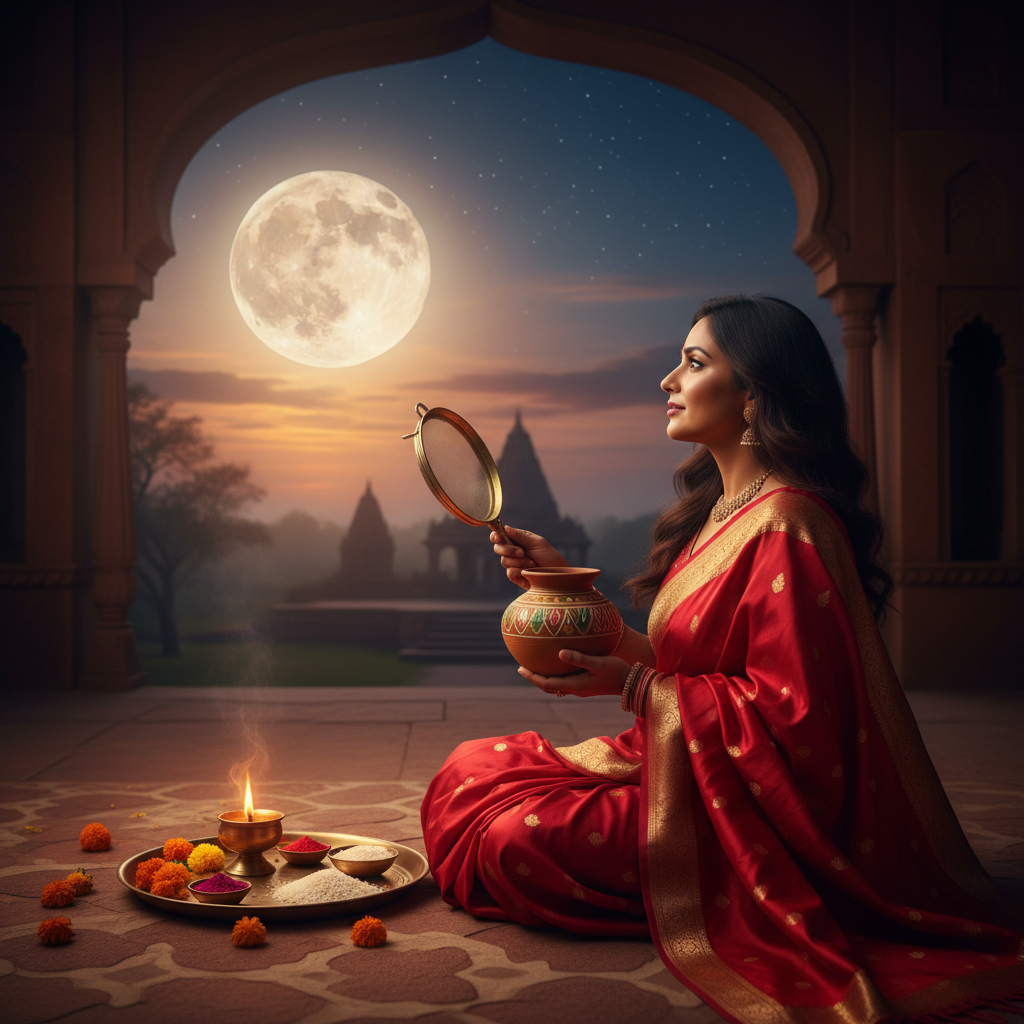
Karwa Chauth (October-November, full moon after Sharad Purnima): Married women fast from sunrise to moonrise for husband's long life. The night before, they apply elaborate mehndi as part of the sargi-preparation. On the day itself, the husband is supposed to admire and compliment the mehndi as part of the breaking-of-fast ritual. Wives whose mehndi turns dark by Karwa Chauth night are particularly praised by the joint family.
Teej (July-August, three forms - Hariyali Teej, Kajari Teej, Hartalika Teej): Monsoon festival for women, especially newlyweds. Henna is applied generously; women wear green outfits, swing on swings hung from banyan or peepal trees, sing teej songs. The mehndi for Teej tends to be more nature-themed (leaves, monsoon clouds, peacocks dancing in rain) than wedding mehndi which is more royal-themed.
Bhai Dooj / Raksha Bandhan: Sisters apply mehndi as part of dressing up for these brother-sister festivals. The mehndi on these occasions is typically simpler - single side of hand or a small wrist design.
Eid-ul-Fitr and Eid-ul-Adha: Muslim women across South Asia apply mehndi the night before Eid (Chand Raat). The designs are often shared between Hindu and Muslim mehndi artists; many of the same patterns appear in both traditions. This is one of the most beautiful examples of cross-religious cultural continuity in the subcontinent.
Navratri: Women applying mehndi for any of the nine nights of Navratri is increasingly common, especially in Gujarat where garba is performed in elaborate dress. Devi-specific designs (kalash, trishul, lotus) are popular.
Diwali: Lakshmi puja involves dressing fully; mehndi the night before is standard in many families, particularly in North India.
Pregnancy ceremonies (Godh Bharai / Baby shower): Mehndi is applied on the expectant mother and the elder women, with designs featuring baby motifs (cradle, small footprints, mother-child pairs).
Sankashti Chaturthi for Ganesha-devotees: Some women apply Ganesha-themed mehndi on Sankashti, with Ganesha's silhouette as the central design.
What unites all these occasions: mehndi marks the day as 'not ordinary'. Even in a household where every Friday is a Lakshmi puja, the rare Friday on which mehndi is applied becomes special. The ritual lifts a celebration from regular to extraordinary. This is why even modern professional women, who may never wear sarees or jewellery in daily life, will sit for elaborate mehndi the night before a major family event. The ancient cooling-medicine-blessing-prayer bundle still works - it transforms a person's mood and outlook for the day, regardless of what they consciously believe about its spiritual meaning.
Reader Questions Answered
Can men apply mehndi? Is it only for women?+
Historically, both men and women applied henna in ancient India and the Middle East - early texts describe royal men applying henna to beard and nails. Modern practice in India has shifted to mainly women, but groom-mehndi is making a comeback: many grooms now apply a small symbol of the bride's name on their palm at the haldi-mehndi ceremony. Sufi-influenced practices and some South Indian traditions never stopped men's mehndi use. There is no spiritual rule against it; the current pattern is cultural fashion, not religious mandate. A man applying a small mehndi on his palm during a wedding or major festival breaks no rule.
Is chemical 'black mehndi' (PPD-based) safe?+
NO - chemical black mehndi contains paraphenylenediamine (PPD), a synthetic hair-dye chemical that causes serious allergic reactions, chemical burns, blistering, scarring, and in some cases permanent skin damage. The dark color appears within 1 hour (vs. 24-48 hours for natural henna) - this is the giveaway that it is chemical. The Indian Council of Medical Research has warned against it; many countries have banned its sale for skin use. ALWAYS use 100% natural henna, identifiable by: greenish-brown paste color, gradual color development over 24-48 hours, herbal smell, no immediate skin reaction. Natural henna NEVER produces black; the deepest color is reddish-maroon to dark brown.
How can I make my mehndi color deeper without chemicals?+
Eight natural tricks: (1) Use fresh, organic henna powder, ground from leaves within the last 6 months. (2) Mix henna paste with lemon juice + tea decoction + a few drops of clove oil (the acid-tannin-essential oil combination releases maximum lawsone). (3) Leave the paste overnight before applying. (4) Apply when your hands are warm (light exercise or warm bath first). (5) Keep the paste on as long as possible - minimum 6 hours, ideally overnight. (6) After scraping off, do NOT wash with water for at least 12 hours - wipe with mustard oil instead. (7) Sit near a clove-flame or low heat during the paste application (gentle warmth helps). (8) Avoid soap, hand sanitiser and water on hands for 24 hours after - the longer you keep dryness, the deeper the color develops.
Can a pregnant woman apply mehndi?+
Natural henna is safe during pregnancy and even traditionally encouraged - it cools the body, relaxes the mind, and the Godh Bharai (baby shower) ceremony includes mehndi. The cooling property is particularly welcome during pregnancy's heat-discomfort. Avoid only: chemical black mehndi (toxic), any mehndi product that smells like ammonia or has unfamiliar synthetic additives, and applying to the abdomen (some traditions advise not). On hands and feet - completely safe through all three trimesters. Many obstetricians actively recommend it to pregnant patients for its calming effect in the final weeks.
About the author
Pandit Mahesh Trivedi · Festival Traditions & Panchang
Pandit Mahesh leads the festival-date and Panchang content on Vandnaa. He cross-references multiple regional panchangs (Drik, Vaishnava, Bengali, Marathi) for every festival date published on the site.
Meet the Vandnaa editorial team →