Why East: The Sun, Indra, and the First Rays
Hindu cosmology assigns specific deities to each of the eight cardinal/intermediate directions (Ashta Dikpalas - the 8 guardians of directions):
- East = Indra (king of devas, source of all energy)
- South-East = Agni (fire god)
- South = Yama (god of death, karma)
- South-West = Niruti (demon king, destruction)
- West = Varuna (water god, oceans)
- North-West = Vayu (wind god)
- North = Kubera (wealth god)
- North-East = Ishana (Shiva)
East is the most auspicious. Three reasons:
1. The Sun rises in the east. Every morning, before human activity begins, the first rays cross the eastern horizon. A temple facing east receives this 'first light' directly into its garbhagriha (inner sanctum) where the deity resides. This is called 'Surya kiran abhishek' - the sun-ray ablution. The deity is bathed in pure dawn light before any priest, devotee, or sound enters. Over centuries, this daily light-bath is believed to keep the deity's energy 'fresh' and renewed.
2. East is Indra's direction. Indra is the king of all devas in Vedic cosmology - the leader and most powerful deity (until later theology elevated Vishnu and Shiva above him). Placing the temple entrance facing Indra's direction is a gesture of welcome to the entire deva-loka. The deities you're worshipping inside the temple are honoured by Indra's symbolic blessing entering with the dawn.
3. East is the direction of beginnings. Hindu time-cycles all begin in the east: each day begins with sun rising in east; each year begins with Chaitra (spring) when the sun crosses the celestial equator going north; each new venture (wedding, business opening, house warming) is begun facing east. The temple - which is the spiritual 'beginning' of devotion - naturally aligns with this direction.
Famous east-facing temples: Tirupati Balaji (Andhra), Srirangam Ranganatha (Tamil Nadu, the largest functional temple in the world), Jagannath Puri (Odisha), Vaishno Devi (Jammu), Somnath (Gujarat), Kashi Vishwanath (Varanasi - though entrance is east-north-east due to Ganga). Even small village temples follow this rule by default.
The pradakshina (circumambulation) flows around the central east-facing deity in a clockwise direction - matching the sun's apparent east-to-west arc across the sky. This mimics the cosmic motion within the small temple architecture.
The Vastu Purusha Mandala: How Temples Are Designed
Every traditional Hindu temple is built on the Vastu Purusha Mandala - a sacred grid that maps a divine cosmic being (the Vastu Purusha) lying face-down on the ground. The temple is essentially built ON this being, with each part of his body corresponding to specific architectural functions.
The grid: typically 64 squares (8x8) or 81 squares (9x9). The central squares represent the Vastu Purusha's navel - the most sacred area, where the garbhagriha (inner sanctum) is placed. The deity's idol sits exactly above this navel point.
The orientation:
- Vastu Purusha lies with head to the NE corner (the most auspicious corner).
- Feet to SW corner.
- This means his face is up (toward sky), but the temple's entrance is from the east (his right side), so the first light enters and illuminates his form.
The temple architecture follows the body:
- Garbhagriha (inner sanctum / belly) = central squares, dark, womb-like.
- Antarala (vestibule / chest) = transition between sanctum and hall.
- Mandapa (pillared hall / face) = where devotees gather.
- Ardha-mandapa (porch / hands) = entrance porch.
- Gopuram or Shikhara (tower / head) = rises above the garbhagriha, symbolising the cosmic mountain (Meru).
- Eastern entrance = where the sun first touches the building daily.
This is why if you visit any traditional temple, the layout feels intuitively correct - you walk in (face), pass through halls (body), and reach the deity in a small dark inner chamber at the centre (heart/navel). The shrine above rises to a point (cosmic mountain). You exit by circumambulating clockwise.
Why this matters for temple energy. When a temple is built precisely on the Vastu Purusha grid with east-facing entrance, the structure itself becomes a resonant chamber for divine energy. The sanctum's small size and dark interior creates an acoustic + energetic resonance when mantras are chanted. The east entrance lets prana flow in continuously with the day's light. The towering shikhara above the deity acts as an 'antenna' connecting the structure to cosmic energy fields.
Modern engineering has confirmed several Vastu predictions: the magnetic field readings inside ancient temples (taken by ASI and various research institutions) are measurably different from the same readings outside the temple - the structure does create a localised energy field.
New temples being built today still try to follow these principles, though urban land constraints often force compromises. A purist temple architect always aims for: east-facing entrance, square or rectangular grid based on Vastu Mandala, garbhagriha at exact centre, eastern axis aligned to true east (not magnetic east - they use celestial alignment).
The Exceptions: Temples That Don't Face East
About 5% of Hindu temples face directions other than east. These exceptions are deliberate, not accidents - each has theological reasoning:
North-facing temples: Used for certain Hanuman temples and Kali temples in some traditions. North is Kubera's direction (wealth) and certain deity-specific energies align better with north.
- Famous examples: Trichy's Rockfort Vinayaka temple, some Hanuman temples in Maharashtra.
West-facing temples: Rare but exist. Often for Vishnu temples (since the Veda associates Vishnu's reclining form with the western sea), or Saturn/Shani temples (Shani's direction is west).
- Famous example: Anantapadmanabhaswamy temple in Trivandrum (Vishnu in reclining yoga-nidra posture, west-facing).
South-facing temples: The rarest. Used specifically for some Bhairava temples, some Kali temples (Kali being a fierce goddess associated with south/Yama), and a few Dakshinamurti Shiva temples (Shiva facing south as the cosmic teacher).
- Famous example: Dakshinamurti shrines (Shiva facing south as teacher) within larger temple complexes.
Why some temples face Hanuman north or south:
- Hanuman is a 'protector' deity - traditionally placed at the boundaries of villages and homes to ward off evil. He often faces the direction from which threats traditionally came: south (Yama / death) or south-west (Niruti / destruction). A north-facing or south-facing Hanuman is positioned to actively repel negative forces from those directions.
- Some Hanuman temples are deliberately south-facing because Hanuman is seen as Yama's restrainer - the only deity who can hold death itself at bay. So a south-facing Hanuman 'looks Yama in the eye'.
Why Kali temples sometimes face south:
- Kali is the destroyer aspect; south is the direction of destruction (Yama, Niruti). The fierce form of the deity faces the fierce direction - balancing destruction with destruction. This is theologically deep: the goddess Kali stands at the SW pointing south, but the architectural entrance is south-facing.
- The most famous: Kalighat Kali temple in Kolkata - though its entrance has been modified over centuries, the deity itself faces south.
Why Vishnu Anantashayana (reclining) temples often face west:
- The Anantashayana posture shows Vishnu reclining on the cosmic serpent Ananta, in his cosmic sleep before creation. The west (direction of sunset, the day's 'sleep') matches this iconography. Trivandrum's Anantapadmanabhaswamy temple is the most famous example.
Tantric/Shakta exceptions:
- Goddess temples following Tantric tradition often have very specific orientations based on the goddess's pita (sacred site). The 51 Shakti Peethas each have unique orientations linked to the body part of Sati that fell there. Kamakhya in Assam, for example, faces a specific direction based on tantric calculation, not generic Vastu rule.
The principle: the default is east, but the specific deity's energetic nature and the spiritual purpose of the temple can override the default. When you see a non-east-facing temple, it's almost always a deliberate theological choice with deep tradition behind it. Modern architects building new temples for traditional deities should consult agama-shastra texts specific to that deity before deciding orientation - it's not arbitrary.
How to Apply This in Your Home Mandir
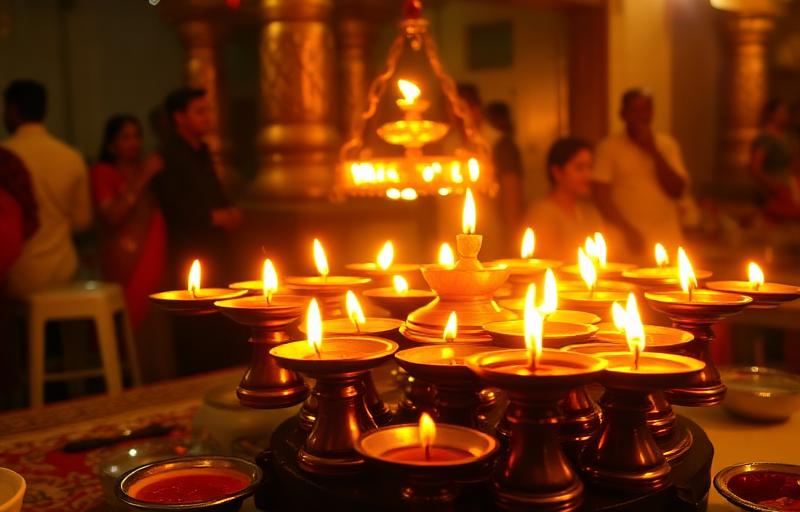
Your home mandir is a miniature temple - the same principles apply, scaled down:
1. Place the mandir in the NE corner of your home. This is Ishan kona (Shiva's corner) - the most spiritually charged direction in any home. North-East zone of any room is also good as a secondary option.
2. The deity should face EAST or WEST inside the mandir. You (as worshipper) should face EAST or NORTH while doing puja - never south. So if the deity faces east, you sit facing west (looking at the deity). If the deity faces west, you sit facing east (facing the sun direction, with the deity in front of you).
The best setup: deity faces east + you face east while sitting facing the deity. This means the mandir is along the west wall of your puja room with the deity inside facing east, and you sit east of the mandir facing west toward the deity. Wait, this requires the deity to face you. Let me re-clarify:
- Most common arrangement: Mandir sits on north or east wall. Deity inside faces south or west (looking out into the room). You sit facing north or east while doing puja, looking toward the deity.
- Critical rule: worshipper should face east or north, never south.
- Critical rule: worshipper should NOT have their back to the main entrance of the room.
3. The mandir itself should be elevated. Floor-level mandir is not ideal - place it on a small wooden stand or built-in shelf at chest height when you're sitting cross-legged (about 2-3 feet from floor).
4. The mandir should not be in:
- Bedroom (especially under the bed or directly facing the bed) - the sleeping zone disrupts the puja zone.
- Bathroom adjacent or against shared bathroom wall - unsanitary energy.
- Kitchen - heat + food preparation disrupts shanti needed for puja.
- Storage closet that's frequently opened - constant disturbance.
- Underneath the staircase - 'pressure' on the deity.
- Against a wall that shares with a toilet or trash area.
If you have a small flat with no separate puja room, the best practical setup is a clean corner of the living room or a kitchen alcove that you keep specifically reserved for puja. The NE corner of the living room with a small built-in shelf at chest height works well.
5. Lighting and ventilation. The mandir should get morning sunlight if possible (east-facing window nearby). It should have natural air circulation. If neither, ensure daily diya lighting which provides both light and air-purification.
6. Floor sitting space. Reserve at least a 3x3 foot square in front of the mandir as your seated puja zone. Place an asan (woven mat or cushion) there. This is YOUR space - the dog, the kids, the chair should not be in this 3x3 zone during puja.
7. Avoid these mistakes:
- Idol stuffed into a cramped shelf with no breathing room.
- Multiple deities pushed together with no individual space.
- Diyas placed where wax/oil can drip onto deities.
- Mandir behind a TV or against a TV wall (entertainment + spiritual don't mix).
- Old/broken idols kept alongside new ones (broken idols should be properly immersed in flowing water, not kept).
The broader principle: treat your home mandir with at least 10% of the respect you'd give a temple. It is your daily spiritual anchor. The orientation rules exist because they actually affect the energy quality of your puja - and you'll feel the difference within a week of proper setup.
What People Ask Most
What if my home has no east-facing wall available for the mandir?+
Second-best options in priority order: (1) North-East corner with deity facing east. (2) North wall with deity facing north. (3) East wall with deity facing west (you sit east, facing west toward deity). (4) East-South-East as last resort. Avoid: south wall, south-west corner, west wall as primary placements. The orientation matters more than wall position - so even if the mandir sits on a less-than-ideal wall, ensure the deity inside the mandir faces east or north.
Why do some famous temples like Kashi Vishwanath not face exact east?+
Kashi Vishwanath actually does face east, but its main entrance is east-north-east due to the temple being built on the bank of the Ganga. The Ganga flows roughly north-south in Varanasi, and the temple's main approach faces the river-side first. The deity itself (the Shiva linga) is in the traditional east-facing position. This adaptation - facing east while respecting the river - is itself part of how Hindu temple architecture incorporates local sacred geography. Many ancient temples have such site-specific compromises while still following the core rules.
Can I place my home mandir in the living room if there's no separate puja room?+
Yes, absolutely - this is the modern urban norm. Place it in the NE corner of the living room, on a wall-mounted shelf or wooden stand at chest height when seated. Reserve a 3x3 foot floor space in front for sitting puja. The only adjustments: ensure the TV/sofa is positioned so you don't have your back to the mandir while watching TV; ensure no shoes/socks accumulate in the puja zone; don't allow pets to enter the immediate space. Many millions of Indian families do successful daily puja from a living-room mandir corner.
Do I need to orient my body to east while doing puja or just face the deity?+
Both matter, with the deity's direction taking priority. Ideal: deity faces east AND you face east (you'd be facing the back of the deity which isn't ideal). Practical: deity faces some direction, you face the deity, AND you try to be facing east or north as a secondary alignment. Worst: facing south (avoid always). Most home mandirs have deity facing south or west (looking out at the worshipper) so worshipper faces north or east while doing puja - this satisfies both rules: facing the deity AND facing east/north.
About the author
Dr. Suresh Iyer · Vastu Shastra & Jyotish, 18+ years
Dr. Suresh has practiced traditional Vastu and basic Vedic Jyotish for over 18 years across South India. He contributes the Vastu, direction, and home-puja layout guides on Vandnaa.
Meet the Vandnaa editorial team →