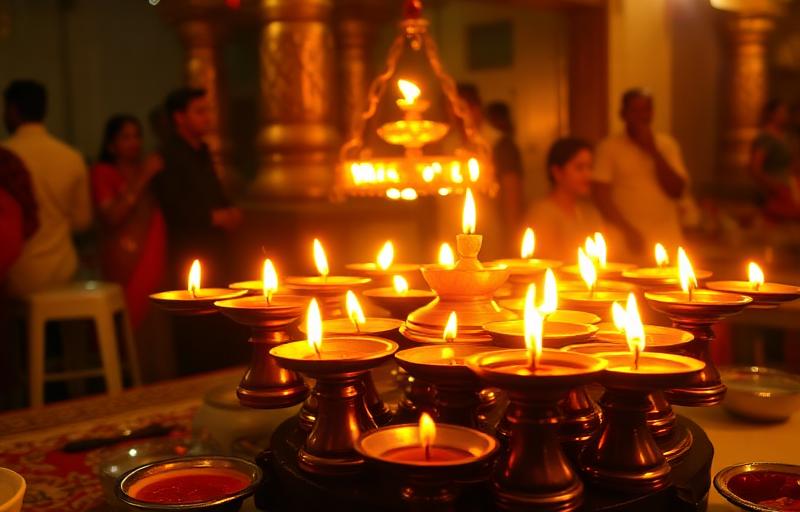
Reason 1-3: The Spiritual Symbolism (Light Over Darkness)
The single most basic reason for lighting a diya is that the flame represents the inner Self - the eternal atma that survives every body's death, the consciousness that is the witness behind all experience. When you light a diya at the start of puja, you are not just preparing the room for the deity; you are also lighting the witness inside yourself so that you can show up fully to the prayer.
This is why the very first verse of the daily Sandhya Vandana - chanted by every traditional brahmin for thousands of years - begins with an invocation of light: 'Tamaso ma jyotirgamaya' (Brihadaranyaka Upanishad 1.3.28), 'lead me from darkness to light'. The diya is the physical anchor of that prayer. Without the lit flame, the prayer floats; with the flame, it has a focal point.
The second spiritual function is that fire is the only one of the five elements that points upward unconditionally. Water flows down, earth sits still, air swirls in all directions, ether is unmoving - but fire always reaches up. This is why fire (Agni) is the messenger of the gods in Vedic ritual: anything offered into a flame goes upward to the deva loka. When you light a diya before the deity, you are creating a tiny Agni channel through which your prayers, intentions, and offerings ascend.
The third spiritual function is the most practical: the diya is the proof of presence. In Hindu metaphysics, deities do not just live in stone or metal idols; they are invited to take temporary residence during the puja, and they leave when the puja ends. The lit flame is what tells the worshipper 'the deity is here right now.' If the diya goes out during puja, traditional pandits stop the ritual immediately - it is a sign that something has interrupted the deity's presence. Re-light, recompose the offerings, and resume only when the flame is steady again.
Reason 4: Diya as Knowledge (Vidya) Burning Away Ignorance
The fourth spiritual reason has a slightly different angle: the diya is the symbolic destroyer of ignorance. The Sanskrit word ajnana (ignorance) is literally described in scriptures as andhakara - 'darkness'. Knowledge is called jnana-jyoti, the 'light of knowledge'. When you light a diya, you are enacting a small but daily ritual of vidya (knowledge) burning away avidya (ignorance).
This is why Diwali - the festival named for the diya itself - is celebrated with rows and rows of lit diyas, in every direction of the home, leaving no corner dark. Diwali is fundamentally a festival of knowledge: it celebrates Lord Rama's return to Ayodhya (the return of righteousness), Krishna's killing of Narakasura (the destruction of demonic ignorance), and Lakshmi's emergence from the cosmic ocean (the appearance of wisdom-prosperity). All three events have the same metaphor at their root: light dispelling darkness.
This is also why students light diyas in front of Saraswati on Saraswati Puja, and why every gurukula traditionally has a lit lamp (sometimes called the akhand jyot) in the classroom that is never allowed to go out. The lamp is the daily, breathing reminder that the purpose of education is to dispel inner darkness, not just acquire information.
A modern application: many practitioners now keep a small ghee diya lit during meditation or study. The flame becomes a focus point for the wandering mind. Over time, the act of lighting the diya becomes a small ritual that signals to the nervous system 'time for focused work begins now' - the same way a writer's first cup of coffee or a yogi's first breath of pranayama signals readiness.
Reason 5-7: The Science of the Flame
Modern research has begun to validate what Indian tradition encoded thousands of years ago. Three measurable scientific effects make the lit diya more than just a symbolic gesture.
Reason 5: Air purification through ghee combustion. When pure cow ghee burns, it releases compounds that are mildly antimicrobial and counter the moulds and bacteria typical of closed Indian household air. A 2007 study at Banaras Hindu University measured significant reduction in airborne bacteria in a closed room after a 30-minute ghee diya burn. This is one reason why traditional pujas insist on ghee diyas rather than vegetable oil or chemical wax candles - the cleansing effect on the ambient air is real.
The smoke produced by a pure ghee flame is also low in particulate matter compared to candles or incense burning together. Smelling the faint ghee smoke at puja is associated with a subtle calm; this is partly placebo and partly the antimicrobial cleansing your body subconsciously responds to.
Reason 6: Light frequency and the brain. The warm orange-yellow light of a ghee flame is centred at roughly 1900-2200 K (kelvins) on the colour-temperature scale - very close to candlelight, much warmer than electric bulbs. This warm range is what triggers melatonin production in the human brain, signalling 'time to relax and be present.' Pujas typically happen at dawn or dusk - exactly when modern bright artificial lighting would otherwise suppress melatonin and keep your nervous system in alert/work mode. The diya restores the natural circadian signalling that the body needs to settle into a contemplative state.
Reason 7: Direction and 'energy flow' (per Vastu). Vastu shastra prescribes specific directional rules for diyas: the ghee diya goes to the right of the deity, the oil diya to the left, and the wick should point east (for prosperity) or north (for spiritual progress). Modern sceptics dismiss this as superstition, but recent thinking ties it to subtle electromagnetic effects of the flame ionising surrounding air molecules in a specific directional pattern. Whether or not you accept the Vastu metaphysics, the rule is simple and harmless to follow - and traditional families that follow it report measurable difference in the 'feel' of the puja room over years.
How to Light Correctly: Rules Most People Get Wrong

Three rules separate a diya lit casually from one lit correctly. None of these take more than a few seconds extra; all of them measurably change the energetic quality.
Rule 1: Light with a match or another diya, never a lighter. Butane lighters introduce industrial fuel residue into the flame. Traditional sources prescribe lighting one diya from another (continuing the flame's lineage) or with a matchstick made from natural wood. The match's small sulphur burn is brief and natural; the lighter's continuous gas flame contaminates the first moments of the new flame. If you have only a lighter, light a stick of incense first, blow out the lighter, then use the incense to light the diya.
Rule 2: Three wicks or one - never two. Single-wick diyas are for daily home worship. Three-wick diyas (representing the three gunas: sattva, rajas, tamas) are for major pujas. Five-wick (panch-arati) and seven-wick are for festivals and aartis. Two wicks together are inauspicious - they are interpreted as 'divided intention'. A single steady flame beats two flickering ones.
Rule 3: Let it burn fully out. Never blow out a puja diya with breath - human breath carries impurities and is considered a violation of the flame. Let the wick burn down naturally, or use a small metal snuffer to smother it. Many traditional families let the puja diya burn until it self-extinguishes; for safety they place it in a wide brass plate so any spilled wax or ghee doesn't damage the surface. When the flame finally goes out on its own, that's read as the deity's silent 'thank you, the puja is complete.'
What People Ask Most
Can I use mustard oil instead of ghee for daily diya?+
Yes for daily evening diya - mustard oil is acceptable, especially for Hanuman/Shani worship (Saturday) where mustard oil is actually preferred. For all other deities and any major puja, ghee is strongly recommended. Mustard oil produces more smoke and a less pleasant burn; ghee produces a cleaner flame and the antimicrobial benefits mentioned above. The cost difference is small; the spiritual difference is meaningful.
What if the diya goes out during puja - is it a bad omen?+
Not necessarily a bad omen, but a sign to pause and re-light immediately. The diya going out usually has a physical cause - draft, wick too short, low ghee. Address that, re-light, and continue. The traditional response: silently say 'Kshama keejiye, Mata/Pita' (forgive me), re-light with full attention, and proceed. Only if the diya repeatedly goes out within minutes - that is a sign to stop the puja, fully clean the puja place, and try again the next day with fresh ghee + new wick.
How long should I keep the diya lit each day?+
Minimum: until the duration of your puja or aarti (5-15 minutes typically). Recommended: light a small ghee diya at dawn for morning puja (let it burn out naturally over 30-60 min) AND a second one at dusk at the main door (oil or ghee, 1-2 hours). The dusk diya is the household's 'Lakshmi invitation' - she enters homes where light is visible at twilight and avoids dark homes. If you can manage only one diya per day, make it the dusk one at the main door.
Is it OK to use an electric LED diya in apartment or hostel?+
Acceptable when real fire is unsafe or banned (smoke alarms, fire-prohibited PG, oxygen tanks in the home, small children). The intent matters more than the medium - an electric diya lit with bhakti is better than no diya lit at all. But: even a 5-minute real ghee diya per day in a safe corner (kitchen cooktop, bathroom, or small ceramic stand) is far superior to a daily LED. Many devotees do LED + a real ghee diya only on Sundays / festival days. As a habit, find a way to do real ghee at least once a week.
About the author
Pandit Mahesh Trivedi · Festival Traditions & Panchang
Pandit Mahesh leads the festival-date and Panchang content on Vandnaa. He cross-references multiple regional panchangs (Drik, Vaishnava, Bengali, Marathi) for every festival date published on the site.
Meet the Vandnaa editorial team →Explore on Vandnaa
Related Articles
Tilak Meaning: Red, White, Yellow, Sandalwood - What Each Tilak Symbolizes & When to Wear
8 min read
Why We Ring the Temple Bell: 7 Spiritual Reasons & 3 Scientific Findings (Complete Guide)
8 min read

Why Do We Offer Coconut in Hindu Puja? 7 Spiritual Meanings
8 min read

Annapurna Stotra: Meaning, Benefits & Daily Recitation Vidhi
10 min read
Vastu for Pooja Room: Direction, Placement & 9 Must-Follow Rules
9 min read