What Arghya Is + Why Water Specifically
Arghya literally means 'offering' (from the Sanskrit 'arha' = 'worthy of'). The arghya offering can be of various substances - water, milk, ghee, flowers, sandalwood paste - but the most common and ancient form is water arghya offered to the Sun (Surya), the Moon (Chandra), and certain deities.
Why water specifically for Surya?
1. Symbolic offering of yourself. Water represents life, consciousness, and the offering of one's own pure essence to the divine. By pouring water to the Sun, you are symbolically offering yourself - your day, your work, your life - to the source of all energy.
2. Reciprocal exchange. The Sun gives us all our energy (sunlight, plant growth, weather, life itself). The minimum thing we can offer in return is water - the most basic, life-giving substance. This is the principle of yagna - giving back to what gives to us.
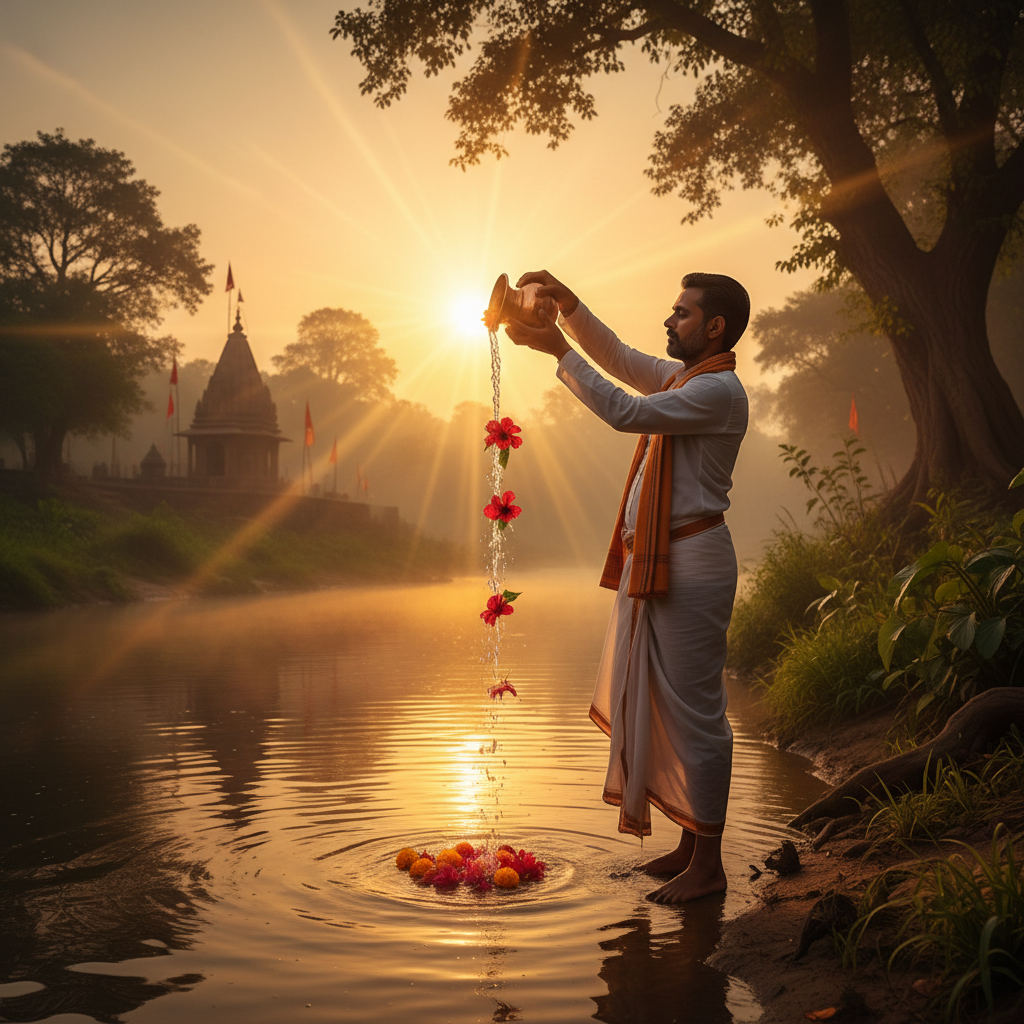
3. Visible to the deity. Water poured in a thin stream catches sunlight, creating a small rainbow or sparkle. This visible 'sparkle' is considered the Sun's acknowledgment of your offering. Some traditions specifically describe seeing the small rainbow as a sign that the arghya was 'accepted'.
4. Vehicle for solar charge. The water, after being poured in front of the sun while reciting Surya mantra, is believed to absorb solar prana. Drinking this water (some traditions) or letting it return to the earth (most traditions) creates an energetic bridge between you and the Sun.
5. The acupressure of the gesture. Standing barefoot, leaning slightly forward, holding a copper vessel and pouring water - this gesture engages the entire body's morning circulation. The arm-extension, the slight bend, the eye contact with the sun, the breath - all contribute to a complete physiological morning awakening.
The vessel: Copper is mandatory. Specifically, a small copper kalash (lota) - not steel, not silver, not plastic, not gold. Copper's specific reasons:
- Copper kills bacteria. Water stored in copper overnight becomes 'tamra-jal' - copper-charged water with measurable antimicrobial properties.
- Copper resonates with solar frequency. The metal of the Sun (in Vedic astrology) is copper/gold. Offering Surya through his own metal creates 'frequency match'.
- Copper colour matches Sun colour. The reddish-orange of copper visually pairs with sunrise tones.
- Copper is conductive. Trace amounts of copper dissolve into water - beneficial for joint health, anti-inflammatory effects, and red blood cell formation. Drinking copper-water (small amounts daily) has documented benefits.
Some poor families historically used clay vessels (also acceptable in tradition) when copper wasn't affordable. But copper has been the standard for Surya Arghya for 3000+ years.
The water specifically:
- Fresh tap water (preferred from a clean source).
- Add a few flower petals (red or yellow ideal - matching Sun colours).
- Some traditions add a few drops of milk (for the moon connection on Mondays) or honey.
- Optionally a tulsi leaf (for Vishnu connection on Thursdays/Saturdays).
- Some add a small piece of raw turmeric or kumkum (for the Sun's red colour).
- Water should be slightly cool (not hot, not iced).
Exact Vidhi: Step-by-Step Daily Practice
Pre-arghya preparation (the night before):
1. Fill a small copper kalash with fresh water before sleeping. 2. Cover with a clean cloth. 3. Keep on a wooden shelf or stone slab (not metal table - the copper's properties work best on natural surfaces). 4. This 'overnight water' is considered most potent for arghya - copper has had 8-10 hours to leach trace minerals into the water.
Morning sequence:
Step 1: Wake up and basic ablutions. Wake before sunrise. Use the toilet, brush teeth, splash face. You don't need a full bath before arghya - the arghya is itself part of your morning awakening, before your formal bath.
Step 2: Walk barefoot to your spot. Choose a place outdoors (or in front of an east-facing window if no outdoor access) where you can see the rising sun. Common spots: balcony, terrace, garden, courtyard, east-facing window. Walk barefoot - this grounds you to the earth's natural electromagnetic field before solar contact.
Step 3: Stand facing east. Spine straight, slight relaxed stance. Holding the copper kalash in both hands at chest height.
Step 4: Sankalp (1 sentence intention). 'I offer this arghya to Lord Surya. May my day be blessed with energy, clarity, and divine protection.'
Step 5: Recite Surya mantra. Choose one (or all three):
Mantra 1 (simplest, beginner): 'Om Suryaya Namah' (3 times)
Mantra 2 (medium): 'Om Hraam Hreem Hraum Sah Suryaya Namah' (3 times) - the seed mantra (Surya beej) for solar energy.
Mantra 3 (Gayatri Mantra): 'Om Bhur Bhuvah Svah, Tat Savitur Varenyam, Bhargo Devasya Dhimahi, Dhiyo Yo Nah Prachodayat.' (1-3 times) - the most powerful Sun mantra in all of Hindu tradition.
Step 6: Pour the water. Slowly raise the kalash above your head while maintaining the mantra. Tilt the kalash so water flows in a thin steady stream. The water should fall in front of you, ideally onto a small open area (grass, soil, paved area that drains).
Key technical details:
- Pour from above eye level (above the head if possible) so the sun is visible 'through' the water stream.
- The stream should be thin - takes 30-60 seconds to pour an entire small kalash.
- Eye contact with the sun is part of the offering - but if direct sun is too bright, look at the water stream catching sunlight.
- DO NOT pour the water on your own body or your feet - the offering is TO the sun, not to yourself.
- Some traditions specifically pour 7 times (counting in mantra cycles) - one for each name of the Sun.
Step 7: Brief silence + final namaskar. After the water is poured, stand in silence for 30-60 seconds. Take 2-3 deep breaths facing the sun. Close eyes briefly. Open eyes, do namaskar (folded hands) to the sun. Some practitioners bow or do a small head-touch-feet pranam.
Step 8: Distribute remaining water. A small amount usually remains in the kalash. Pour this onto a plant or tree root (NOT into the drain). The earth absorbs the blessed water.
Step 9: Continue with rest of morning routine. Now go for bath, formal puja, breakfast, work. The arghya has set the spiritual tone for your entire day.
Timing:
- Sunrise time varies. Use a panchang app to know exact sunrise.
- The arghya should be done within the first 60 minutes after sunrise (the 'Surya Sandhya' window).
- Brahma Muhurta (4-6 AM, before sunrise) is the ideal preparation time.
- Late risers can still benefit from doing arghya within 1-2 hours after sunrise, though the effect diminishes.
- Cloud-covered days: do it facing the direction of the sun even if not visible. Energy reaches even through clouds.
Special days for extra-intensive arghya:
- Sunday - the Sun's day. Many devotees do extended arghya with full mantra recitation.
- Ratha Saptami (Magh Shukla Saptami, usually January-February) - Surya's birthday. Devotees do arghya 12 times reciting all 12 names of Surya.
- Makar Sankranti (January 14) - Sun enters Capricorn. Major Surya devotion day.
- Chhath Puja (October-November) - the most elaborate Surya festival, primarily in Bihar/UP. Arghya done at sunrise and sunset for 4 days.
- Solar eclipse days - arghya in advance (before eclipse begins) for special protection.
Documented Benefits + Why Daily Practice Works
Physical benefits (documented):
1. Vitamin D synthesis. 15-30 minutes of morning sun exposure during arghya activates vitamin D production in skin. Vitamin D deficiency affects 80%+ of urban Indians. Daily arghya can prevent or reverse mild deficiencies without supplementation.
2. Circadian rhythm regulation. Morning light through retinas (even with eyes briefly closed) signals the brain's master clock (SCN). This regulates sleep-wake cycles, hormone release timing, mood. Daily arghya at consistent time strongly anchors your circadian rhythm.
3. Reduced morning lethargy. Combining cool air, water, sun exposure, breath work, and movement is a complete morning activation protocol. Practitioners report being significantly more alert by 9 AM than non-practitioners.
4. Cardiovascular benefits. Standing barefoot (grounding) plus arm-raising plus deep breathing during arghya = mild cardiovascular exercise. The complete sequence equals roughly 5 minutes of moderate physical activity.
5. Eye health. Brief morning sun gazing (not direct staring - just brief eye contact through water stream) has been studied as 'sun-gazing therapy'. When done correctly (only morning sun, only brief contact, never midday sun), it has shown benefits for vision and pineal gland activation.
6. Joint health. Standing barefoot on cool earth or stone in the morning has documented anti-inflammatory effects ('earthing' research). Combined with vitamin D synthesis, arghya supports joint and bone health long-term.
7. Pineal gland activation. The pineal gland (sometimes called the 'third eye' in mystic traditions) is highly sensitive to light. Morning sun signals coordinate melatonin shutdown and serotonin release. Daily arghya practitioners often report deeper meditation experiences as a result.
Mental and spiritual benefits:
1. Discipline anchor. Like Surya Namaskar, daily arghya provides a non-negotiable morning structure. This radiates discipline into other life areas.
2. Connection with nature. Modern urban life disconnects us from natural rhythms. Daily arghya re-establishes the basic relationship: you, the sun, the earth, the water - the four fundamental elements of life.
3. Gratitude practice. Each arghya is a small daily 'thank you' to the source of life. This cultivates baseline gratitude that improves mental health.
4. Mantra benefit. The Gayatri or Surya mantra recited during arghya has its own benefits - increased mental clarity, reduced anxiety, deeper sadhana.
5. Reduced 'feeling stuck' in life. Many people report that daily arghya 'unsticks' periods of life stagnation. The combination of sun energy + mantra + intention seems to break through inertia.
6. Sun is universal. Unlike many deities, the Sun is visible, present, and indisputable. Arghya is the most accessible Hindu practice for anyone (including non-Hindus, sceptics, atheists) - you can do it without 'believing' in any deity, just appreciating the Sun.
Who especially benefits:
- Office workers (artificially-lit environments lack natural light exposure).
- Students (especially during exam preparation - improved focus and energy).
- Anyone with seasonal depression (winter months in north India or globally).
- Vitamin D deficient (very common in urban India).
- Insomnia sufferers (circadian reset).
- Those starting a major new venture (the morning energy and intention-setting boost).
- Pregnant women (especially second and third trimester - vitamin D and discipline benefit both mother and baby).
- Recovering from illness (gentle morning exercise + sun + intention = supportive recovery).
Who should be cautious:
- Eye conditions (cataracts, glaucoma) - avoid any direct sun gazing; do arghya without looking at sun.
- Skin conditions (photosensitivity) - cover skin during arghya; don't worry about sun exposure.
- Severe hypotension (low BP) - the morning movement and breath work can spike BP momentarily; do gradually.
- Mobility limitations - can be done from seated position on balcony if standing is hard.
The progression for new practitioners:
- Week 1: Just do it - even if briefly, even if forgetting mantra, even if rushing. Build the morning habit.
- Week 2-3: Add mantra recitation. Slow down the pouring.
- Month 2: Refine the timing - aim for within 30 minutes of sunrise.
- Month 3: Maintain consistency through travel, weather, schedule disruption.
- Month 6: Notice subtle physiological changes - vitamin D markers in blood work, better sleep, mood improvements.
- Year 1: The practice has become identity, not effort. Skipping a day feels wrong.
For families: teach children from young age. A child who grows up doing arghya naturally maintains the practice through life. Many South Indian and Bengali families have unbroken family arghya traditions going back generations.
Common Mistakes + Modern Adaptations
Common mistakes:
1. Using a steel or plastic kalash. Defeats the entire purpose. Buy a small copper kalash (Rs.150-500 in any puja shop) - it's a one-time purchase that lasts decades.
2. Pouring water on yourself. The offering goes TO the sun (in front of you, falling to earth) - not on your own head or feet. This is a common confusion.
3. Doing it after sunrise window. Doing arghya at 10 AM or noon defeats the purpose. The 'rising sun' has specific spiritual potency that the high-noon sun does not.
4. Looking directly at the sun. Brief eye contact OK (through the water stream); sustained direct staring can damage eyes especially after 30 min post-sunrise. Use eye blinks; don't stare.
5. Doing it indoors with no sun visibility. If you can't see the sun (or sky in its direction), the arghya loses much potency. Even a small east-facing window with curtains open is better than complete indoor practice.
6. Skipping when running late. Modern adaptation: even a 2-minute mini-arghya is better than nothing. Just basic mantra + brief water pour + namaskar = still beneficial.
7. Doing it before brushing teeth or basic hygiene. Mouth should be rinsed; basic body cleanliness is needed (you don't need full bath, but mouth and hands should be clean).
8. Wasting the water. Tipping remaining water down the drain - this water has been charged with mantra and offered to Sun. Pour it on plants instead.
9. Doing it for show or social media. Performing the ritual for Instagram defeats the sankalp. Keep it private. The discipline is for your own benefit.
10. Believing it 'replaces' regular puja. Arghya is a morning practice; formal puja (with deity, offerings, multiple mantras) is separate and typically done later in the morning. Both are needed for complete daily sadhana.
Modern adaptations for urban life:
For apartment dwellers without balcony/terrace access:
- Use an east-facing window. Open the curtains fully. Stand at the window.
- Pour the water into a flowerpot (with plants) placed near the window.
- Visualise the sun and direct your offering toward the window/sun direction.
- Adapt as much as possible without obsessing over perfect setup.
For people who travel frequently:
- Carry a small folding-handle copper kalash (available - just 50g, fits in toiletry bag).
- Even hotel-room arghya facing east window works.
- Frequent fliers report that maintaining arghya despite travel is one of the most stabilising practices.
For seniors or those with mobility issues:
- Done sitting in a chair facing east, with kalash on a small table.
- Pour the water into a bowl rather than the floor (easier to manage).
- All the spiritual benefits remain; only the standing-and-pouring physical aspect adapts.
For pregnant women:
- Continue as normal but with comfortable seating if standing is tiring.
- Add a small drop of milk to the arghya water (associated with healthy pregnancy).
- The vitamin D + sunshine + intention is especially supportive during pregnancy.
For couples/families doing together:
- Husband and wife can do arghya side by side - very auspicious for marriage harmony.
- Children can do their own mini-arghya alongside parents - teach them from age 5+.
- Family arghya creates collective devotional energy that protects the whole home.
For someone in serious illness:
- Done from the bed or chair, facing window.
- Often a family member does it on behalf of the ill person, dedicating the merit.
- The arghya is considered especially beneficial for solar-energy-related issues: low vitamin D, depression, weakness, heart issues.
Long-term commitment: Daily arghya is one of the most sustainable Hindu practices because it takes just 5-7 minutes and has zero cost. Many practitioners who started in their 20s continue into their 80s. The cumulative effect over decades is significant - mental clarity, physical vitality, deep sense of connection to natural cycles, and the steady protection of having honoured the Sun daily. Start tomorrow morning.
Frequently Asked Questions
What if I can't see the sun (overcast sky, rain) - should I still do arghya?+
Yes, absolutely. Face the direction of the sun (use a compass app if needed - sun rises in east always). The sun's energy reaches even through clouds. Many practitioners do arghya regardless of weather - it becomes a year-round discipline. Heavy rain might force doing it from indoors at an east window. The intention and the practice matter more than visible sun.
Can I drink the copper-water that I had prepared overnight for arghya?+
Yes - this is actually a separate Ayurvedic practice. You can prepare TWO kalashes: one for arghya (poured to sun), one for drinking (consumed on empty stomach in morning). Drinking copper-charged water has its own benefits: better digestion, balanced doshas, anti-inflammatory. The arghya kalash water is for offering only - not drinking afterwards (it's considered already given to the deity). Don't combine the two functions in one vessel.
Can women do Surya Arghya during menstruation?+
Traditional rule says skip during the first 3 days of menstruation. Modern practice varies - many women continue with simpler practice (just mantra recitation, no water pouring) during cycle. The reasoning behind the rule: the body is in a high-energy detox phase and combining external high-energy practices can be overwhelming. Personal choice - some women feel better doing it; others feel better resting. There is no strict 'sin' in continuing; modern adaptation is acceptable.
Is Chhath Puja basically a more elaborate version of daily arghya?+
Yes, exactly. Chhath Puja is the most elaborate 4-day version of arghya, primarily practiced in Bihar, UP, Jharkhand, and the Bhojpuri diaspora. It involves arghya at sunset (Sandhya Arghya) and sunrise (Usha Arghya) for two consecutive days, with extreme fasting and standing-in-water rituals. The same principles apply - copper kalash, water offering, mantras, sun gazing - just intensified to a major festival scale. Anyone who does daily arghya naturally understands Chhath at a deeper level.
About the author
Pandit Ravindra Sharma · Vedic Rituals & Bhakti, 22+ years
Pandit Ravindra is the Vandnaa editorial team's resident specialist on aarti, chalisa, and daily devotion. He has performed home and temple pujas across Varanasi and Delhi for over two decades and contributes the bhakti-focused articles on this site.
Meet the Vandnaa editorial team →