The 5 Sitting Positions and What Each Is For
Hindu sitting hierarchy from beginner to advanced:
1. Sukhasana (easy pose) - simple cross-legged sitting, each foot tucked under the opposite thigh. This is the default for daily puja. Anyone can do it without practice. Sit-down on a small flat cushion (about 2-3 inches thick) which tilts the hips slightly forward and makes the spine stack naturally.
2. Ardha Padmasana (half lotus) - one foot rests on the opposite thigh; the other tucked beneath. Used for short meditation (10-20 min). Requires moderate hip flexibility.
3. Padmasana (full lotus) - both feet placed on the opposite thighs, soles up. The classic 'meditation Buddha' posture. Used for serious sadhana and longer meditation (30+ min). Locks the energy circuit completely. Requires significant hip-knee flexibility - takes most adults months of practice to do comfortably.
4. Vajrasana (thunderbolt) - kneeling with feet under buttocks, knees together. Used for specific pujas, especially when reading scripture or chanting mantras. The only meditation posture you can do immediately after eating (it actively aids digestion).
5. Siddhasana (perfect pose) - one heel pressed against the perineum, other heel against the pubic bone, both knees on the ground. Advanced yogic posture, used for kundalini sadhana. Not for casual puja.
For 95% of daily puja and meditation, sukhasana is enough. Padmasana is the ideal but optional. The principle that matters is legs crossed in some form, spine straight, feet not touching the ground.
Why feet must not touch the ground. Hindu energy theory: prana (life energy) enters from the crown of the head and circulates through the body, exiting at the feet during normal standing/walking. During puja, you want to retain prana - so you fold the feet upward, closing the exit. This is the same logic behind why you don't enter a temple with shoes (shoes 'leak' your accumulated walking prana). Sitting cross-legged on the floor (or cushion) keeps your feet at upper-body level, closing the circuit.
The Energy Physics: Why Closed Circuit Matters
Yogic energy theory (which closely mirrors what modern electrophysiology has begun documenting):
The human body as an electromagnetic circuit. Every nerve impulse is electrical; the heart generates its own measurable magnetic field; the brain's electrical activity is mapped by EEG. Yogis understood this 3,000+ years before electrophysiology - they called it prana flow.
Key principle: a closed circuit retains current; an open circuit loses it. Standing/walking puts your body in 'open circuit' mode - prana flows in (crown), flows down, exits feet, dissipates into ground. Sitting cross-legged with feet up converts your body into a closed circuit:
- Crown chakra (Sahasrara) intake.
- Spine acts as the central nadi (sushumna).
- Energy descends to root chakra.
- Instead of exiting through feet, it loops back up through the crossed legs.
- The hands resting palms-up on knees (or in chin mudra) complete the upper circuit.
This closed circuit can be measured. Multiple studies on long-term meditators have documented elevated brainwave coherence (alpha and theta waves) during seated meditation that does NOT appear in the same person while standing or walking. The posture itself contributes to the effect, separate from the meditation technique.
Why chairs don't work for puja. Sitting in a chair with feet flat on the floor keeps the body in open-circuit mode. Even if you do the mantras, the meditation, the offerings - the energy keeps leaking through the feet. This is why traditional Hindu households make even visiting elders sit on the floor for puja - the chair offer is for after the puja concludes.
Exceptions: pregnant women in advanced trimesters, people with severe arthritis, the elderly with mobility issues - these may use a low chair with feet on a slightly raised footrest (so feet are off the bare ground, maintaining the principle as closely as possible). Modern 'meditation chairs' or 'kneeling stools' are also acceptable for those who genuinely cannot sit cross-legged.
Why spine alignment matters. The sushumna nadi (central spinal energy channel) requires the spine to be vertical and straight for energy to flow up smoothly. A slumped or bent spine creates 'kinks' in the energy flow. This is why every seated meditation tradition (Hindu, Buddhist, Christian contemplative) insists on upright spine - it's not about discipline, it's about energy mechanics.
Documented Health Benefits of Cross-Legged Sitting
Beyond the spiritual reasoning, modern research has documented several physiological benefits:
1. Hip mobility preservation. Adults who regularly sit cross-legged maintain hip flexibility well into old age. Those who exclusively sit in chairs lose 30-50% of hip rotation by age 60. The simple act of folding legs daily keeps the hip joints active.
2. Improved digestion (especially vajrasana). Sitting in vajrasana for 10-15 minutes after a meal is the only sitting position that actively aids digestion. The folded posture compresses the abdominal area gently, promoting peristalsis. This is why many Indian families traditionally sit cross-legged on the floor to eat - it both prepares and aids digestion.
3. Better posture awareness. Floor sitting requires active core engagement and natural spine alignment. Chairs encourage passive slumping. People who do daily puja in cross-legged posture report significantly better back posture over decades than chair-only sitters.
4. Lower-body blood flow. Counterintuitively, brief periods of cross-legged sitting (under 30 minutes) actually improve circulation by gently restricting blood, then releasing it on uncrossing. The restriction triggers vasodilation response. Longer than 45-60 minutes can cause numbness - which is why most pujas are kept under that duration.
5. Pelvic floor strength. Padmasana specifically engages and strengthens the pelvic floor muscles. Regular practitioners have measurably stronger pelvic-floor support, reducing incontinence risk in old age.
6. Alpha brainwave induction. Within 5-10 minutes of seated meditation in proper posture, the brain enters alpha-state (relaxed alertness, 8-13 Hz). This is the state associated with creativity, problem-solving, and emotional regulation. Standing meditation can also produce alpha but takes much longer (20+ minutes). The seated posture accelerates the shift.
Risk factors:
- People with knee osteoarthritis should sit on a higher cushion (4-6 inches) to reduce knee bending.
- Sciatica sufferers should alternate which leg crosses on top to avoid asymmetric pressure.
- Pregnant women in 3rd trimester should use sukhasana (not padmasana) and a cushion under hips.
- Anyone with prior knee surgery should consult their doctor before attempting full padmasana.
For children: encourage daily cross-legged sitting (during TV, study, meals) from age 5 onwards. The hip flexibility is much easier to develop young than to recover in adulthood. Indian children who sit cross-legged daily can typically do padmasana by age 10-12 with no effort.
How to Train Your Body to Sit Cross-Legged Comfortably
For adults who have lost the flexibility, here's a 6-week progression to comfortable seated puja:
Week 1-2: Sukhasana with high cushion (3-4 inches).
- Sit on a folded blanket or bolster.
- Cross legs naturally - one foot tucked under each opposite thigh.
- Hands on knees, palms up.
- Hold for 5 minutes initially, increase by 2 minutes daily.
- Focus on spine straight, shoulders relaxed.
Week 3-4: Lower the cushion to 2 inches.
- Same position but hips slightly lower.
- Hold for 15-20 minutes.
- If knees float up uncomfortably, add a small support under each knee with rolled blankets.
Week 5-6: Sukhasana with minimal cushion (1 inch).
- Target 25-30 minutes comfortably.
- Try alternating which leg is on top every 5 minutes for symmetric flexibility.
Beyond Week 6: Try ardha padmasana.
- One foot on top of opposite thigh, the other tucked under.
- Hold for 10 minutes, increase gradually.
- Switch legs each session.
Beyond 3 months: Attempt full padmasana.
- Only after ardha padmasana is comfortable for 20+ minutes.
- Always come out slowly - never jump up. The pose compresses knees and ankles; sudden release can hurt.
Daily helper poses (10 min/day):
- Butterfly stretch (Baddha Konasana): sit, soles together, knees bent outward, gently press knees toward floor. Opens hips.
- Pigeon pose: opens hip rotators.
- Garland pose (Malasana): deep squat - improves ankle and hip flexibility together.
- Cobblers pose: like butterfly but with forward fold over feet.
Pro tips for puja-specific use:
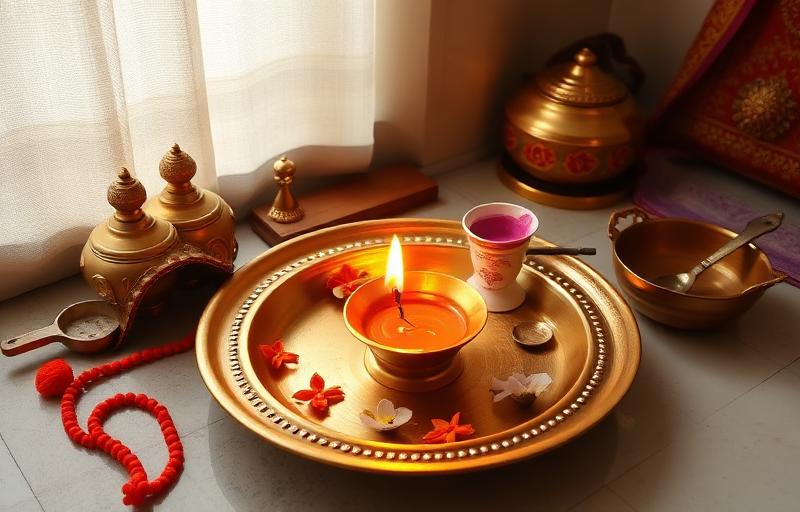
- Place a soft cushion (asan) on a wool blanket or jute mat under you. Synthetic carpets do NOT count as proper asan.
- Traditional asan materials in order of preference: deer skin (mrigchhala - now ethically replaced with woven equivalents), tiger skin (similar), kusha grass, silk cloth, wool blanket. The principle: insulate yourself from the ground's electrical neutrality so your accumulated puja energy stays within you.
- Don't sit directly on bare floor for puja - it 'grounds' your energy. Even a simple cotton mat is better than nothing.
- Same asan should be used daily for personal sadhana - over months, the asan itself becomes 'charged' with your practice energy.
The biggest mistake: forcing painful positions to look advanced. Pain disrupts puja entirely. Use whatever cushion height keeps you comfortable for the full duration. Sukhasana on a thick bolster done with focused attention is infinitely better than padmasana with throbbing knees that you keep adjusting.
Reader Questions Answered
Can I do puja sitting on a chair if my knees can't fold?+
Yes for legitimate medical reasons (severe arthritis, post-knee-surgery, advanced age, pregnancy). Use a low wooden chair or stool, place feet on a small footrest so they don't touch the bare ground, and sit with spine very upright. Place your puja items on a slightly raised platform so you don't have to bend down. The chair compromise is acceptable when medically necessary - what's never acceptable is doing puja casually slumped in a chair when you could sit on the floor.
How long should I be able to sit in padmasana for serious sadhana?+
Classical target: 3 hours uninterrupted in padmasana with no body shift. Realistic modern target: 45-90 minutes comfortably. For daily personal puja, 20-30 minutes is plenty. For Gayatri sadhana, 108-round japa typically takes 25-30 minutes. For longer mantra cycles (1008 rounds), 90 minutes. Build slowly - don't aim for 3 hours from year one. Most serious sadhakas reach the 90-minute mark within 5-7 years of daily practice.
Does the direction of crossed legs matter (right over left or left over right)?+
Yes, with nuance. In padmasana, right foot on top of left thigh is considered more 'fiery' (suitable for active meditation, mantra japa, energising practice). Left foot on top of right thigh is considered more 'cooling' (suitable for relaxation, restorative meditation, evening practice). Best practice: alternate between sessions - or do one round each way during longer sadhana. For sukhasana, less strict - both directions are fine; alternate weekly for symmetric hip development.
What if my foot falls asleep during puja - is it bad luck to stop and stretch?+
Not bad luck at all - it's a normal physical limitation. Pause the puja for 30 seconds, stretch the leg out gently (don't stand abruptly), shake the foot until circulation returns, then re-fold and resume. Numbness is the body asking for circulation; ignoring it can damage nerves over time. Frequent numbness means your cushion is too low or wrong position - adjust setup rather than push through. Real adverse karma comes from skipping or rushing puja, not from a brief leg-stretch break.
About the author
Pandit Mahesh Trivedi · Festival Traditions & Panchang
Pandit Mahesh leads the festival-date and Panchang content on Vandnaa. He cross-references multiple regional panchangs (Drik, Vaishnava, Bengali, Marathi) for every festival date published on the site.
Meet the Vandnaa editorial team →