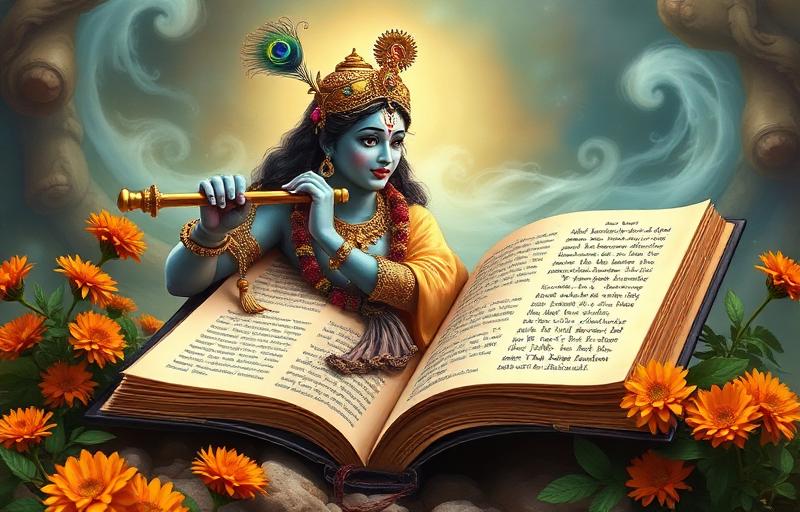
The Switch at Birth
Kamsa, king of Mathura, had imprisoned his own sister Devaki and her husband Vasudeva after a divine voice warned him that Devaki's eighth child would be the one to kill him. He killed each of her first several children as they were born, until the eighth, Krishna, arrived on a night the prison's guards fell mysteriously asleep and its chains loosened on their own.
Vasudeva, guided by this same unexplained cosmic assistance, carried the infant Krishna across the flooding Yamuna river to the home of Nanda and Yashoda in Gokul, where, that same night, Yashoda had given birth to a daughter. Vasudeva exchanged the children, leaving Krishna with Nanda and Yashoda and carrying the infant girl back to Devaki's cell, all before anyone in either household had fully registered what had happened.
Who the girl actually was
This infant girl was not an ordinary child at all but Yogamaya, the goddess of divine illusion, born specifically at this moment to be substituted for Krishna and to play out the role of the eighth child everyone, Kamsa included, expected to find in Devaki's arms.
Kamsa's Attempt, and the Voice That Followed
When Kamsa learned of the birth (accounts vary on exactly how quickly, but consistently soon after), he rushed to the prison to kill this eighth child himself, disregarding Devaki and Vasudeva's pleading that a daughter posed no threat to any prophecy about a son. Seizing the infant to dash her against a stone, Kamsa found she slipped from his grasp and rose upward into the sky, transforming as she rose into her full form as the goddess Yogamaya, armed and radiant, no longer resembling an ordinary infant at all.
From the sky, Yogamaya delivered the message the entire deception had been designed to convey: that the one destined to kill Kamsa had already been born safely elsewhere, beyond his reach, and that his effort here had been futile from the start, a taunt as much as a warning. She then vanished, leaving Kamsa to reckon with the knowledge that his true threat was alive and unidentifiable among however many infants had been born across his kingdom that night.
Why Yogamaya specifically, and not some other protective device
The choice of a goddess of illusion, rather than any other kind of divine intervention, to carry out this specific substitution is treated in Puranic tradition as thematically exact: what saved Krishna was not force overpowering Kamsa directly at this early stage, but perception itself being manipulated, Kamsa seeing exactly what he expected to see (a vulnerable infant, seemingly female, in Devaki's arms) right up until the substitution had already served its purpose and could safely be revealed.
Where Yogamaya Is Worshipped Today
Yogamaya is identified across Puranic and devotional tradition as a form of the Devi, and in several regional traditions she is associated with Vindhyavasini, literally the one who dwells in the Vindhya range, a goddess with an active living shrine at Vindhyachal near Mirzapur in Uttar Pradesh, one of the region's significant Shakti pilgrimage sites, where she is worshipped independently of the Krishna narrative as a powerful, self-standing form of the goddess in her own right.
Why this matters for how the story is read
What this connection underlines is that Yogamaya is not simply a plot device invented to serve one moment in Krishna's birth story - she is presented across the wider tradition as a genuinely independent, cosmically significant form of the Devi, with her own worship, her own shrine, and her own devotional following, who happened, in this particular episode, to play the specific role of protecting the child who would become Krishna. The Krishna birth episode is, in this light, one appearance among several of a goddess whose fuller identity and cult exist independently of that one narrative function.
A pattern this establishes for the rest of Krishna's life
Yogamaya's role here - illusion and perception doing the protective work that direct confrontation could not yet achieve - is often read as a template the wider Krishna narrative returns to repeatedly: from the swapped identities and disguises that mark several later episodes to the broader devotional idea that Krishna's own leelas throughout his life operate as much through maya, divine play and illusion, as through raw power, with Yogamaya's intervention at his birth standing as the opening instance of a theme that runs through the entire life that follows.
What People Ask Most
Who was the infant girl exchanged for Krishna at birth?+
She was Yogamaya, the goddess of divine illusion, born specifically at that moment to be substituted for Krishna. When Kamsa tried to kill her, she rose into the sky in her true divine form and revealed that the true child destined to end him had already been born safely elsewhere.
Is Yogamaya the same as Vindhyavasini Devi?+
Several regional traditions identify Yogamaya with Vindhyavasini, a form of the Devi with an active living shrine at Vindhyachal near Mirzapur, Uttar Pradesh, worshipped independently as a powerful goddess in her own right beyond her role in the Krishna birth narrative.
Why couldn't Kamsa actually kill Yogamaya when he tried?+
As a goddess rather than an ordinary infant, Yogamaya was never actually vulnerable to Kamsa's attempt - she slipped from his grasp and rose into the sky in her true divine form the moment he tried to harm her, revealing the deception only once it had already served its full purpose.
About the author
Anjali Mehta · Editor, M.A. Religious Studies
Anjali is the managing editor for Vandnaa and oversees the festival and vrat coverage. She holds an M.A. in Religious Studies and reviews every published article for accuracy, accessibility, and tradition-fidelity.
Meet the Vandnaa editorial team →