गलत सभा में एक असावधान पांव
Puranic accounts, most notably in the Ganesha Purana, describe Krauncha as a gandharva, one of the celestial musicians attached to the courts of the gods, present at a large gathering of sages and celestial beings.
Amid the crowd, Krauncha is said to have carelessly stepped on the foot of the sage Vamadeva, an accident born of simple inattention in a packed hall rather than any deliberate disrespect.
Vamadeva, however, took the contact as a serious affront and cursed Krauncha on the spot to be transformed into a mushika, a mouse or rat, a punishment strikingly disproportionate to what had actually happened, and one that several retellings note even other sages present found harsh.
Krauncha, now trapped in the reduced and vulnerable form of a rodent, is said to have wreaked considerable havoc as a result of his new nature and considerable residual size and strength: rampaging through the ashram of the sage Parashara, in some versions destroying stores of grain and provisions on a scale no ordinary mouse could manage, since the being inside the small form retained much of his original power even while trapped in it.
बांधा गया और नया उद्देश्य पाया
The disturbance eventually reached Ganesha, who came to deal with the oversized, destructive mouse causing damage across the region. Rather than simply killing the creature, Ganesha threw his pasha, his noose, and captured Krauncha, binding him.
Recognising Ganesha's power, Krauncha, in his mouse form, is said to have surrendered and pleaded for the god's protection and forgiveness, offering himself in whatever service Ganesha wished.
Ganesha's response, in the tradition's telling, was to accept the surrender and, rather than releasing Krauncha to resume his gandharva form, chose to keep him as his own vahana, his mount, granting the transformed being a permanent role serving one of the most widely worshipped deities in the pantheon.
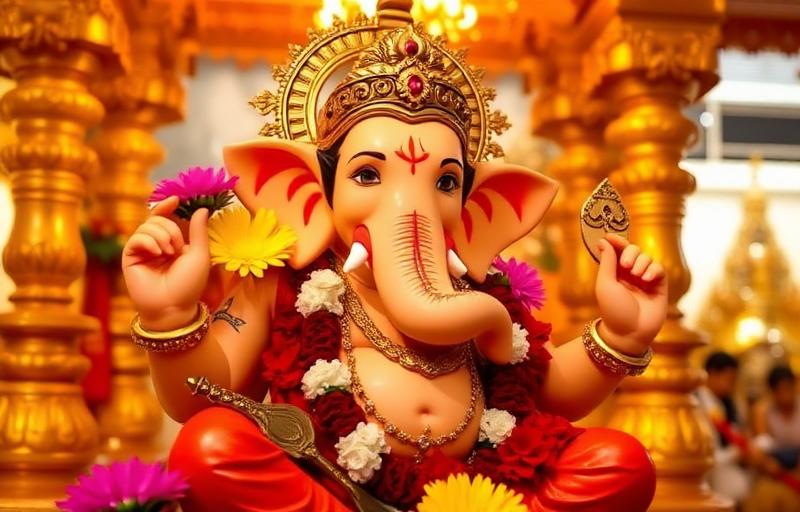
This detail is what later iconography consistently preserves: Ganesha, whose own bulk is proverbially enormous, is depicted riding a creature proverbially tiny, and the tradition's own explanation for the pairing is precisely this story, treating the mismatch in scale as the whole point rather than an oversight.
यह जोड़ी क्या कहना चाहती है
Devotional commentary on this vahana has offered various readings of the symbolism over the centuries: the mouse as a symbol of desire and ego, small but capable of gnawing through anything given the chance, kept firmly under the control of wisdom and remover-of-obstacles Ganesha represents.
Others read it more simply as an expression of Ganesha's specific domain as remover of obstacles: a mouse can slip through the smallest gap, into the tightest space, and a god who rides one is, by extension, a god whose reach and access nothing can fully block.
Whichever reading a devotee favours, the underlying narrative gives the pairing a specific history rather than treating it as an arbitrary iconographic choice: Krauncha's disproportionate curse, his rampage, his capture and his surrender are each a link in the chain that put a gandharva permanently beneath an elephant-headed god's own weight, an outcome neither party could have predicted from one careless step in a crowded hall.
लोग सबसे ज़्यादा क्या पूछते हैं
गणेश के मूषक बनने से पहले क्रौंच कौन थे?+
एक गंधर्व, स्वर्गीय संगीतकारों में से एक, जिन्हें ऋषि वामदेव ने भीड़ भरी सभा में गलती से पांव दबने पर मूषक रूप में बदल दिया।
How did Krauncha become Ganesha's vahana?+
As a mouse, Krauncha caused destruction on a scale no ordinary rodent could manage. Ganesha captured him with his noose, and Krauncha surrendered and pleaded for protection, after which Ganesha kept him as his permanent mount.
गणेश का मूषक वाहन क्या दर्शाता है?+
सामान्य व्याख्याओं में मूषक को इच्छा अथवा अहंकार का प्रतीक माना जाता है जो ज्ञान द्वारा वश में है, अथवा गणेश की विघ्नहर्ता के रूप में सूक्ष्मतम स्थानों तक पहुंचने की क्षमता का प्रतीक।
About the author
Anjali Mehta · Editor, M.A. Religious Studies
Anjali is the managing editor for Vandnaa and oversees the festival and vrat coverage. She holds an M.A. in Religious Studies and reviews every published article for accuracy, accessibility, and tradition-fidelity.
Meet the Vandnaa editorial team →