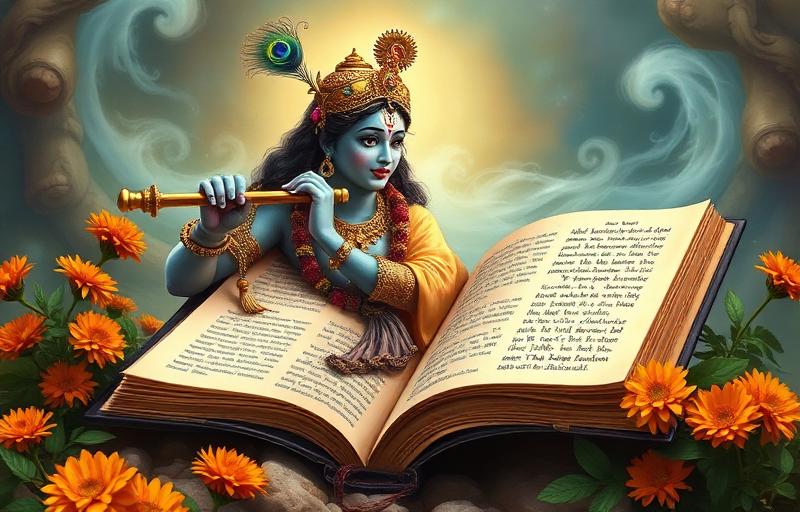
What is Advaita Vedanta
Advaita Vedanta is one of the most influential schools of Hindu philosophy, teaching advaita, meaning "not two" or non-duality. At its core is the understanding that the individual Self, Atman, and the ultimate reality, Brahman, are not separate entities but fundamentally one and the same.
According to Advaita, what appears as separation, the sense of being an individual distinct from God and from everything else, is due to avidya, ignorance, and maya, the veiling and projecting power that makes the one reality appear as the diverse world we experience. Removing this ignorance does not create a new state, it simply reveals what was always true.
Scriptural Origin
Advaita Vedanta draws its authority chiefly from the Upanishads, the Bhagavad Gita and the Brahma Sutras, together called the Prasthana Trayi, the three foundational sources of Vedanta. Great statements from the Upanishads, such as "Tat Tvam Asi" (That Thou Art) and "Aham Brahmasmi" (I am Brahman), are central to its teaching.
The philosophy was systematized most influentially by Adi Shankaracharya in the eighth century, who wrote extensive commentaries on the Upanishads, the Gita and the Brahma Sutras, alongside independent works like the Vivekachudamani. Shankaracharya's teaching journey and the four mathas he established across India helped Advaita Vedanta become one of the most widely studied philosophical traditions in Hindu thought.
Meaning and Significance
The significance of Advaita lies in its radical claim that the seeker is not separate from the very reality they seek. Suffering, in this view, comes not from any real lack but from mistaking the temporary and changing, the body, mind and ego, for one's true, unchanging nature.
Advaita often uses the analogy of a rope mistaken for a snake in dim light, the fear is real, but its cause is a misperception, not an actual snake. Similarly, the sense of being small, limited and separate from Brahman is described as a misperception that clear knowledge dissolves, revealing the ever-present unity beneath.
How This Understanding is Approached

Advaita Vedanta is traditionally approached through a structured process rather than sudden belief:
- Shravana - hearing the teaching of non-duality from a qualified teacher, grounded in scripture
- Manana - reflecting deeply on this teaching until intellectual doubts are resolved
- Nididhyasana - sustained, quiet meditation on this understanding until it becomes direct, lived experience
- Preparation through Viveka and Vairagya - cultivating discrimination between the eternal and the temporary, along with dispassion toward fleeting attachments
This is generally considered a subtle and advanced path, often undertaken with the guidance of a teacher and after some grounding in ethical living and mental steadiness, though its core ideas continue to inform devotional and philosophical thought at every level.
Benefits as per Tradition
Tradition describes the realization of Advaita as bringing complete freedom from fear, since fear depends on a sense of separateness that this understanding dissolves. Devotees who study this philosophy often speak of a quiet, settled joy that does not depend on external circumstances.
Advaita is considered by its followers to lead directly to moksha, liberation from the cycle of birth and death, since it removes the very root of bondage, the ignorance of one's true nature. Even those who approach it more as a philosophy than a full practice find its teaching on the transient nature of worldly attachments valuable for cultivating equanimity in daily life.
A Daily-Life Takeaway
A gentle, everyday reflection of Advaita is remembering that roles and labels, one's job, mood or circumstance of the moment, are not the whole of who one is. Pausing during stress to silently recall "this is a passing wave, not the ocean of who I am" borrows quietly from this teaching.
As tradition reminds us, worship is an act of faith and love, not a transaction, and Advaita's vision of oneness reminds devotees that the same divine presence they bow to in the temple is never, even for a moment, truly distant from them.
What People Ask Most
Does Advaita Vedanta deny the existence of God or deities?+
No. Advaita affirms Brahman, the ultimate reality, and traditionally accommodates devotion to personal forms of the divine, Ishvara, as Brahman experienced through devotion and worship at a practical level. Many Advaita teachers, including Shankaracharya, composed deeply devotional hymns to various deities alongside their philosophical works.
How is Advaita Vedanta different from Vishishtadvaita?+
Both are schools within Vedanta but differ on the relationship between the Self, the world and Brahman. Advaita, taught by Adi Shankaracharya, holds an absolute non-dual identity between Atman and Brahman. Vishishtadvaita, taught by Ramanuja, holds a qualified non-dualism, where the world and individual souls are real and form the body of Brahman, related but not simply identical.
Is Advaita Vedanta only for scholars, or can ordinary devotees benefit from it?+
While its full depth is traditionally studied under a teacher over time, its broad themes, that the true Self is more than the fluctuating body and mind, and that worldly attachments are temporary, offer everyday devotees a helpful perspective for facing stress, loss and change with greater steadiness.
About the author
Anjali Mehta · Editor, M.A. Religious Studies
Anjali is the managing editor for Vandnaa and oversees the festival and vrat coverage. She holds an M.A. in Religious Studies and reviews every published article for accuracy, accessibility, and tradition-fidelity.
Meet the Vandnaa editorial team →