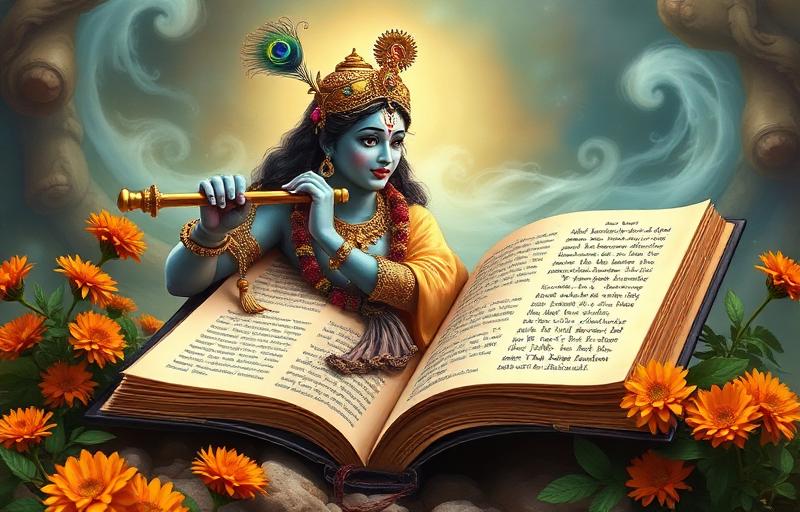
Three Arrows and a Vow That Made Him Dangerous to Everyone
Barbarika was the son of Ghatotkacha, Bhima's rakshasa son from Hidimba, and the Naga princess most often named Ahilawati or Mourvi. He grew up an extraordinary archer, and the tradition gives him a bow and three arrows from Shiva and Agni that were not ordinary weapons. Each arrow, once released, would mark every target the archer intended and return to the quiver on its own. With those three arrows in hand, Barbarika did not need an army. He needed one shot to mark the weaker side's opponents for destruction, a second to mark that side's own forces so the first arrow knew where not to strike, and a third to finish the work.
And Barbarika had made a private vow: he would always fight on the side that was losing.
When he set out toward Kurukshetra to watch the great battle everyone was talking about, his mother made him promise to keep that vow. It sounds like a small detail. It is not. Applied literally, against two armies of roughly equal size that would trade the advantage back and forth all eighteen days, the vow meant Barbarika would fight first for one side, then the moment it started losing, switch to the other, then switch back, until between his three arrows and his shifting loyalty he would eventually have crippled both armies and stood alone as the only combatant left standing.
Krishna understood this before anyone else did. On the eve of the war, disguised as a Brahmin, he met Barbarika on the road and asked, almost idly, how he intended to fight an eighteen-day war with only three arrows. Barbarika, without any boasting, explained exactly what has been described above: one arrow to mark, one to bind, one to finish, and the whole thing could be done in a moment, not eighteen days. Krishna asked him to prove it on a nearby tree, and Barbarika's arrow pierced every leaf on it and looped back to circle Krishna's own foot, since Krishna had, as a further test, quietly placed his foot over one leaf. The arrow refused to strike the god's foot and instead waited, circling.
That was proof enough. A war fought to decide dharma could not be settled in one afternoon by a third party keeping a private vow to whichever side happened to be weaker at that hour. Krishna knew that if Barbarika joined the field at all, Kurukshetra would not be the war the Bhagavad Gita is set inside. It would be something else, decided by an archer nobody had planned for.
The Dakshina Krishna Actually Wanted
Still in disguise, Krishna asked Barbarika for alms, as a Brahmin is entitled to. Barbarika, generous by nature, offered anything he owned. Krishna asked for his head.
Barbarika did not argue that this was unfair, and the text does not have him weep or plead. What he asks for instead is telling: he asks Krishna to reveal his true form first, because he wants to know which god is asking this of him, and he asks, if his head must be given, to be allowed to watch the entire war from a vantage point, since he had come specifically to see it. Krishna granted both. He revealed himself, praised Barbarika's courage and understanding, and placed the severed head on a hill overlooking the plain of Kurukshetra, where it remained conscious for all eighteen days, watching everything.
There is a well-known coda to this. After the war, the surviving Pandavas fell into an argument about who deserved the most credit for the victory. Each brother had a claim. Krishna, to settle it, pointed to the hill and suggested they ask the head, which had after all seen the entire war without taking part in it and had nothing to gain by favoring anyone. The head's answer was blunt: it had seen no Bhima, no Arjuna, no army at all doing the killing. It had seen only Krishna's Sudarshana Chakra moving across the field, and at certain moments, Draupadi's fury taking a form that consumed the fighting. Everything else, in the head's account, was Krishna's Sudarshana and Draupadi's Kali-like anger acting through human hands.
It is not a comfortable answer, and it is not meant to be. It is the text's way of saying, through the one witness with no stake in the outcome, that credit and cause are not the same thing on a battlefield decided by dharma, not by any single warrior's skill.
From a Hilltop in Kurukshetra to a Temple in Rajasthan
Krishna did not leave the story there. He blessed Barbarika that in the Kali Yuga, he would be worshipped under Krishna's own name, and that anyone who approached him with a genuine, difficult problem, the kind other gods might be slow to touch, would find him quick to answer. This is the origin most often given for Khatu Shyam ji, whose main temple stands in the town of Khatu in Sikar district, Rajasthan, and who draws some of the largest crowds of any pilgrimage site in North India, especially during the fair around Falgun (roughly February-March).
The names attached to him carry the whole story. He is called Shyam, Krishna's own name, per that blessing. He is called Barbareek and, in some regional forms, Barbarika. He is called Lakhdatar, meaning one who gives in lakhs, a name devotees use because he is believed to answer prayers generously and without demanding the elaborate observance other deities might expect first. He is also called Haare ka Sahara, the support of the one who has lost, a title that reaches directly back to the original vow: he fought, and now he is invoked, for whoever is losing.
The story's textual history is worth being honest about. The core Kurukshetra episode does not appear in the critical edition of the Sanskrit Mahabharata that scholars treat as the base text; it belongs to a later and regional layer, most associated with the Jaimini Ashvamedha Parva and with oral and devotional retellings especially strong in Rajasthan. That does not make it a lesser story. It makes it, like a great deal of what devotees actually carry in memory and practice, a living addition that a community kept telling because it answered something the core epic did not: what happens to the small, extraordinary figure standing just outside a war too large for him to fight in his own way.
Quick Answers
Why is Khatu Shyam considered so quick to answer prayers?+
The belief traces directly to Krishna's blessing after Barbarika's sacrifice: that in the Kali Yuga he would answer devotees generously and without demanding elaborate ritual first, which is why he is called Lakhdatar and Haare ka Sahara, the support of one who is losing.
Is Barbarika the same figure as Khatu Shyam?+
Yes, tradition holds that Barbarika's head, preserved after his sacrifice at Kurukshetra, is the same form worshipped today as Khatu Shyam ji at the temple in Khatu, Rajasthan.
Why did Krishna ask for Barbarika's head instead of just forbidding him to fight?+
Barbarika had made a genuine vow to always support the losing side, and simply telling him not to fight would not have resolved the danger his three infallible arrows posed to the balance of the war. Asking for his head as dakshina, which Barbarika could honorably give and Krishna could honorably request, removed the risk while letting Barbarika keep his word and his dignity.
Does the Barbarika episode appear in the original Sanskrit Mahabharata?+
Not in the critical edition scholars treat as the base Sanskrit text. It belongs to a later regional layer, associated with the Jaimini Ashvamedha Parva and especially strong Rajasthani oral and devotional tradition, which is where the Khatu Shyam worship also developed.
About the author
Anjali Mehta · Editor, M.A. Religious Studies
Anjali is the managing editor for Vandnaa and oversees the festival and vrat coverage. She holds an M.A. in Religious Studies and reviews every published article for accuracy, accessibility, and tradition-fidelity.
Meet the Vandnaa editorial team →