What Is the Brahmanda Purana
The Brahmanda Purana takes its name from Brahmanda, the cosmic egg from which, according to tradition, the entire universe unfolded. It is counted among the older Maha Puranas and is deeply concerned with cosmology - how the universe came into being, its structure, and the vast cycles of time that govern it.
Its most treasured legacy for many devotees today is that it traditionally serves as the source text for the Lalita Sahasranama, the thousand names of the Goddess Lalita.
Origin and Narration
As with other Puranas, its compilation is traditionally attributed to sage Ved Vyasa, and its teachings are conveyed through familiar sage-to-sage dialogue. The Lalita Sahasranama section is traditionally set within a conversation between the sage Agastya and Hayagriva, the horse-headed form of Vishnu associated with knowledge.
This dialogue format allows profound philosophical and devotional material to be delivered gradually, in response to genuine questions, rather than as a dry list of doctrine.
What the Purana Contains
The Brahmanda Purana discusses the structure of the cosmos, the nature of time across vast cycles, and genealogies of gods, sages and kings, in keeping with the classical Puranic themes. Some traditions also associate a version of the Adhyatma Ramayana, which reads Rama's story through a spiritual and philosophical lens, with material connected to this Purana.
Its cosmological detail is paired with devotional material, so grand descriptions of the universe sit alongside intimate teachings on worship.
The Lalita Sahasranama

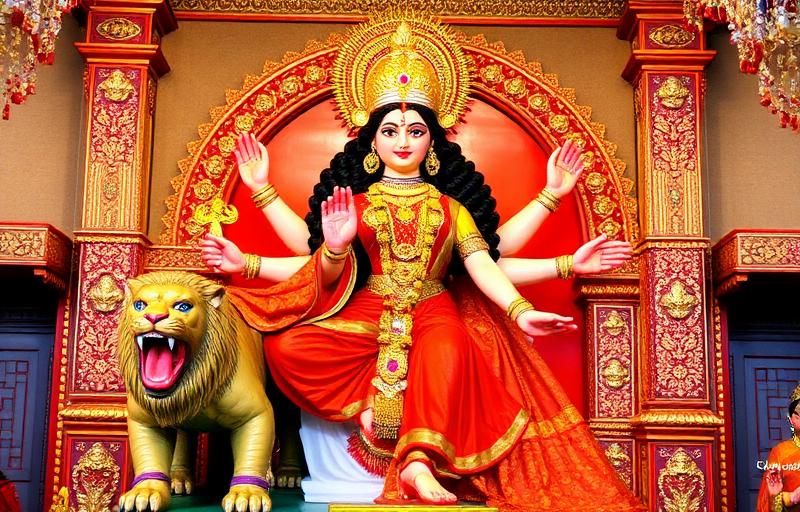
Its best-loved contribution remains the Lalita Sahasranama, a garland of a thousand names describing the Goddess in her form as Lalita Tripurasundari, each name carrying layered meaning about her nature and grace. Devotees across generations have chanted this section independently of the larger Purana, making it one of the most widely recited hymns in Devi worship.
The Purana's other cosmological narratives, while less commonly recited, remain valued by those studying Puranic cosmology in depth.
Significance and Benefits
Devotees believe that reciting the Lalita Sahasranama with devotion brings peace, clarity and a felt closeness to the Goddess, as per tradition. Its rhythmic structure makes it suitable for daily or weekly recitation, and many households include it in their regular devotional practice, especially on Fridays associated with Devi worship.
The wider Purana, meanwhile, offers devotees a sense of the vastness of creation, encouraging humility before the scale of divine order.
A Simple Takeaway for Devotees
Even without studying the full cosmology of the Brahmanda Purana, a devotee can carry its spirit by chanting a few names from the Lalita Sahasranama with attention, letting each name's meaning settle for a moment.
Such devotion, like all worship, is an act of faith and love, not a transaction.
What People Ask Most
What is the Brahmanda Purana known for?+
The Brahmanda Purana is known for its detailed cosmology of how the universe unfolded from the cosmic egg, and for traditionally being the source of the Lalita Sahasranama.
What is the Lalita Sahasranama?+
The Lalita Sahasranama is a hymn of a thousand names of Goddess Lalita Tripurasundari, traditionally set within the Brahmanda Purana as a dialogue between sage Agastya and Hayagriva.
Why is it called the Brahmanda Purana?+
It is named after Brahmanda, the cosmic egg from which the universe is traditionally said to have emerged, reflecting the Purana's central focus on cosmology and creation.
About the author
Acharya Vinaya Kapoor · M.A. Sanskrit, Mantra & Stotra Studies
Acharya Vinaya holds an M.A. in Sanskrit from Banaras Hindu University and writes the mantra and stotra commentary on Vandnaa. Her focus is on accurate pronunciation, traditional context, and helping modern readers connect with classical texts.
Meet the Vandnaa editorial team →