How Many Chandidases
A guide has to start here, because the honest answer is that we do not know.
The Chandidas problem is one of the standing questions in Bengali literary history, and it is not a minor one.
What the manuscripts show: padas signed Chandidas appear across a range of at least two centuries, in different dialects, with different literary characteristics, and with several different qualifying names attached:
- Badu Chandidas
- Dwija Chandidas, dwija meaning twice born
- Dina Chandidas, dina meaning poor or humble
- Chandidas, unqualified
The main positions scholars take:
One. There were several different poets over two centuries, all using the name, and the corpus is a composite.
Two. There was one poet, and the variations are scribal, dialectal or the result of a long career.
Three. Some intermediate position, with a historical Chandidas and later poets composing under the name, which is what happened to Kabir, Surdas, Mirabai and most other major bhakti figures.
The current consensus, to the extent there is one: at least two, and probably more. In particular, the author of the Srikrishnakirtan is generally distinguished from the author of the padavali songs.
Why this app states it plainly: because Bengali readers know it, because pretending to a single tidy biography would be false, and because the poems are what they are regardless.
The traditional biography
What the tradition holds, whoever it is about:
- Nanoor, also Nannur, in Birbhum district, West Bengal
- Fourteenth or fifteenth century
- A brahmana, and the priest of the Bashuli Devi temple at Nanoor, a local goddess
- He loved a woman named Rami, also Rajakini, of the washerman caste
- The community found out and he was required to give her up
- He would not
And that is the story, and everything else follows from it.
Rami
What the situation was
He was a brahmana and a temple priest. She was a rajaki, a washerwoman, of a community low in the caste order and one whose work, handling other people's soiled clothes, made it worse.
The gap between them was, in that society, absolute: not a matter of disapproval but of ritual pollution, and a brahmana priest in a relationship with a washerwoman was a scandal that had a formal procedure attached to it.
What the community did
A sabha, an assembly of brahmanas, was convened.
What he was told: give her up, and perform prayaschitta, the ritual expiation, and be restored.
What the accounts say happened
He agreed to the expiation, or appeared to. The ceremony was arranged and he came.
And Rami was in the crowd, standing at the edge, watching.
And he went to her.
In the version most told he saw her, walked out of the ceremony, went to where she was standing and bowed to her, in front of the assembly.
And that was the end of the negotiation. He was outcast.
What he wrote
The most quoted sentence in Bengali, and it comes from this:
Sabar upare manush satya, tahar upare nai.
Above everything is the truth of a human being. There is nothing above that.
How to read it precisely. It is easy to soften into a general sentiment and it is sharper than that.
Manush satya is not humanity in the abstract. It is the truth of a person, the actual fact of a specific human being, and the claim is that this outranks:
- Caste rules
- Ritual purity
- The community's judgement
- Scripture, as it was being quoted at him
- His own priesthood and his position
All of which were on the other side of the argument, and all of which he lost.
The line has been used since in Bengali politics, in literature, by reformers, by nationalists and by people with no religious commitment at all, and it is one of the very few devotional lines in any Indian language that has become a secular commonplace.
Rami's own poems
A small number of padas are attributed to Rami herself, addressed to Chandidas.
Their content: her side of it. What it cost her, what people said, and what he was to her.
Whether they are genuinely hers is disputed along with everything else in this entry. What is not disputed is that the tradition preserved poems in her name, which it did not have to do, and that Bengal has always treated her as a figure in her own right rather than as an episode in his life.
His end
The accounts are dark and they vary.
The most told version has a woman of rank, in some accounts a Nawab's wife or a nobleman's, becoming infatuated with him, and his refusal leading to his being beaten, publicly, on that person's orders.
And Rami was made to watch, or was present, and he died.
How to hold that: it is not verifiable and the biography as a whole is uncertain. What can be said is that the tradition ends his story with him being killed for a refusal, in front of her, and chose to remember it that way.
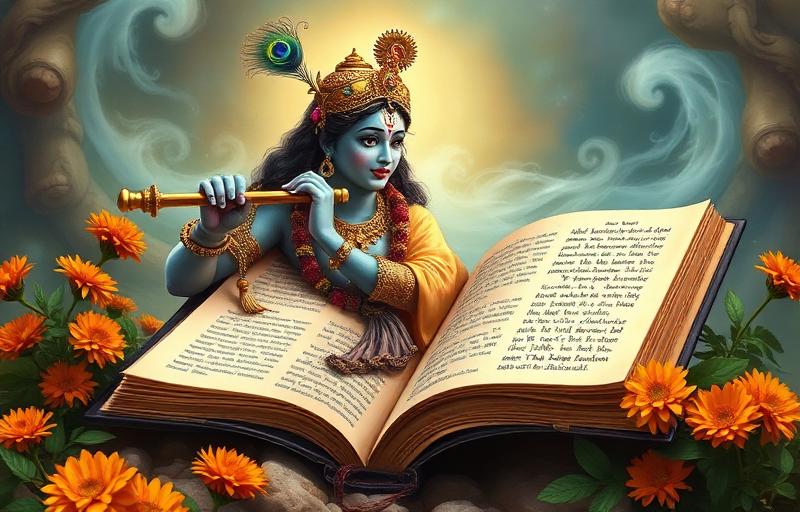
The Srikrishnakirtan
How it was found
In 1909, Basanta Ranjan Ray Vidvadvallabh found a manuscript in a cowshed in a village in Bankura district.
What it turned out to be: the Srikrishnakirtan, or Srikrishnasandarbha, attributed to Badu Chandidas, and after the Charyapada it is the oldest substantial text in Bengali.
It was published in 1916 and it changed the field. Before that find, the early history of Bengali literature had a gap in it.
What the text is
- Around 412 padas
- In thirteen sections
- Telling the Radha and Krishna story as a continuous narrative
- With three speaking characters: Krishna, Radha, and Barai, the old woman who acts as go between
- Meant for performance, with the raga and tala indicated
Why it matters, and this is the important part
It is not the Radha and Krishna of later devotion, and it is worth being honest about how far it is not.
In the mature Vaishnava treatment, Radha's love is the highest form of devotion, the relationship is the model for the soul's love of god, and everything about it is idealised.
In the Srikrishnakirtan:
- Krishna wants Radha and pursues her, persistently and without much regard for what she wants
- Radha does not want him, for a long stretch of the text, and says so repeatedly
- Barai negotiates, and her role is closer to a procurer's than a friend's
- Krishna uses his position and, at points, force and coercion
- There is a well known section in which he takes the toll, blocking her way and demanding payment
- Radha's eventual response is not straightforward and the text does not tidy it
What to do with that
Two things, and both matter.
One. State it. The oldest Bengali telling of this story is rough, coercive in places, and much closer to a village narrative than to theology. That is a fact about the text and it is why scholars find it so valuable: it shows the material before the devotional reading had settled over it.
Two. Do not read the coercion as approved. The text is a narrative and not a prescription, its Krishna is a figure in a story rather than a model for conduct, and no reading of it makes what he does acceptable behaviour for anybody.
And the necessary plain statement: pursuing somebody who has said no is harassment. In India it is an offence under the provisions on stalking and sexual harassment in the Bharatiya Nyaya Sanhita, and women's helpline 181, police 112 and the One Stop Sakhi Centres exist for it. Nothing in any devotional text changes that, and any person citing scripture at a woman to explain why her refusal does not count is misusing it.
The later padavali
The songs signed Chandidas that circulated in Bengal, and that Chaitanya loved, are a different body of work from the Srikrishnakirtan and are much closer to the mature Vaishnava register.
Chaitanya's three: the Gita Govinda, the songs of Vidyapati, and the songs of Chandidas.
Those songs are the ones that entered kirtan, and their characteristic note is not eroticism but grief: Radha after he has gone, describing what it is like.
Sahaja, and a Necessary Warning
Content note: this section discusses tantric sexual practice and the abuse that has been carried out under its name. It is included because Chandidas is claimed by that tradition and a guide that omitted it would be leaving readers less protected.
Sahaja
Sahaja means natural, spontaneous, innate, or born together with. It names a strand running through eastern Indian religion from the Buddhist Sahajayana and the Charyapada onward, and later through the Bauls, the Vaishnava Sahajiyas and the Nath traditions.
Its general claims:
- What you are looking for is already the case and does not need to be constructed
- Ritual, scripture and institutional religion get in the way
- The body is the site of practice, and the divine is to be found in it rather than elsewhere
- The man of the heart, the maner manush, is within, and that is the whole search
Chandidas and the Sahajiyas
The Vaishnava Sahajiya movement, which developed in Bengal after Chaitanya, claims Chandidas as a founder, and reads the Rami relationship as parakiya practice: love outside marriage, held by that tradition to be the highest form because it has nothing to gain and everything to lose.
And in its tantric forms, Sahajiya practice involved ritual sexual union with a partner, understood as a re enactment of Radha and Krishna, with elaborate doctrine attached about the transformation of desire.
Whether Chandidas practised any of this is unknown and is part of the same evidentiary fog as everything else in this entry.
What the mainstream tradition thought of it
Worth stating, because it is not a modern objection.
The Gaudiya Vaishnava mainstream, from the Goswamis of Vrindavan onward, was hostile to the Sahajiyas and said so repeatedly. Their objection was that the Sahajiyas had confused the model with the method, taken the erotic language of the theology literally, and produced a licence.
So this is a criticism from inside, made by the tradition's own theologians, and it is several centuries old.
The necessary modern statement
And this is the reason the section exists.
No legitimate teacher in any tradition requires sexual contact from a student.
- A guru who tells you that sexual practice with them is part of your spiritual development is committing abuse, and the doctrine being cited does not change that
- This has happened repeatedly, in every tradition, in India and elsewhere, to adults and to children, and it is the single most common form of serious harm in religious settings
- The power imbalance between a teacher and a student makes meaningful consent very difficult, which is why professional bodies in every field prohibit such relationships outright
- If it is happening to you or to somebody you know: police 112, women's helpline 181, Childline 1098 for anybody under eighteen, and the POCSO Act 2012 covers any sexual offence against a child regardless of who commits it or in what setting
- Free legal aid is a statutory right, national number 15100
- Tele MANAS 14416 for the mental health side
The warning signs this series has repeated throughout: a teacher who demands secrecy, isolates you from your family, requires money for blessings, claims exclusive power over your outcomes, or behaves in ways that would not survive being described plainly to somebody outside.
None of that is a reason to dismiss the Sahaja material, which contains real insight and produced the Baul songs, among the finest things in Bengali. It is a reason to know what the tradition's own critics said about it and what has been done under its name.
What to Take From Him
One. Above everything is the truth of a human being.
Sabar upare manush satya, tahar upare nai.
It is not a general humanist sentiment. It was said by a man being told by an assembly of his own community that a specific woman's caste made her impossible, and that if he gave her up he could have his position back.
And what he put above the rules was not a principle. It was a person, standing at the edge of the crowd.
Which is why the line survived. Abstractions do not cost anything. He lost his priesthood, his caste, his community and, if the accounts are right, his life.
Two. The manuscript in the cowshed.
The oldest substantial text in Bengali after the Charyapada spent an unknown number of centuries in a shed in a village in Bankura, and was found by one scholar in 1909 who recognised what he was looking at.
Two things follow. What survives is largely accident. And somebody has to be looking.
Three. The oldest telling is not the most devotional one.
The Srikrishnakirtan is rough, coercive in places, and much closer to a village narrative than to theology, and it shows the material before five hundred years of devotional reading settled over it.
That is worth knowing about this and about every other story you have received in a finished form. The finished version is a version.
And the plain statement that goes with it: nothing in it makes pursuing an unwilling person acceptable. Police 112, women's helpline 181.
Four. And the warning.
The tradition that claims him produced real insight and produced the Baul songs. It also produced groups in which sexual practice was doctrinally required, and its own tradition's theologians attacked it for centuries on exactly that ground.
No legitimate teacher requires sexual contact from a student, and any doctrine cited to justify it is being misused. Police 112, Childline 1098, women's helpline 181, free legal aid 15100, Tele MANAS 14416.
A daily practice from this entry:
- Hare Krishna or Radhe Radhe
- The line, kept: above everything is the truth of a human being, and there is nothing above that
- One Chandidas pada in translation, from the padavali rather than the Srikrishnakirtan if you want the devotional register
- And, at Nanoor in Birbhum if you are ever there, the Bashuli temple site
A closing thought
A brahmin priest at a goddess temple in Birbhum fell in love with a woman who washed clothes for a living, which in that place and that century was not a scandal but an impossibility.
The assembly of his community convened, told him to give her up and perform the expiation, and offered him his position back.
He came to the ceremony, saw her standing at the edge of the crowd, walked out of it, went over to her and bowed.
And what he wrote about it is the sentence that Bengali politicians, novelists, reformers and people with no religion at all have been quoting for six hundred years: above everything is the truth of a human being, and there is nothing above that.
The Short Version
The honest opening: there were probably several poets named Chandidas across at least two centuries, distinguished in the manuscripts as Badu Chandidas, Dwija Chandidas, Dina Chandidas and Chandidas unqualified. The Chandidas problem is a standing question in Bengali literary history, and in particular the author of the Srikrishnakirtan is generally distinguished from the author of the padavali songs.
The traditional biography: of Nanoor in Birbhum district, West Bengal, fourteenth or fifteenth century, a brahmana and the priest of the Bashuli Devi temple. He loved Rami, also Rajakini, a woman of the washerman caste, which in that society was not disapproval but ritual impossibility.
What happened: an assembly of brahmanas convened and told him to give her up and perform prayaschitta, and he would be restored. He came to the ceremony, saw Rami standing at the edge of the crowd, walked out of it, went to her and bowed, in front of the assembly. He was outcast.
The line: sabar upare manush satya, tahar upare nai. Above everything is the truth of a human being, and there is nothing above that. It is the most quoted sentence in Bengali and has been used by politicians, novelists and reformers with no religious commitment for six hundred years.
The Srikrishnakirtan: found in a cowshed in Bankura district in 1909 by Basanta Ranjan Ray and published in 1916, it is the oldest substantial Bengali text after the Charyapada. Around 412 padas in thirteen sections, with Krishna, Radha and Barai the go between. It is rough and in places coercive, much closer to a village narrative than to theology, and shows the material before the devotional reading settled over it. Nothing in it makes pursuing an unwilling person acceptable.
Sahaja: the Vaishnava Sahajiya movement claims him as a founder and reads the Rami relationship as parakiya practice. The Gaudiya mainstream was hostile to the Sahajiyas for centuries on the ground that they had confused the model with the method. No legitimate teacher in any tradition requires sexual contact from a student: police 112, women's helpline 181, Childline 1098.
Rami: a small number of padas are attributed to her, and Bengal has always treated her as a figure in her own right.
Reader Questions Answered
Who was Chandidas?+
A Bengali poet of the fourteenth or fifteenth century, and probably more than one person. Padas signed Chandidas appear across at least two centuries in different dialects with different qualifying names, Badu, Dwija and Dina Chandidas among them, and the Chandidas problem is a standing question in Bengali literary history. The traditional biography places him at Nanoor in Birbhum district as a brahmana and the priest of the Bashuli Devi temple, who loved Rami, a woman of the washerman caste, and was outcast for refusing to give her up.
What is the line sabar upare manush satya?+
Above everything is the truth of a human being, and there is nothing above that. It is the most quoted sentence in Bengali, and it was said by a man being told by an assembly of his own community that a specific woman's caste made her impossible and that if he gave her up he could have his position back. What he put above the rules was not a principle but a person standing at the edge of the crowd, and he lost his priesthood, his caste and his community for it. The line has been used since by politicians, novelists, reformers and people with no religious commitment at all.
What is the Srikrishnakirtan?+
The oldest substantial text in Bengali after the Charyapada, attributed to Badu Chandidas, found in a cowshed in a village in Bankura district in 1909 by Basanta Ranjan Ray and published in 1916. It has around 412 padas in thirteen sections, telling the Radha and Krishna story as a continuous narrative with three speaking characters: Krishna, Radha and Barai the go between. It is much rougher than later devotional treatments: Krishna pursues Radha persistently, she does not want him for long stretches and says so, and he uses his position and at points force. It shows the material before the devotional reading settled over it.
How should the coercion in the Srikrishnakirtan be read?+
As a fact about the text, and not as an endorsement. The text is a narrative and not a prescription, its Krishna is a figure in a story rather than a model for conduct, and no reading of it makes what he does acceptable behaviour for anybody. Pursuing somebody who has said no is harassment, in India an offence under the stalking and sexual harassment provisions of the Bharatiya Nyaya Sanhita, and women's helpline 181, police 112 and the One Stop Sakhi Centres exist for it. Any person citing scripture at a woman to explain why her refusal does not count is misusing it.
What is Sahaja and what is the Vaishnava Sahajiya tradition?+
Sahaja means natural, spontaneous or innate, and names a strand running through eastern Indian religion from the Buddhist Sahajayana and the Charyapada onward and later through the Bauls and the Nath traditions. Its claims are that what you are looking for is already the case, that ritual and institutional religion get in the way, and that the body is the site of practice. The Vaishnava Sahajiya movement, which developed in Bengal after Chaitanya, claims Chandidas as a founder and in its tantric forms involved ritual sexual union with a partner. The Gaudiya Vaishnava mainstream was hostile to the Sahajiyas for centuries on the ground that they had confused the model with the method.
Does any tradition require sexual practice with a teacher?+
No legitimate teacher in any tradition requires sexual contact from a student. A guru who tells you that sexual practice with them is part of your spiritual development is committing abuse, and the doctrine being cited does not change that. This has happened repeatedly in every tradition, in India and elsewhere, to adults and to children, and it is the most common form of serious harm in religious settings, because the power imbalance between teacher and student makes meaningful consent very difficult. Police 112, women's helpline 181, Childline 1098 for anybody under eighteen, the POCSO Act 2012 for any sexual offence against a child, free legal aid 15100, Tele MANAS 14416.
About the author
Pandit Ravindra Sharma · Vedic Rituals & Bhakti, 22+ years
Pandit Ravindra is the Vandnaa editorial team's resident specialist on aarti, chalisa, and daily devotion. He has performed home and temple pujas across Varanasi and Delhi for over two decades and contributes the bhakti-focused articles on this site.
Meet the Vandnaa editorial team →