The Temple at Garhbor
The Charbhuja temple stands in the village of Garhbor in Rajsamand district of Rajasthan, in the hill country below Kumbhalgarh, roughly a hundred kilometres north of Udaipur.
What is there:
- A stone temple with a shikhara, standing on a raised platform reached by steps
- A sanctum holding a four armed image of Vishnu in dark stone, from which the name Charbhuja comes
- A large courtyard and pillared halls for the crowds the temple draws
- Subsidiary shrines within the enclosure
- The village around it, which lives largely by the temple
Charbhuja simply means four armed, the standard iconography of Vishnu holding the shankha, chakra, gada and padma. The name is used across Rajasthan for Vishnu shrines, but Garhbor is the one meant when the name is used without qualification in Mewar.
Local reckoning counts Charbhuja among the principal shrines of Mewar, in a group usually given as Charbhuja at Garhbor, Shrinathji at Nathdwara, Eklingji near Udaipur and Kesariyaji at Rishabhdev, though the lists people recite vary a little.
What that grouping tells you is that this is not a village temple with local reach. It is one of the fixed points of devotional geography in southern Rajasthan.
The Katha of the Hidden Image
The story attached to the image is the reason people come, and it is told in Garhbor with a good deal of confidence and in outside accounts with rather more hedging.
As it is told locally:
- The image is very ancient, and one telling traces it to Vajranabha, the great grandson of Krishna, who is credited in tradition with making images of Krishna and Vishnu after the Yadava line ended
- Another telling attaches its worship to the Pandavas
- During a period when shrines in the region were under attack, the priests concealed the image in the waters of a nearby kund or lake rather than let it be broken
- It remained hidden for a long stretch, its location kept within the priestly family
- It was later recovered and installed at Garhbor, and a date corresponding to the late fourteenth century is commonly given for that installation
How to hold a story like this. The early portions are devotional genealogy, of the kind that attaches to many important images, and they are not the sort of claim that historical evidence is expected to settle. The later portion, concealment during a dangerous period and recovery afterwards, describes something that demonstrably happened across northern and western India, and Garhbor is one of many shrines with such an account.
What is striking is the strategy the katha praises. There is no battle in this story and no martyrdom. The priests hid the deity in water, kept the secret, and waited. The tradition treats that as the highest devotion, on the reasoning that the duty was to keep worship alive, not to make a stand.
The Priests of Garhbor
One feature of Charbhuja sets it apart from most large Vaishnava temples in Rajasthan, and it follows directly from the story of the hidden image.
What is distinctive:
- The hereditary priesthood at Garhbor is held by a Gurjar family rather than by Brahmins
- The right is traced to the family that protected the image during the period of concealment
- The arrangement has continued for centuries and is accepted without controversy in the region
Why this matters. Temple service in a shrine of this standing is almost always a Brahmin hereditary right, and exceptions are uncommon enough to be worth noticing. At Garhbor the community that took the risk kept the service, and the tradition treats that as the correct outcome rather than as an anomaly requiring explanation.
This is not a small point about a village custom. It is a statement about what confers the right to serve a deity, and Garhbor answers it with an act rather than a birth. Similar arrangements exist at a scattering of shrines across India, usually where a non Brahmin community is remembered as having found, protected or first worshipped the image.
For a visitor the practical effect is simply that the priests you meet at Charbhuja belong to a lineage whose claim rests on an event in the temple's own history. It is worth knowing before you assume the usual pattern.
Jaljhulani Ekadashi
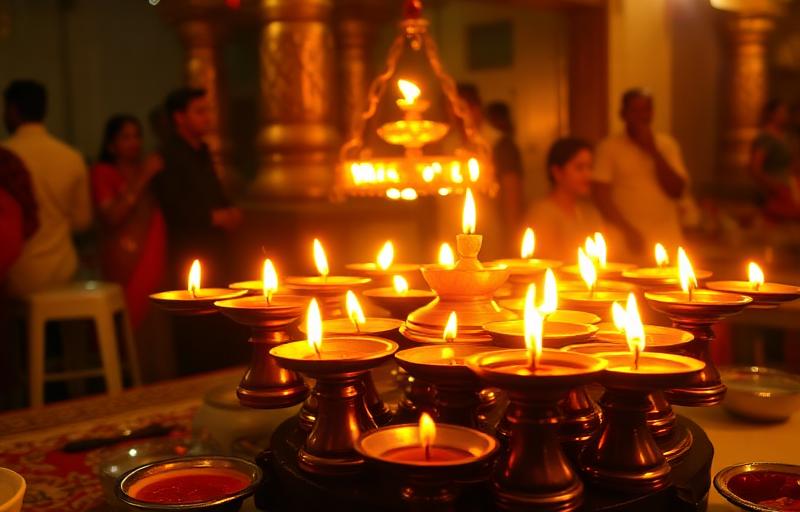
The temple's great occasion is Jaljhulani Ekadashi, the eleventh day of the bright fortnight of Bhadrapada, which falls in late August or September. Check the panchang, since the date moves each year.
What the festival is:
- Jaljhulani means the swinging or bathing of the deity in water
- The utsava murti, the processional image, is taken out from the temple in a shobha yatra through the village
- The deity is brought to a water body and the water ritual is performed
- The procession returns with music, banners and very large crowds
Why the water. The festival belongs to the Vaishnava calendar of the monsoon months, when Vishnu is understood to be in yoga nidra between Devshayani Ekadashi in Ashadha and Devuthani Ekadashi in Kartika. Jaljhulani falls within that period, and taking the deity to water is a seasonal act of service, cooling and refreshing after the heat.
At Garhbor the festival draws devotees from across Mewar and beyond, and the village population multiplies for the day.
The rest of the calendar:
- Janmashtami, given the Krishna connection in the image's katha
- Devuthani Ekadashi in Kartika, when Vishnu is woken
- The Ekadashis through the year, observed as at any Vishnu temple
- Ordinary daily darshan with the usual periods of opening and closure
Vishnu in a Shaiva State
Charbhuja is worth placing in the religious map of Mewar, because the state's official devotion and its popular devotion did not point at the same deity.
The official position:
- Mewar's presiding deity is Eklingji, a form of Shiva
- The Maharanas styled themselves Diwan of Eklingji, ruling as the deity's stewards
- The state's ceremonial life was anchored at Kailashpuri
The popular position:
- Mewar and the country around it is thick with Vaishnava shrines of great popularity
- Shrinathji arrived at Nathdwara in the seventeenth century and became one of the most visited shrines in India
- Charbhuja at Garhbor and Sanwaliya Seth near Chittorgarh draw enormous crowds
- Folk deities of the region, including Dev Narayan ji, are understood as forms or avatars of Vishnu
There is no contradiction here, and it would be a mistake to read one as displacing the other. A state can be Shaiva in its constitutional formula while its population is largely Vaishnava in daily devotion, and Mewar was exactly that.
What this does explain is the geography. A pilgrim in this region does not choose between Shiva and Vishnu. The standard Mewar circuit takes in Eklingji, Nathdwara, Charbhuja and often Kesariyaji in a single journey, and the people making it would not describe themselves as belonging to one sect rather than another.
Visiting Charbhuja
Getting there
- Garhbor village, Rajsamand district, in the hill country below Kumbhalgarh
- Roughly 100 km from Udaipur and about 40 km from Kumbhalgarh fort, on hill roads
- Rajsamand and Kelwara are the nearest towns of any size
- Nearest airport and main railway station are at Udaipur. A hired car is the practical arrangement
Timings
- Darshan is available in fixed periods morning and evening, with a midday closure. Check locally before travelling
- Aarti times are the busiest and the best to attend
When to go
- Jaljhulani Ekadashi in Bhadrapada for the great procession, if you can handle crowds
- October to March for comfortable travel through the hills
- Janmashtami and Devuthani Ekadashi for full temple observance
- Ordinary weekdays outside festivals for an unhurried darshan
Practical notes
- Accommodation in Garhbor is basic. Most visitors stay at Kumbhalgarh, Rajsamand or Udaipur
- Leave footwear and, where required, phones at the designated counters
- Photography inside the sanctum is not permitted
- Dress conservatively, as at any major shrine
Combining the visit
- Kumbhalgarh fort, with its enormous wall, is the obvious pairing and is close by
- Ranakpur, the great Jain temple complex, lies in the same hill belt and is regularly visited on the same route
- Nathdwara for Shrinathji, and Eklingji on the way back to Udaipur
A closing thought. Most famous images in India are famous for what they look like or for who built the temple around them. Charbhuja is famous for a decision, taken by people whose names are not recorded, to put a deity underwater and keep quiet about it until it was safe. The temple is really a monument to patience.
What People Ask Most
Where is the Charbhuja temple?+
In Garhbor village, Rajsamand district, Rajasthan, in the hill country below Kumbhalgarh. It is roughly 100 km from Udaipur and about 40 km from Kumbhalgarh fort, and Udaipur has the nearest airport and main railway station.
What does Charbhuja mean?+
Four armed, the standard iconography of Vishnu holding the shankha, chakra, gada and padma. The sanctum image at Garhbor is a four armed Vishnu in dark stone, and the name is used for Vishnu shrines across Rajasthan.
What is the story of the image being hidden?+
Local tradition holds that during a period when shrines in the region were under attack, the priests concealed the image in the waters of a nearby kund rather than let it be broken, kept the location within the family, and recovered and installed it at Garhbor later, commonly dated to the late fourteenth century.
Who are the priests at Charbhuja?+
The hereditary priesthood is held by a Gurjar family rather than by Brahmins, a right traced to the family remembered as having protected the image during the period of concealment. The arrangement has continued for centuries and is accepted in the region.
When is the main festival?+
Jaljhulani Ekadashi, the eleventh day of the bright fortnight of Bhadrapada, falling in late August or September. The processional image is taken through the village to a water body for the water ritual. Check the panchang, since the date moves each year.
What else can be visited nearby?+
Kumbhalgarh fort with its enormous wall is close by, Ranakpur lies in the same hill belt, and Nathdwara for Shrinathji and Eklingji near Udaipur are usually combined on the same Mewar circuit.
About the author
Pandit Ravindra Sharma · Vedic Rituals & Bhakti, 22+ years
Pandit Ravindra is the Vandnaa editorial team's resident specialist on aarti, chalisa, and daily devotion. He has performed home and temple pujas across Varanasi and Delhi for over two decades and contributes the bhakti-focused articles on this site.
Meet the Vandnaa editorial team →